National Company Law Appellate Tribunal judgments

123 National Company Law Appellate Tribunal judgments explained in plain English: what was decided, the law applied and why it matters. Page 2 of 6.

Liquidation order set aside; Sec 12A withdrawal allowed despite missing 66% vote under Sec 33 | Corporate Insolvency - IBC : NCLAT
|National Company Law Appellate Tribunal

Liquidation order set aside; Sec 12A withdrawal allowed despite missing 66% vote under Sec 33 | Corporate Insolvency - IBC : NCLAT

NCLAT quashed the liquidation order of Jeppiaar Cements, revived the corporate insolvency resolution process and permitted withdrawal of the Sec 12A application even though the Committee of Creditors failed to meet the 66 % voting threshold prescribed by Sec 33. The ruling affirms a resolution professional’s discretion to deem a Sec 12A withdrawal viable, protecting creditor interests and keeping restructuring options open for the debtor.


Section 14 IBC Contribution Order Valid Without Section 66 Finding | NCLAT
Case Law Analysis
|National Company Law Appellate Tribunal

Section 14 IBC Contribution Order Valid Without Section 66 Finding | NCLAT

NCLAT ruled that a contribution order under Section 14 of the IBC can be imposed without a prior Section 66 finding, and that a Section 74 direction is only a reference now rendered moot by amendment. This means directors and resolution professionals may be liable for contributions during the moratorium even absent a default finding.

SQC 1 & NFRA Orders | Audit Firms and Engagement Partners Jointly Liable for Professional Misconduct: NCLAT Upholds Penalties
Case Law Analysis
|National Company Law Appellate Tribunal

SQC 1 & NFRA Orders | Audit Firms and Engagement Partners Jointly Liable for Professional Misconduct: NCLAT Upholds Penalties

NCLAT affirmed NFRA's imposition of ₹3L and ₹5L penalties on a chartered accountant and his firm for professional misconduct in the Vikas WSP Limited audit. The ruling reinforces that audit firms and engagement partners share joint liability under Standards on Quality Control (SQC 1), setting a precedent for stricter accountability in statutory audits.

Section 33(1)(a) IBC | Liquidation Mandatory When Promoter Fails Settlement Commitments & CoC Cooperation : NCLAT Chennai
Case Law Analysis
|National Company Law Appellate Tribunal

Section 33(1)(a) IBC | Liquidation Mandatory When Promoter Fails Settlement Commitments & CoC Cooperation : NCLAT Chennai

NCLAT Chennai upholds liquidation under Section 33(1)(a) of the IBC, ruling that repeated failure to honor settlement proposals and non-cooperation with the Committee of Creditors (CoC) justifies bypassing resolution efforts. The judgment reinforces that liquidation is a last resort but becomes binding when promoters undermine the Corporate Insolvency Resolution Process (CIRP).

Section 31(4) IBC | One-Year Deadline for Regulatory Approvals Mandatory; Failure Triggers Liquidation : NCLAT
Case Law Analysis
|National Company Law Appellate Tribunal

Section 31(4) IBC | One-Year Deadline for Regulatory Approvals Mandatory; Failure Triggers Liquidation : NCLAT

NCLAT upholds liquidation of a corporate debtor after the resolution applicant failed to secure RBI approvals within the one-year deadline under Section 31(4) of the Insolvency and Bankruptcy Code. The ruling reinforces strict compliance with regulatory timelines, impacting insolvency practitioners and creditors in CIRP proceedings.

Section 133 Indian Contract Act | Novation or Variance Without Guarantor Consent Discharges Personal Guarantee : NCLAT
Case Law Analysis
|National Company Law Appellate Tribunal

Section 133 Indian Contract Act | Novation or Variance Without Guarantor Consent Discharges Personal Guarantee : NCLAT

NCLAT holds that any renewal, novation, or variance of credit facilities without the personal guarantor's consent automatically discharges their liability under Section 133 of the Indian Contract Act. This ruling reinforces the protection of guarantors under the IBC and sets a precedent for creditors to secure explicit consent for modifications.

Operational Debt Under IBC | Advance Payment Under Consortium Agreement Constitutes Operational Debt: NCLAT
Case Law Analysis
|National Company Law Appellate Tribunal

Operational Debt Under IBC | Advance Payment Under Consortium Agreement Constitutes Operational Debt: NCLAT

The NCLAT has ruled that advance payments made under a consortium agreement for goods supply qualify as operational debt under Section 5(21) of the IBC, even when payment obligations are structured between consortium members rather than directly with a corporate debtor. This expands the scope of operational creditors in complex supply chains and clarifies that inter-se financial arrangements do not negate the existence of a debt arising from a transaction in the ordinary course of business.

Regulation 29, IBBI Liquidation Regulations | Set-off Permitted Only Between Corporate Debtor and Creditor, Not Across Group Entities : NCLAT
Case Law Analysis
|National Company Law Appellate Tribunal

Regulation 29, IBBI Liquidation Regulations | Set-off Permitted Only Between Corporate Debtor and Creditor, Not Across Group Entities : NCLAT

The NCLAT has clarified that Regulation 29 of the IBBI Liquidation Regulations does not permit set-off claims between a corporate debtor and a creditor through affiliated group entities, upholding the doctrine of corporate separateness. This ruling directly impacts how operational creditors and liquidators assess mutual obligations in insolvency proceedings, preventing cross-entity netting that could distort the waterfall of claims under the IBC.

Section 121(2) IBC | Three-Month Deadline for Personal Guarantor Bankruptcy Applications is Directory, Not Mandatory : NCLAT
Case Law Analysis
|National Company Law Appellate Tribunal

Section 121(2) IBC | Three-Month Deadline for Personal Guarantor Bankruptcy Applications is Directory, Not Mandatory : NCLAT

NCLAT rules that the three-month timeline under Section 121(2) of the IBC for filing bankruptcy applications against personal guarantors is directory, not mandatory, allowing condonation of delay under the Limitation Act. This decision clarifies that financial creditors can proceed with insolvency applications even beyond the prescribed period, ensuring flexibility in personal guarantor insolvency proceedings.

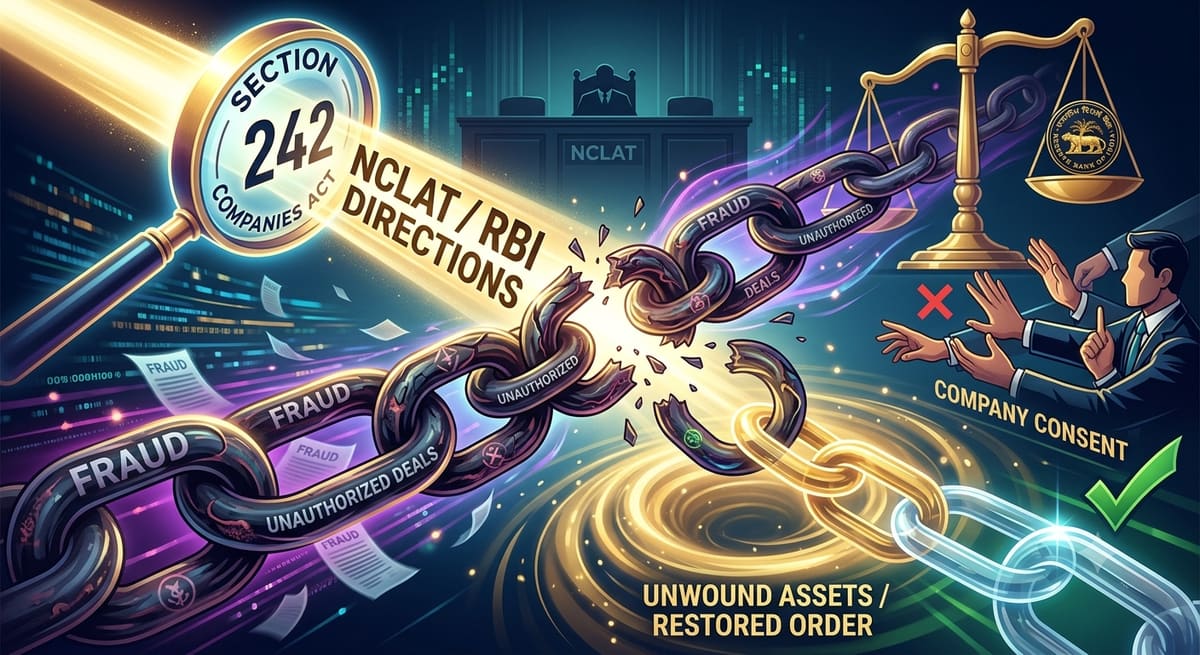
Section 242 Companies Act | Fraudulent Transactions Can Be Unwound Without Consent: NCLAT Upholds RBI Directions as Binding
Case Law Analysis
|National Company Law Appellate Tribunal

Section 242 Companies Act | Fraudulent Transactions Can Be Unwound Without Consent: NCLAT Upholds RBI Directions as Binding

NCLAT ruled that fraudulent transactions under Section 242 of the Companies Act can be set aside without the consent of involved parties, reinforcing RBI directions as legally binding. The judgment impacts insolvency proceedings and corporate governance, particularly for NBFCs and group companies engaged in sham lending arrangements.

Fraudulent Transactions Do Not Constitute Financial Debt Under Section 5(8) IBC : NCLAT Rejects CIRP Admission for Unauthorized Disbursements
Case Law Analysis
|National Company Law Appellate Tribunal

Fraudulent Transactions Do Not Constitute Financial Debt Under Section 5(8) IBC : NCLAT Rejects CIRP Admission for Unauthorized Disbursements

NCLAT holds that disbursements made into unauthorized accounts through fraudulent means cannot be classified as financial debt under the Insolvency and Bankruptcy Code, 2016. The ruling bars initiation of Corporate Insolvency Resolution Process (CIRP) where loan agreements lack valid authorization, reinforcing the doctrine of indoor management in financial transactions.

Section 65 IBC | Malicious Refusal by Single Creditor to Accept Repayment Justifies CIRP Termination : NCLAT
Case Law Analysis
|National Company Law Appellate Tribunal

Section 65 IBC | Malicious Refusal by Single Creditor to Accept Repayment Justifies CIRP Termination : NCLAT

NCLAT rules that a single creditor’s unjustified refusal to accept repayment of an admitted debt during CIRP constitutes abuse of process under Section 65 IBC, warranting termination of insolvency proceedings. The ruling protects corporate debtors from frivolous or malicious creditor actions that undermine the IBC’s objectives.

Settlement Breach as Material Default | NCLAT Revives CIRP Upon Non-Compliance with Consent Terms : NCLAT
Case Law Analysis
|National Company Law Appellate Tribunal

Settlement Breach as Material Default | NCLAT Revives CIRP Upon Non-Compliance with Consent Terms : NCLAT

NCLAT rules that a financial creditor can revive Corporate Insolvency Resolution Process (CIRP) if the corporate debtor breaches court-recorded settlement terms, treating non-compliance as a material default. This reinforces strict adherence to settlement agreements under the Insolvency and Bankruptcy Code, impacting creditors' rights to reinitiate insolvency proceedings.

IBC Section 5(24)(i) | Step-Down Control Through Subsidiaries Constitutes Related Party Status : NCLAT
Case Law Analysis
|National Company Law Appellate Tribunal

IBC Section 5(24)(i) | Step-Down Control Through Subsidiaries Constitutes Related Party Status : NCLAT

NCLAT has ruled that control exercised indirectly through subsidiary entities qualifies as 'related party' under the IBC, triggering strict scrutiny of claims and denying secured creditor status for immovable asset claims. This clarifies the scope of related party exposure in CIRP and caps recoveries to principal paid under FEMA, significantly impacting restructuring strategies for corporate groups with layered ownership.

IBC Section 7 | Interest Default Over ₹1 Crore Triggers CIRP Initiation Even After OTS Breach: NCLAT
Case Law Analysis
|National Company Law Appellate Tribunal

IBC Section 7 | Interest Default Over ₹1 Crore Triggers CIRP Initiation Even After OTS Breach: NCLAT

NCLAT rules that a financial creditor’s interest default exceeding ₹1 crore constitutes a valid default under Section 7 of the IBC, even if the corporate debtor breached a One Time Settlement (OTS). The ruling clarifies that service of notice via MCA-registered email suffices for CIRP initiation, impacting creditors’ rights and insolvency proceedings.

Section 242(4) Companies Act | Right to File Para-Wise Reply After Remand is Absolute : NCLAT Upholds Natural Justice in Oppression & Mismanagement Cases
Case Law Analysis
|National Company Law Appellate Tribunal

Section 242(4) Companies Act | Right to File Para-Wise Reply After Remand is Absolute : NCLAT Upholds Natural Justice in Oppression & Mismanagement Cases

NCLAT rules that parties in oppression and mismanagement proceedings under Section 242(4) of the Companies Act have an absolute right to file a detailed para-wise reply after remand, reinforcing principles of natural justice. The judgment clarifies that this right cannot be denied even if procedural defects exist, ensuring fair adjudication in corporate disputes.

Section 95 IBC | Debenture Trustee Has Locus to Initiate Personal Insolvency if Guarantee Deed Explicitly Authorizes It: NCLAT
Case Law Analysis
|National Company Law Appellate Tribunal

Section 95 IBC | Debenture Trustee Has Locus to Initiate Personal Insolvency if Guarantee Deed Explicitly Authorizes It: NCLAT

NCLAT rules that a debenture trustee can file a Section 95 IBC application against a personal guarantor only if the guarantee deed expressly permits it, clarifying the scope of creditor locus in personal insolvency proceedings. This holding impacts debenture trustees, personal guarantors, and lenders relying on guarantee deeds for insolvency actions.

Contempt of Court | NCLAT Rules Contempt Cannot Lie for Orders Based on Erroneous Factual Premise : NCLAT
Case Law Analysis
|National Company Law Appellate Tribunal

Contempt of Court | NCLAT Rules Contempt Cannot Lie for Orders Based on Erroneous Factual Premise : NCLAT

NCLAT holds that contempt proceedings cannot be sustained if the underlying court order rests on a mistaken factual basis. The ruling clarifies that compliance must be objectively possible-disbursements made prior to the order render contempt inapplicable, offering critical protection to liquidators and parties acting in good faith.