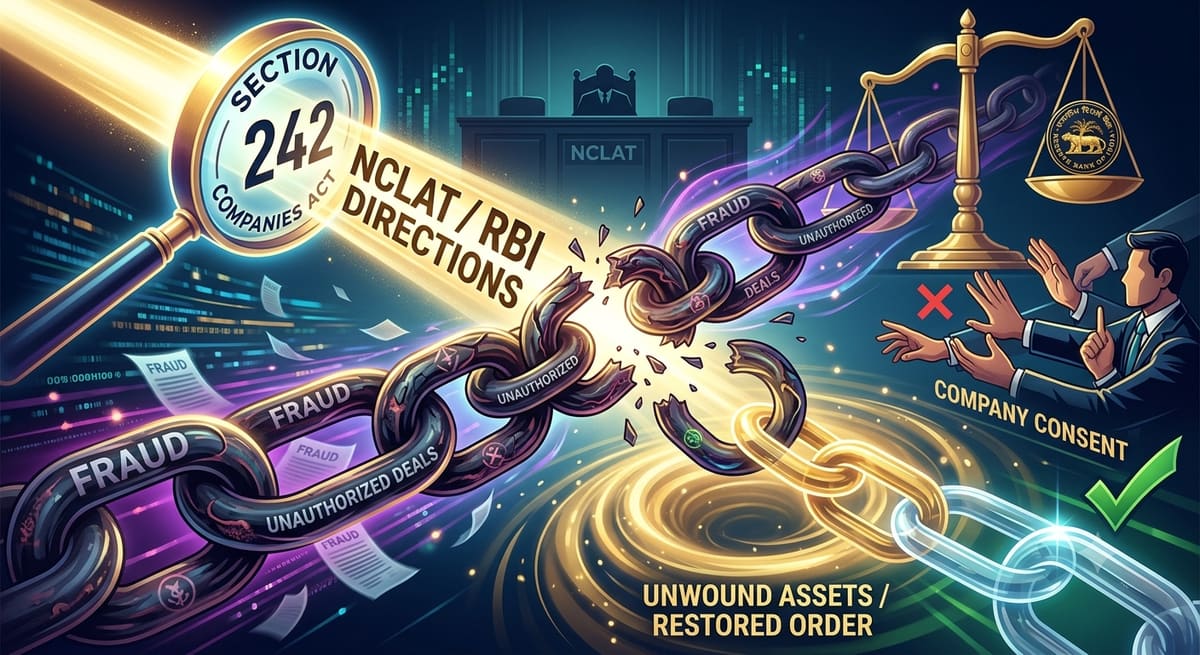
The National Company Law Appellate Tribunal (NCLAT) has upheld the National Company Law Tribunal's (NCLT) order declaring the purported 100% share transfer and transfer of immovable property of Vivid Solutions Pvt Ltd to be illegal, null, and void due to non-compliance with mandatory legal procedures.
Background & Facts
The Dispute
The dispute arose from a series of transactions between the appellants (Vivid Solutions Pvt Ltd, its directors, and Ukay Metal Industrial Pvt Ltd) and the respondents (Mukesh Jain, Sushil Jain, Sonu Jain). The respondents alleged that the appellants manipulated statutory records to falsely claim 100% shareholding in Vivid Solutions Pvt Ltd and transferred the company's sole immovable asset without executing valid transfer documents.
Key Facts
- 12.09.2012: Appellants transferred Rs. 1 crore to respondents as part of a proposed 100% share transfer and property transfer.
- 20.09.2012: Respondents called an Extraordinary General Meeting (EOGM) and passed a resolution appointing appellants as directors of Vivid Solutions Pvt Ltd.
- 21.12.2012: A Memorandum of Understanding (MOU) was executed between the parties, proposing further payment of Rs. 2 crore by appellants to respondents for 100% share transfer and property transfer. The MOU explicitly left the final consideration amount to be determined later.
- 23.01.2013: Appellants paid Rs. 2 crore to respondents as per the MOU.
- 30.03.2014: Appellants paid Rs. 1 lakh towards the face value of 100% shares of respondents.
- 31.03.2014: Respondents resigned from the directorship of Vivid Solutions Pvt Ltd.
- April 2014: Respondents handed over share transfer forms, share certificates, and company documents to appellants. Form MGT-7 was filed with the Registrar of Companies (ROC) reflecting the change in directorship.
- 20.06.2014: Appellants availed an interest-free loan of Rs. 5 crore from respondents, secured against the original share certificates. The loan was repaid by appellants in 2014.
- 31.03.2015: Appellants filed the balance sheet for FY 2014-15 with the ROC, reflecting all transactions with respondents.
- 2017: Respondents' balance sheet for FY 2016-17 showed the company's sole immovable asset (E-74, MIDC, Nashik) as transferred to Ukay Metal Industrial Pvt Ltd against an unsecured loan of Rs. 3 crore, without any registered conveyance or transfer deed.
- 07.04.2019: Appellants filed revised annual returns with the ROC, retrospectively altering the shareholding pattern to reflect appellants as 100% shareholders from April 2014.
- 06.05.2019: Respondents filed a Company Petition before the NCLT, Mumbai, challenging the alleged share transfer and property transfer.
Procedural History
- 08.10.2021: NCLT, Mumbai, passed an order declaring the respondents as 100% shareholders of Vivid Solutions Pvt Ltd and the alleged transfer of shares and property to be illegal, null, and void. The NCLT held that no valid transfer of shares or property had occurred due to non-compliance with mandatory procedures.
- Company Appeal (AT) No.125 of 2021: Filed by appellants before the NCLAT against the NCLT order.
- 24.07.2026: NCLAT dismissed the appeal, affirming the NCLT's order.
Relief Sought
The appellants sought quashing of the NCLT order dated 08.10.2021 and a declaration that the respondents' shareholding in Vivid Solutions Pvt Ltd was transferred legally and validly.
The Legal Issue
The central question was whether the alleged transfer of 100% shareholding in Vivid Solutions Pvt Ltd and the transfer of the company's sole immovable asset were valid, given the non-compliance with mandatory procedures under Section 56 of the Companies Act, 2013 and Section 17 of the Registration Act, 1908 read with Section 54 of the Transfer of Property Act, 1882.
Arguments Presented
For the Appellant
- The MOU dated 21.12.2012 created a binding contract for the transfer of 100% shareholding and property.
- The payment of Rs. 3 crore (Rs. 1 crore + Rs. 2 crore) and Rs. 1 lakh towards share value constituted valid consideration.
- The respondents handed over share transfer forms, share certificates, and company documents to appellants, and the ROC records were updated accordingly.
- The respondents' subsequent actions (e.g., filing revised annual returns on 07.04.2019) were justified as a response to the respondents' refusal to cooperate.
For the Respondent
- No valid share transfer deed (Form SH-4) was executed or filed with the company.
- No endorsement of transfer was made on the original share certificates.
- The property transfer was effected through mere book entries without a registered conveyance, violating Section 17 of the Registration Act, 1908 and Section 54 of the Transfer of Property Act, 1882.
- The revised annual returns filed on 07.04.2019 were a belated and fabricated attempt to usurp the respondents' shareholding and property rights.
- The statutory records filed with the ROC from 2014-2017 consistently reflected the respondents as 100% shareholders, enjoying a presumption of correctness.
The Court's Analysis
The NCLAT meticulously examined the facts and legal principles governing share transfers and property transfers under the Companies Act, 2013, and the Transfer of Property Act, 1882.
The Tribunal noted that the appellants' claim of a valid share transfer rested on the MOU dated 21.12.2012 and the alleged handing over of share transfer forms and share certificates. However, the MOU explicitly left the final consideration amount to be determined later, and no share transfer deed (Form SH-4) was executed or filed with the company. The Tribunal held:
"Admittedly, as on the date of filing of the Company Petition, i.e. 06.05.2019, the genuine and contemporaneously filed statutory records, which had stood on the register of the ROC since 2014-2017 reflected Respondent Nos.1 to 3 as the 100% shareholders of Appellant No.1 Company. The only document suggesting otherwise is the retrospective, unilateral revision filed by the Appellants on 07.04.2019, a mere month before the Petition, after two FIRs already stood registered against Appellants No.2 and 3."
The Tribunal further observed that the property transfer was effected through mere book entries without a registered conveyance, violating Section 17 of the Registration Act, 1908 and Section 54 of the Transfer of Property Act, 1882. The Tribunal held:
"The Bench notes that there is no document to support that the said property has been transferred to respondent no.4. The manner in which an immovable property can be transferred only by way of Registered Conveyance/Agreement deed which is not there in the instant case."
The Tribunal rejected the appellants' contention that the respondents' share transfer forms were lost, noting that the respondents were seasoned businessmen and the absence of evidence rendered such a claim untrustworthy. The Tribunal also held that the appellants' attempt to justify the transfers based on the MOU was misconceived, as the MOU did not create a concluded contract for the transfer of shares or property.
The Tribunal concluded that the appellants' actions amounted to manipulation of statutory records to usurp the respondents' shareholding and property rights, constituting oppression and mismanagement of the gravest kind. The Tribunal held:
"Thus, there is a clear violation of procedure prescribed for 'Transfer of Property' u/s Section 54 of Transfer of Property Act, 1882 and Section 17 of the Registration Act, 1908 and also violation of the procedure prescribed under Section 56 of the Companies Act for the transfer of shares."
The Verdict
The NCLAT dismissed the appeal, affirming the NCLT's order dated 08.10.2021. The Tribunal held:
- The respondents (Mukesh Jain, Sushil Jain, Sonu Jain) are the 100% shareholders of Vivid Solutions Pvt Ltd.
- The alleged transfer of 100% shareholding to the appellants is declared illegal, null, and void for non-compliance with Section 56 of the Companies Act, 2013.
- The alleged transfer of the company's sole immovable asset (E-74, MIDC, Nashik) to Ukay Metal Industrial Pvt Ltd is declared illegal, null, and void for non-compliance with Section 17 of the Registration Act, 1908 read with Section 54 of the Transfer of Property Act, 1882.
- The appellants' actions constituted oppression and mismanagement, warranting no interference with the NCLT's order.
What This Means For Similar Cases
Mandatory Compliance Is Non-Negotiable
- Section 56 of the Companies Act, 2013 mandates the execution and filing of a share transfer deed (Form SH-4) for valid share transfers. Mere book entries or handing over of share certificates without endorsement are insufficient.
- Practitioners must ensure that all statutory procedures for share transfers are strictly complied with, including the execution of transfer deeds, endorsement on share certificates, and filing with the ROC.
Property Transfers Require Registered Conveyance
- Section 54 of the Transfer of Property Act, 1882 and Section 17 of the Registration Act, 1908 mandate that transfers of immovable property must be effected through registered conveyance or agreement deeds.
- Book entries or unilateral alterations in balance sheets are insufficient to effect a valid transfer of property. Practitioners must ensure that all property transfers are documented and registered as required by law.
Statutory Records Enjoy Presumption of Correctness
- Contemporaneous statutory records filed with the ROC enjoy a presumption of correctness and cannot be lightly displaced.
- Retrospective or unilateral alterations in statutory records are liable to be struck down as fabricated or mala fide.
Corporate Governance and Transparency Are Paramount
- Manipulation of statutory records to usurp shareholding or property rights constitutes oppression and mismanagement, warranting judicial intervention.
- Companies must adhere to corporate governance norms and maintain transparency in their dealings to avoid disputes and litigation.