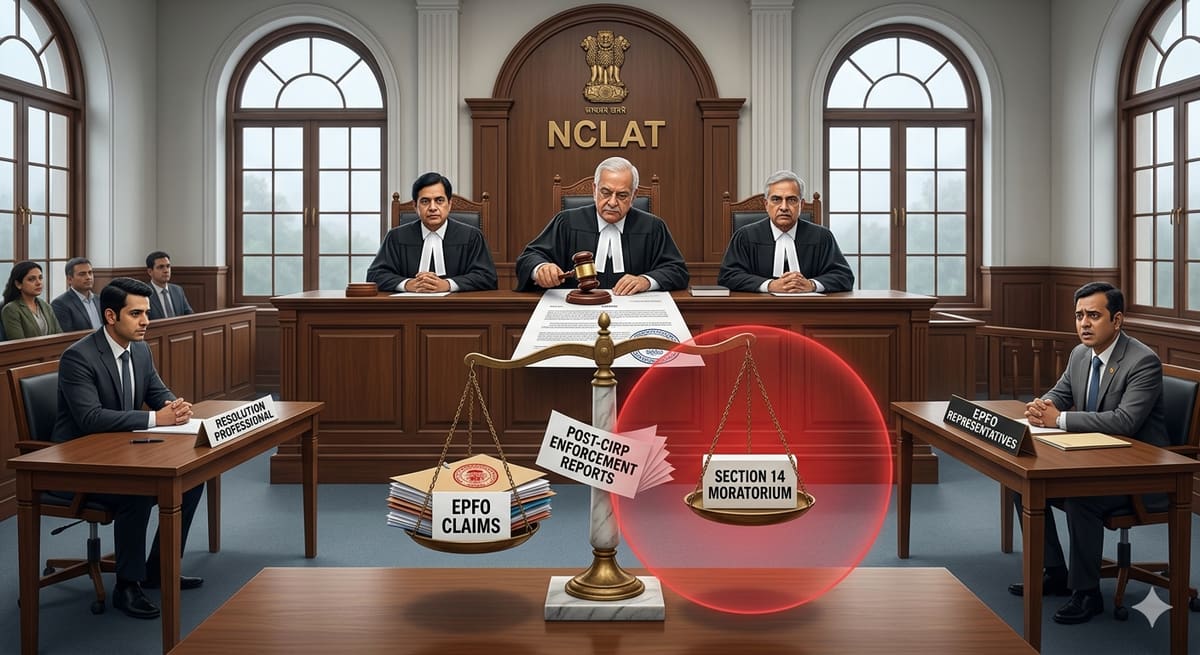
The National Company Law Appellate Tribunal clarified that the adjudicating authority may impose a contribution order under the moratorium provision of the IBC without first deciding a claim of fraudulent trading under Section 66, and that a direction to the IBBI and MCA under the now-repealed Section 74 is merely a reference, not a punitive order.
Background & Facts
The Dispute
The appellant, Ammeet Kumar Agarwal, a suspended director of Supreme Transport Organisation Private Limited (the corporate debtor), challenged an order dated 19 December 2024 passed by the National Company Law Tribunal, Mumbai Bench, Court-II. The order directed the appellant and other suspended directors to jointly and severally contribute Rs 8,05,11,748 to the corporate debtor’s account within thirty days and to forward a copy of the order to the Insolvency and Bankruptcy Board of India (IBBI) and the Ministry of Corporate Affairs (MCA) for action under Section 74 of the Insolvency and Bankruptcy Code (IBC).
Key Facts
- 08 September 2023: The corporate debtor was admitted to Corporate Insolvency Resolution Process (CIRP) under Section 7 of the IBC.
- 15 September 2023: NCLAT stayed the constitution of the Committee of Creditors (CoC) subject to the appellant depositing Rs 10,49,26,262 as a fixed deposit with the Registrar, NCLAT, within thirty days.
- 16 October 2023: The Tribunal extended the deposit deadline by thirty days and rejected IA No. 4871 2023 seeking permission to sell two unencumbered properties, holding that such sales were impermissible after CIRP commencement.
- 02 November 2023: The appellant sold the Panvel property, mortgaged to Axis Bank, in clear breach of the moratorium.
- 06 December 2023: The interim protection granted on 15 September 2023 was vacated as the fixed-deposit condition remained unfulfilled.
- 09 April 2024: The Tribunal directed the resolution professional to keep the sale proceeds from the Panvel property in an interest-bearing account with a nationalised bank.
- 08 October 2024: The appellant filed a detailed reply denying the allegations, asserting that the cheques in question were drawn before CIRP.
- 10 May 2024: The resolution professional filed IA No. 3653 2024 under Sections 66, 74 and 60(5) of the IBC read with Section 213 of the Companies Act, 2013, seeking reimbursement of Rs 8,05,11,748 withdrawn during the moratorium.
- 19 December 2024: NCLT ordered the appellant and other suspended directors to contribute Rs 8,05,11,748 and to forward the order to IBBI and MCA for action under Section 74.
- 26 May 2026: The Insolvency and Bankruptcy Code (Amendment) Act, 2026 omitted Section 74, rendering any direction under that provision ineffective.
- 03 August 2026: NCLAT delivered the present judgment.
Procedural History
- 08 September 2023: Admission of CIRP (Section 7 IBC).
- 15 September 2023: Interim order staying CoC, conditional on fixed deposit.
- 16 October 2023: Extension of deposit deadline; denial of IA 4871 2023.
- 06 December 2023: Vacating of interim protection.
- 09 April 2024: Direction to keep sale proceeds in interest-bearing account.
- 10 May 2024: IA 3653 2024 filed under Sections 66, 74, 60(5).
- 19 December 2024: NCLT order directing contribution and reference to IBBI/MCA.
- 03 August 2026: NCLAT judgment dismissing the appeal.
Relief Sought
The appellant sought (i) setting aside of the contribution order dated 19 December 2024, (ii) quashing of the direction to IBBI and MCA under Section 74, and (iii) declaration that the adjudicating authority lacked jurisdiction to pass any order without a finding under Section 66.
The Legal Issue
The central questions were: (1) Can the adjudicating authority impose a contribution order under the moratorium provision of Section 14 of the IBC without first determining the alleged fraudulent trading under Section 66? (2) Is a direction to the IBBI and MCA for action under Section 74 within the jurisdiction of the adjudicating authority, especially after the amendment removing Section 74?
Arguments Presented
For the Appellant
- The appellant contended that the IA was filed primarily under Section 66; therefore, any relief must be predicated on a finding of fraudulent trading, which the NCLT failed to make.
- He argued that the contribution order was effectively an order under Section 66 and thus ultra vires.
- He maintained that the direction to IBBI/MCA under Section 74 was beyond jurisdiction and, after the 2026 amendment, became void.
- Reliance was placed on Sudhir Dinanath Chaturvedi v. True IPE LLP (NCLAT 2025) and Regen Powertech Private Ltd. v. Wind Construction Pvt. Ltd. (NCLAT 2022) for the principle that relief under Section 66 requires a finding of fraud.
For the Respondent
- The respondent argued that the IA invoked Sections 66, 74 and 60(5); the relief sought was primarily to protect the insolvency estate under the moratorium (Section 14) and the residual jurisdiction under Section 60(5).
- It submitted that the adjudicating authority was entitled to grant restoration of funds withdrawn during the moratorium without a Section 66 finding.
- The direction to IBBI/MCA was characterized as a mere reference, not a punitive order, consistent with Almas Global Opportunity Fund SPC v. CA Kannan Triuvengadam (NCLAT 2022).
- It highlighted that the amendment removing Section 74 only affected the enforceability of the reference, not the contribution order.
The Court's Analysis
The Tribunal first examined the statutory framework. Section 66 of the IBC empowers the adjudicating authority to pass orders when the business of the corporate debtor was carried on with intent to defraud creditors or when directors failed to exercise due diligence before the commencement of CIRP. The provision is therefore aimed at adjudicating fraudulent or wrongful trading.
In contrast, Section 14 imposes a moratorium on the corporate debtor once CIRP commences, prohibiting any transfer, encumbrance or disposal of assets. Section 60(5) confers a wide jurisdiction on the adjudicating authority to entertain any question of law or fact arising out of the insolvency resolution process. The Tribunal held that the relief sought - restoration of Rs 8,05,11,748 to the debtor’s account - was directly linked to a breach of the moratorium, not to a finding of fraudulent trading.
"The relief ultimately granted was not founded upon Section 66 but upon the consequences flowing from the violation of the statutory moratorium."
The Tribunal emphasized that the mere inclusion of Section 66 in the IA does not make every relief contingent upon a finding under that provision. It distinguished the present case from Sudhir Dinanath Chaturvedi, where the adjudicating authority attempted to grant relief under Section 66 without satisfying its ingredients. Here, the order was based on Section 14 and Section 60(5), which are independent of Section 66.
Regarding the direction to IBBI and MCA, the Tribunal observed that such a direction is a statutory reference, not a punitive order, aligning with the principle in Almas Global Opportunity Fund SPC. Moreover, the 2026 amendment deleting Section 74 rendered any enforcement action under that provision impossible, but it did not invalidate the reference itself. Consequently, the direction became ineffective but did not affect the validity of the contribution order.
The Tribunal concluded that the adjudicating authority had acted within its jurisdiction, correctly exercised its powers under the moratorium and residual jurisdiction, and that the appellant’s challenge was untenable.
The Verdict
The appeal is dismissed. The contribution order directing the appellant and other suspended directors to pay Rs 8,05,11,748 to the corporate debtor’s account stands. The direction to forward the order to IBBI and MCA for action under the now-repealed Section 74 is held to be a non-enforceable reference. No costs are awarded. All pending interim applications, if any, are disposed of.
What This Means For Similar Cases
Relief Under Section 14 Is Independent of Section 66
- Practitioners can seek restoration of assets withdrawn during the moratorium without first establishing a fraud finding under Section 66.
- The adjudicating authority may rely on its jurisdiction under Section 60(5) to address breaches of the moratorium.
Directions Under Section 74 Are Mere References
- Orders directing the IBBI or MCA to consider action under Section 74 are not punitive; they are procedural references.
- Following the 2026 amendment, any such reference becomes ineffective, but it does not invalidate the primary relief.
Amendments Can Render Certain Directions Moot
-
Lawyers must monitor statutory amendments; a direction based on a repealed provision loses enforceability.
-
Draft reliefs that do not depend solely on provisions vulnerable to amendment.
-
Ensure that applications clearly articulate the statutory basis for each prayer.
-
When invoking multiple provisions, be prepared to justify each relief on its own statutory ground.
-
Anticipate that the adjudicating authority may exercise residual jurisdiction under Section 60(5) for matters ancillary to the primary relief.