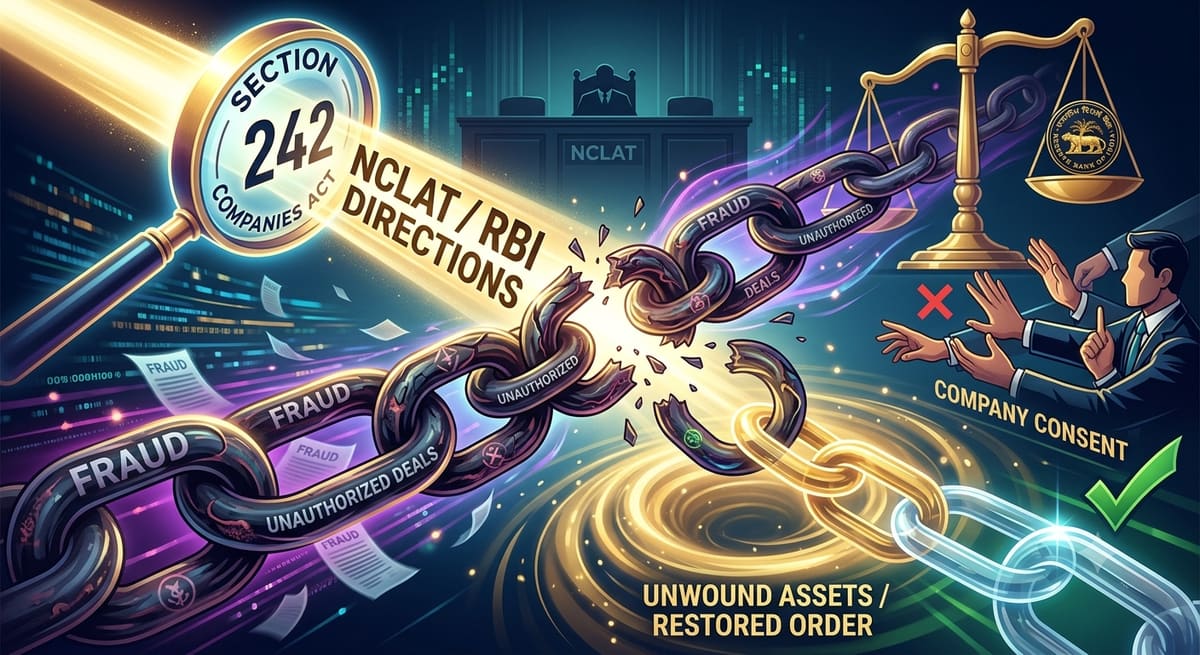
The National Company Law Appellate Tribunal has clarified that statutory powers under Section 242 of the Companies Act, 2013, to unwind corporate transactions are not contingent upon consent when the transactions are alleged to be fraudulent or void. This ruling overturns a lower tribunal’s erroneous interpretation that mutual agreement is mandatory, and affirms that regulatory breaches and fraudulent intent can justify judicial intervention without party consent.
Background & Facts
The Dispute
The dispute arises from a complex web of inter-group financial transactions between Infrastructure Leasing & Financial Services Limited (IL&FS), its wholly owned subsidiary IL&FS Financial Services Limited (IFIN), and SREI Infrastructure Finance Limited (SIFL), designed to circumvent Reserve Bank of India (RBI) directives restricting intra-group lending. The transactions, totaling ₹1,080 crore, involved IFIN lending to third-party entities controlled by SIFL, which in turn lent equivalent amounts to IL&FS group companies, primarily IL&FS Transportation Networks Limited (ITNL). These arrangements were structured to mask direct lending to group entities, thereby evading RBI’s 2017 directive to reduce group exposure.
Key Facts
IFIN, a Non-Banking Finance Company (NBFC), was directed by RBI on 01.11.2017 to run down its exposure to group companies with no fresh lending.
Between March 2017 and March 2018, IFIN executed six circuitous transactions through SREI Group entities (including Attivo, Sahaj, Vistar, Giridhan, BRNL) to route ₹1,080 crore to IL&FS group companies.
Each transaction was backed by letters of awareness issued by SIFL to IFIN and vice versa, creating an illusion of third-party involvement.
RBI’s March 2019 inspection report concluded that both groups were acting in concert to bypass regulatory norms.
The Serious Fraud Investigation Office (SFIO) report dated 28.05.2019 found these transactions deceptive, with funds routed to ITNL to evade RBI limits.
Grant Thornton Bharat LLP’s forensic audit confirmed the transactions were circuitous and designed to circumvent regulatory oversight.
SEBI’s order dated 15.12.2022 also found IFIN had used intermediaries to lend to ITNL.
In March 2023, the newly constituted board of IL&FS resolved to unwind these transactions, citing fraud and regulatory violation.
IFIN had previously filed Section 7 applications under the Insolvency and Bankruptcy Code, 2016 (IBC) against some of the third-party borrowers (Attivo, Sahaj, Vistar, etc.), seeking recovery of amounts.
Procedural History
01.11.2017: RBI issues direction to IFIN to cease fresh lending to group companies.
March 2017 - March 2018: Six circuitous transactions executed between IFIN, SIFL, and IL&FS group entities.
22.03.2019: RBI Inspection Report identifies circumvention of lending norms.
28.05.2019: SFIO submits report classifying transactions as fraudulent.
15.12.2022: SEBI issues order confirming IFIN’s use of intermediaries.
14.03.2023: New IL&FS Board resolves to unwind the transactions.
18.07.2023: IL&FS files I.A. No. 3169/2023 before NCLAT seeking collapse of transactions.
16.01.2025: NCLAT passes order allowing collapse of transactions with mutual consent but declines to order collapse of transactions without consent, leaving the issue open for examination by NCLT.
09.07.2025: CA No. 226/2025 filed by IL&FS before NCLT Mumbai seeking declaration that the six transactions are sham and fraudulent.
09.07.2025: CA No. 99/2025 and CA No. 368/2025 filed by SIFL seeking release of settlement amounts.
13.04.2026: NCLT Mumbai dismisses CA No. 226/2025, holding consent mandatory under Section 242(2)(f), and allows CA No. 99/2025 and CA No. 368/2025.
14.03.2026: IL&FS files appeals before NCLAT challenging the NCLT order.
The Parties' Positions
IL&FS (Appellant): Argued that the transactions were fraudulent, void, and designed to circumvent statutory RBI directions. Contended that Section 242(1) grants wide powers to the Tribunal to unwind such transactions without consent, and that the NCLT erred in requiring mutual agreement. Relied on RBI, SFIO, and Grant Thornton reports to establish fraud.
SIFL (Respondent): Argued that consent under Section 242(2)(f) is mandatory for termination of any agreement, and that IL&FS cannot change its legal strategy after initiating Section 7 proceedings. Invoked doctrines of election, approbation and reprobation, and estoppel to bar IL&FS from challenging the validity of transactions it previously treated as enforceable.
Relief Sought
IL&FS sought:
A declaration that the six transactions were sham, fraudulent, and void.
Recognition of IFIN as the legitimate creditor of ITNL.
De-recognition of SIFL and SREI entities as creditors of IL&FS group companies.
Direction to Grant Thornton Bharat LLP to adjust creditor claims accordingly.
Preservation of all amounts due to SIFL from IL&FS group resolutions in an escrow account pending final adjudication.
The Legal Issue
The central questions were: (1) Whether consent of the third party is a mandatory precondition for the National Company Law Tribunal to unwind transactions alleged to be fraudulent under Section 242 of the Companies Act, 2013; (2) Whether breach of RBI directions can render a transaction void; and (3) Whether the doctrine of approbation and reprobation bars a company from challenging transactions it previously pursued through Section 7 proceedings.
Arguments Presented
For the Appellant
The appellant relied on the wide, general powers under Section 242(1) of the Companies Act, 2013, which empower the Tribunal to make any order it deems fit to end oppression or mismanagement. It argued that Section 242(2)(f), requiring consent for termination of agreements, is illustrative and not exhaustive, and does not apply to void or fraudulent transactions. It cited Bennet Colman & Co. v. Union of India, Pearson Education v. Prentice Hall India, and Phoenix ARC v. Spade Financial Services to establish that sham transactions are legally void ab initio and cannot be protected by consent requirements. It emphasized that RBI directions under Section 45N of the RBI Act are statutory and binding, not advisory, and that SFIO and Grant Thornton reports conclusively established fraud.
For the Respondent
The respondent contended that Section 242(2)(f) imposes a mandatory condition of consent for any termination of agreements with third parties, regardless of the nature of the transaction. It relied on Incable Net v. Apaksh Broadband and Jai Kumar Arya v. Chaya Devi to argue that the Tribunal cannot override statutory conditions. It invoked the doctrine of approbation and reprobation, asserting that IL&FS had elected to treat the transactions as valid by initiating Section 7 proceedings against third parties, and could not later challenge their validity. It also argued that RBI’s inspection reports were merely advisory and could not invalidate contracts.
The Court's Analysis
The NCLAT undertook a rigorous analysis of the statutory framework under Section 242 of the Companies Act, 2013, and the nature of the transactions in question. It began by examining the order dated 16.01.2025 passed by the NCLAT itself, which had declined to order collapse of the six transactions due to absence of consent but explicitly stated that the NCLT could examine the issue in pending proceedings. The NCLAT held that the NCLT had misread this order as establishing consent as a mandatory precondition for all collapses, when in fact it merely recognized consent as a procedural step for the specific application before it.
"This Tribunal in its order dated 16.01.2025 has neither held nor issued any direction to the NCLT that collapsing is permissible only when the parties have already agreed and no other parties."
The Court then turned to the scope of Section 242(1), which grants the Tribunal wide, general powers to make any order it thinks fit to end oppression or mismanagement. It emphasized that Section 242(2)(a) to (m) are illustrative, not exhaustive, citing Bennet Colman & Co. and Pearson Education. The Court held that the proviso to Section 242(2)(f) requiring consent applies only to valid, subsisting agreements, and cannot fetter the Tribunal’s power to set aside void or fraudulent transactions.
The Court further held that RBI directions issued under Section 45N of the RBI Act are statutory and binding on NBFCs, not advisory. It relied on Nedumpilli Finance Co. v. State of Kerala, affirming that regulatory directions are not mere suggestions but legal obligations. The Court observed:
"Breach of the advisories/directions by IL&FS cannot invalidate the transactions or void the financing arrangements..." - this reasoning by NCLT was incorrect.
Regarding the doctrines of election and approbation and reprobation, the Court held they are inapplicable where fraud is alleged. Citing Immai Appa Rao v. Gollapalli Ramalingamurthi, it held that courts will not enforce fraudulent transactions even if both parties participated in the fraud, as doing so would violate public policy. The Court quoted Holman v. Johnson: "No court will lend its aid to a man who founds his cause of action upon an immoral or an illegal act."
The Court also rejected the argument that Section 7 proceedings barred the collapsing application, noting that the new board acted to rectify past mismanagement, and that initiating recovery proceedings does not constitute an affirmation of the transaction’s validity.
The Verdict
The appeals are allowed. The order dated 13.04.2026 of the NCLT, Mumbai Bench - I, is set aside. CA No. 226/2025 is revived for fresh consideration on its merits. CA No. 99/2025 and CA No. 368/2025 are also revived for fresh orders. The amounts payable to SIFL from the resolution of IL&FS group entities, currently held in escrow, shall remain in escrow until CA No. 226/2025 and the other applications are finally decided. No order as to costs.
What This Means For Similar Cases
Consent Is Not a Shield for Fraudulent Transactions
Practitioners must now argue that Section 242(2)(f)’s consent requirement applies only to valid contracts, not to sham or void transactions.
Where fraud, misrepresentation, or regulatory evasion is alleged, the Tribunal has inherent power under Section 242(1) to unwind transactions without party consent.
Evidence from regulators (RBI, SFIO, SEBI) can be decisive in establishing fraud, even without direct admission by parties.
Regulatory Directions Are Binding, Not Advisory
RBI directions under the RBI Act are statutory obligations; breach does not merely attract penalties but may render transactions void.
Companies cannot rely on regulatory non-compliance as a defense when challenging transactions in insolvency or oppression proceedings.
Insolvency professionals and forensic auditors’ reports carry significant evidentiary weight in establishing fraudulent intent.
Election Doctrine Does Not Bar Fraud Claims
Initiating recovery proceedings under Section 7 of the IBC does not constitute an affirmation of transaction validity.
A new board or management may challenge past fraudulent acts without being estopped, especially where the prior management is implicated.
Courts will not permit parties to benefit from fraudulent schemes, even if they initially pursued inconsistent remedies.
Practitioners should immediately file applications under Section 242 seeking unwinding of transactions where regulatory breaches and third-party routing are evident.
Escrow mechanisms should be sought early to preserve disputed funds pending adjudication.
Always include regulatory reports and forensic audit findings as core evidence in oppression and mismanagement petitions.