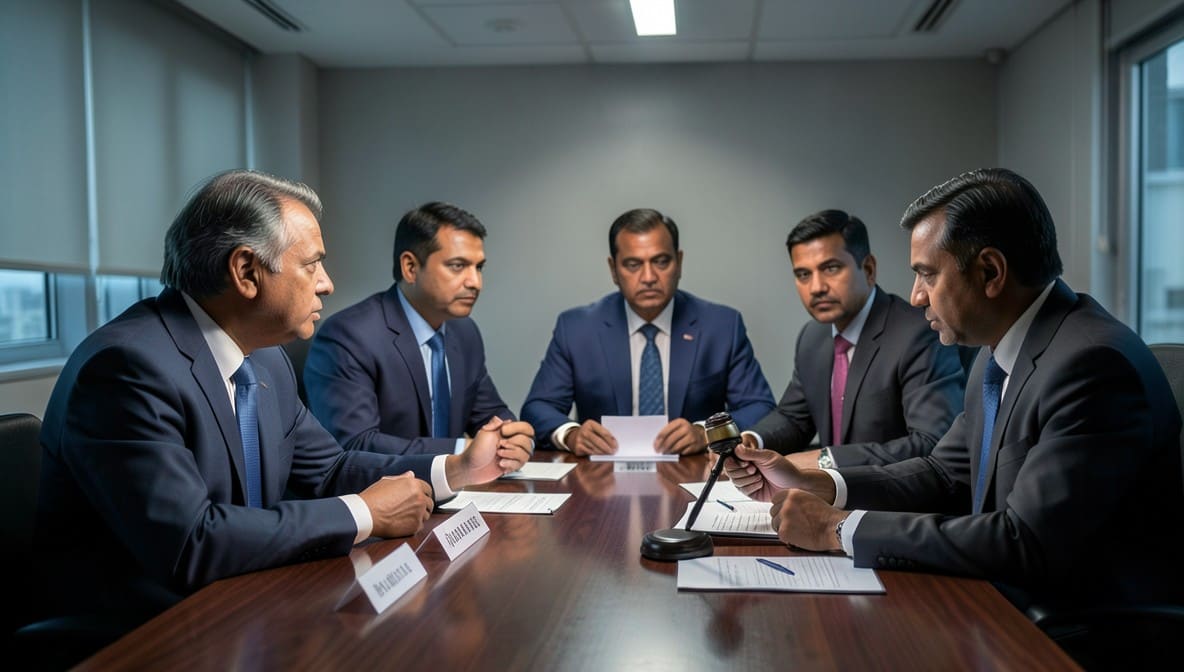
The National Company Law Appellate Tribunal set aside the liquidation order of Jeppiaar Cements Ltd, restored the corporate insolvency resolution process and directed the resolution professional to explore the Sec.12A withdrawal route, underscoring that liquidation under the IBC is a last-resort remedy and must be predicated on a statutory 66% vote.
Background & Facts
The Dispute
The appellant, Mr. Babu Manoharan Jaikumar Christhurajan, challenged the order dated 26.08.2022 passed by the Adjudicating Authority which directed the liquidation of M/s. Jeppiaar Cements Ltd, the corporate debtor (CD). The liquidation was sought on the ground that the corporate debtor had defaulted on substantial loans guaranteed by the CD and that the resolution process could not be concluded within the prescribed timeline.
Key Facts
- 27.06.2013: Jeppiaar Power Corporation Ltd obtained a term loan of ₹92.50 crores from Indian Bank; the CD stood as guarantor.
- 05.08.2016: The principal borrower obtained an additional loan of ₹48.50 crores from Indian Bank, again guaranteed by the CD.
- 10.10.2019: The Adjudicating Authority, under Sec.7 IBC, admitted the CD into the Corporate Insolvency Resolution Process (CIRP).
- An Interim Resolution Professional (IRP) was appointed and constituted the Committee of Creditors (CoC) comprising Indian Bank (96.65% voting share) and HDFC Bank (3.35%).
- Sec.12(1) prescribed a 180-day period for CIRP, which was to end on 07.04.2020.
- 18.04.2022: The RP moved IA-656 of 2022 to exclude 737 days of Covid-related extension, shifting the final CIRP date to 14.04.2022.
- 15.07.2022: Both IA-321 of 2020 (90-day extension) and IA-656 of 2022 were listed before the Adjudicating Authority.
- 30.03.2022: Indian Bank sanctioned a One-Time Settlement (OTS) for the directors of the principal borrower, with a repayment deadline of 30.06.2022.
- 13.06.2022: The 11th CoC meeting discussed liquidation; voting window opened on 16.06.2022 and closed on 04.07.2022. No CoC member voted in favour of liquidation.
- 06.07.2022: The RP filed an application under Sec.60(5) seeking directions.
- 12.07.2022: RP emailed the CoC about the Sec.60(5) application.
- 14.07.2022: RP informed creditors that the Registry advised filing under Sec.33(1); Indian Bank replied, "Please proceed in accordance with the provisions of the IBC."
- 28.07.2022: Indian Bank extended the OTS deadline to 30.09.2022.
- 26.08.2022: The Adjudicating Authority allowed IA-800 of 2022 under Sec.33(1) and ordered liquidation.
- 15.09.2022: Indian Bank accepted full OTS payment from personal guarantors and issued a No-Objection Certificate.
- 20.04.2023: Indian Bank’s IA-512 of 2023 under Sec.12A for withdrawal of CIRP was dismissed.
- 24.08.2026: The present judgment was delivered.
Procedural History
- 27.06.2013: Term loan availed by Jeppiaar Power Corp.
- 05.08.2016: Second loan availed, CD guaranteed.
- 10.10.2019: CD admitted to CIRP (Sec.7 IBC).
- 18.04.2022: IA-656 filed for exclusion of Covid extension.
- 15.07.2022: IA-321 and IA-656 listed before AA.
- 30.03.2022: OTS sanctioned by Indian Bank.
- 13.06.2022: 11th CoC meeting; liquidation resolution put to vote.
- 06.07.2022: RP filed Sec.60(5) application.
- 14.07.2022: RP filed Sec.33(1) application after Registry advice.
- 26.08.2022: AA ordered liquidation under Sec.33(1).
- 15.09.2022: OTS fully paid; NOC issued.
- 20.04.2023: IA-512 (Sec.12A) dismissed.
- 24.08.2026: Appeal heard and judgment delivered.
Relief Sought
The appellant sought quashing of the liquidation order dated 26.08.2022, restoration of the CIRP, and direction to the resolution professional to consider the Sec.12A withdrawal mechanism.
The Legal Issue
Whether the order of liquidation passed under Sec.33(1) of the Insolvency and Bankruptcy Code can be set aside and the CIRP revived, allowing the corporate debtor to pursue the Sec.12A withdrawal route, given that the statutory 66% vote requirement was not satisfied and the OTS obligations were fulfilled.
Arguments Presented
For the Appellant
- The liquidation was ordered without the requisite 66% affirmative vote of the CoC as mandated by Sec.33(2).
- The resolution professional acted on the Registry’s advice rather than his independent judgment, violating the statutory mandate that the RP act on his conscience consistent with CoC directions.
- The personal guarantors had complied with the OTS, and Indian Bank had issued a NOC, rendering liquidation unnecessary.
- The time-extension provisions under Sec.12(1) and Sec.12(3) are directory; the RP could have awaited the expiry of the 330-day ceiling (11.09.2022) before invoking liquidation.
For the Respondent
- The application was filed under Sec.33(1) because the statutory timeline for CIRP had expired, giving the AA discretion to order liquidation.
- The RP’s reliance on the Registry’s advice does not invalidate the application; the RP remains empowered to file under Sec.33(1).
- The OTS settlement was partial at the time of liquidation; the remaining financial creditor (HDFC Bank) had not been fully satisfied.
- The dismissal of IA-512 under Sec.12A was proper as the liquidation order precluded any further withdrawal.
The Court's Analysis
The Court began by reaffirming that liquidation is a remedy of last resort and must be predicated on a clear statutory mandate, particularly the 66% vote requirement under Sec.33(2). It observed that the CoC, comprising Indian Bank and HDFC Bank, did not record any affirmative vote for liquidation during the 11th meeting, thereby breaching the statutory threshold.
"Where there are more options than one to end an insolvency condition of the corporate debtor, then fairness involved in choosing an option should be allowed to prevail."
The Court noted that the resolution professional’s independence is sacrosanct; reliance on the Registry’s advice cannot supplant the RP’s duty to act on his conscience and the CoC’s directions. The judgment distinguished the present case from Asha Chopra v. Hind Motors, where the liquidation reversal was sought after years of liquidation, emphasizing that here the OTS had been fully honoured and a NOC issued, making liquidation unnecessary.
Statutory time limits under Sec.12(1) and Sec.12(3) were held to be directory. The Court held that the RP could have awaited the final permissible date of 11.09.2022 (330 days) before invoking liquidation, especially since the OTS compliance demonstrated a viable exit route via Sec.12A. The Court further clarified that Sec.12A is an integral part of the insolvency resolution process, offering a legitimate exit even after a liquidation order, provided procedural fairness is observed.
The Court rejected the respondent’s contention that the RP’s filing under Sec.33(1) was automatically valid upon expiry of the CIRP timeline. It stressed that procedural fairness and statutory voting requirements cannot be ignored merely because the timeline lapsed. Consequently, the liquidation order was deemed unsustainable.
The Verdict
The Court set aside the liquidation order dated 26.08.2022, restored the CIRP, directed the resolution professional to explore the Sec.12A withdrawal route, closed all pending interlocutory applications and awarded no costs.
What This Means For Similar Cases
Liquidation Not Automatic Without 66% Vote
- Practitioners must ensure that any resolution professional’s application under Sec.33(1) is supported by a minimum of 66% affirmative votes of the CoC.
- Absence of such a vote renders the liquidation order vulnerable to reversal.
Resolution Professional’s Independent Discretion
- The RP must act on his independent judgment, not merely on Registry advice.
- Any deviation must be justified on the record; otherwise, the order may be set aside.
Sec.12A Viable Exit Even After Liquidation Order
- Even after a liquidation order, the Sec.12A withdrawal mechanism remains available if the corporate debtor can settle debts and obtain creditor consent.
- Lawyers should advise clients to pursue Sec.12A promptly when OTS or settlement is achieved, rather than relying solely on liquidation.
Actionable Takeaways
- Verify the CoC voting record before filing a liquidation application.
- Document the RP’s independent decision-making process.
- Assess the feasibility of Sec.12A withdrawal as soon as settlement is possible.
- Treat statutory timelines as directory; prioritize substantive compliance over procedural expiry.