Madhya Pradesh High Court judgments

1273 Madhya Pradesh High Court judgments explained in plain English: what was decided, the law applied and why it matters. Page 23 of 54.

Section 3-G(5) NH Act | Arbitrator Cannot Remand Land Acquisition Disputes : MP HC Reaffirms Binding Precedent
Case Law Analysis
|Madhya Pradesh High Court

Section 3-G(5) NH Act | Arbitrator Cannot Remand Land Acquisition Disputes : MP HC Reaffirms Binding Precedent

Madhya Pradesh High Court reiterates that arbitrators under Section 3-G(5) of the National Highways Act, 1956, lack jurisdiction to remand land acquisition disputes for fresh adjudication. The ruling binds all arbitrators to decide matters based on available material, reinforcing the precedent set in WP No. 2521/2017. This decision impacts landowners, NHAI, and arbitrators handling compensation disputes under the Act.

Land Demarcation Duty Under Revenue Law | Authorities Must Act Within 30 Days Without Deciding Title or Possession : MP HC Gwalior
Case Law Analysis
|Madhya Pradesh High Court

Land Demarcation Duty Under Revenue Law | Authorities Must Act Within 30 Days Without Deciding Title or Possession : MP HC Gwalior

The Madhya Pradesh High Court has mandated that revenue authorities must complete land demarcation between survey numbers within 30 days of application, as per state circulars, and cannot refuse on grounds of title disputes or possession claims. This clarifies the limited role of revenue officers in boundary disputes and protects landowners from administrative inaction, reinforcing procedural fairness in land record management.

Judges (Protection) Act, 1985 | Quasi-Judicial Acts Immune from Disciplinary Action Absent Malafide Intent : MP HC Indore
Case Law Analysis
|Madhya Pradesh High Court

Judges (Protection) Act, 1985 | Quasi-Judicial Acts Immune from Disciplinary Action Absent Malafide Intent : MP HC Indore

The Madhya Pradesh High Court has held that disciplinary proceedings against a quasi-judicial officer cannot proceed for errors made in the course of statutory functions unless malafide intent is proven. This ruling shields revenue officers, tehsildars, and similar functionaries from retaliatory departmental action over bona fide judicial decisions, reinforcing the independence of quasi-judicial roles under Article 14 and the Judges (Protection) Act.

Pensionable Service | Daily Wager Service Countable Only If Appointment Complied with Recruitment Rules, 1977 : MP HC Jabalpur
Case Law Analysis
|Madhya Pradesh High Court

Pensionable Service | Daily Wager Service Countable Only If Appointment Complied with Recruitment Rules, 1977 : MP HC Jabalpur

The Madhya Pradesh High Court has ruled that daily wage service can be counted as pensionable service under the Pension Rules, 1979, but only if the initial appointment strictly adhered to the Recruitment Rules of 1977. This clarifies a critical threshold for thousands of informal workers seeking pension benefits, making procedural compliance - not just length of service - the decisive factor.

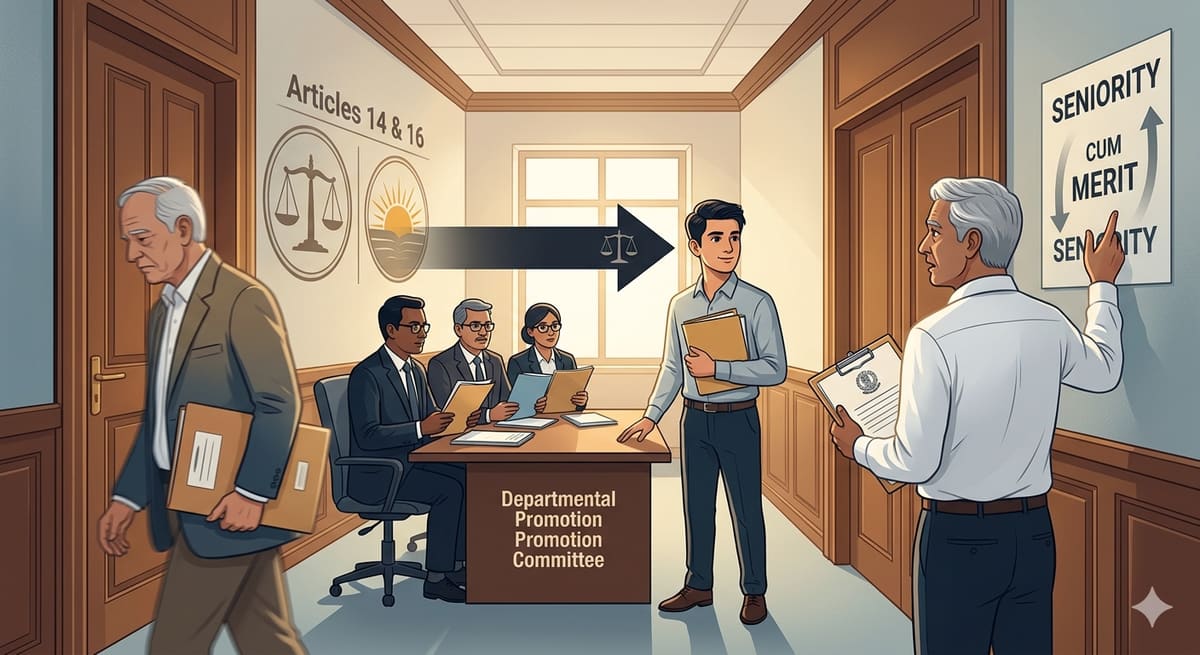
Seniority Cum Merit Doctrine | DPC Must Not Supersede Senior Officers Without Valid Justification Under Articles 14 & 16 : MP HC Indore
Case Law Analysis
|Madhya Pradesh High Court

Seniority Cum Merit Doctrine | DPC Must Not Supersede Senior Officers Without Valid Justification Under Articles 14 & 16 : MP HC Indore

The Madhya Pradesh High Court quashed a promotion order that bypassed a senior officer in favor of juniors, holding that the Departmental Promotion Committee violated the seniority cum merit principle enshrined under Articles 14 and 16. The ruling mandates a fresh DPC review with retrospective effect, ensuring that procedural fairness and constitutional equality govern public employment promotions.

Order 8 Rule 6A CPC | Counter-Claim for Partition Must Include All Joint Properties by Metes and Bounds : MP HC Jabalpur
Case Law Analysis
|Madhya Pradesh High Court

Order 8 Rule 6A CPC | Counter-Claim for Partition Must Include All Joint Properties by Metes and Bounds : MP HC Jabalpur

MP High Court rules that a counter-claim for partition under Order 8 Rule 6A CPC cannot be restricted to the suit property alone-it must encompass all jointly owned properties by metes and bounds, as piecemeal partition is legally impermissible. The ruling clarifies that defendants can expand the scope of partition claims beyond the plaint, reinforcing the principle of comprehensive adjudication in property disputes.

Section 111(4) BNS | Mandatory Prior Cognizance Order Required for Organized Crime Charge: MP HC Quashes Framing Without Compliance
Case Law Analysis
|Madhya Pradesh High Court

Section 111(4) BNS | Mandatory Prior Cognizance Order Required for Organized Crime Charge: MP HC Quashes Framing Without Compliance

MP High Court rules that charges under Section 111(4) of Bharatiya Nyaya Sanhita cannot be framed without prior judicial cognizance orders, setting a precedent for procedural safeguards in organized crime prosecutions. The decision mandates strict adherence to preconditions, impacting future cases under the new criminal code.

Fundamental Rules Amendment | Medical Officers Entitled to Retirement at 65 Under M.P. Service Rules: MP HC
Case Law Analysis
|Madhya Pradesh High Court

Fundamental Rules Amendment | Medical Officers Entitled to Retirement at 65 Under M.P. Service Rules: MP HC

MP High Court quashes premature retirement order, affirming that Medical Officers with 20+ years of service are entitled to retire at 65 under amended Fundamental Rules. The ruling underscores the state's obligation to retain experienced medical professionals, especially in rural areas, and mandates consequential benefits for affected officers.

Pranay Sethi Guidelines | MP HC Mandates 40% Future Prospects, Rs.40,000 Consortium & Rs.15,000 Estate Compensation in Motor Accident Claims : MP HC Indore
Case Law Analysis
|Madhya Pradesh High Court

Pranay Sethi Guidelines | MP HC Mandates 40% Future Prospects, Rs.40,000 Consortium & Rs.15,000 Estate Compensation in Motor Accident Claims : MP HC Indore

Madhya Pradesh High Court enhances motor accident compensation by strictly applying Pranay Sethi guidelines, awarding 40% future prospects, Rs.40,000 per claimant for loss of consortium, and Rs.15,000 for loss of estate. The ruling sets a precedent for standardized compensation calculations in unskilled labor cases where income evidence is lacking.

Section 304 Part II IPC | Gross Negligence in School Transport Causing Deaths Constitutes Culpable Homicide: MP HC Upholds Conviction
Case Law Analysis
|Madhya Pradesh High Court

Section 304 Part II IPC | Gross Negligence in School Transport Causing Deaths Constitutes Culpable Homicide: MP HC Upholds Conviction

The Madhya Pradesh High Court ruled that overloading a school van with 22 children in a 7-seater and driving with earphones, leading to three deaths, amounts to culpable homicide under Section 304 Part II IPC. The judgment underscores that reckless vehicular negligence resulting in fatalities attracts criminal liability, setting a precedent for school transport safety and vehicular manslaughter cases.

Service Regularisation Benefits Under 1985 Circular Limited to Government Teachers, Not Private Aided Schools: MP HC
Case Law Analysis
|Madhya Pradesh High Court

Service Regularisation Benefits Under 1985 Circular Limited to Government Teachers, Not Private Aided Schools: MP HC

MP High Court rules that a 1985 government circular converting Lab Assistants to Assistant Teachers applies exclusively to government schools, denying private aided school teachers benefits like salary arrears and kramonnati. The ruling clarifies that court-ordered benefits post-2019 do not retroactively apply to the circular's issuance date, impacting service regularisation claims in private aided institutions.

Rule 8(7) M.P. Civil Services Rules | Probation Completion Without Permanent Confirmation Does Not Extinguish Lien on Previous Post: MP HC
Case Law Analysis
|Madhya Pradesh High Court

Rule 8(7) M.P. Civil Services Rules | Probation Completion Without Permanent Confirmation Does Not Extinguish Lien on Previous Post: MP HC

MP High Court rules that a government employee’s lien on their prior post remains intact unless they are permanently confirmed in the new post, even after probation completion. The judgment clarifies that mere probation expiry does not automatically extinguish lien rights under service law, impacting employees transitioning between government roles.

Section 24(2) LARR Act | Land Acquisition Lapses If Possession Not Taken Within 5 Years: MP HC Gwalior Directs Collector to Adjudicate
Case Law Analysis
|Madhya Pradesh High Court

Section 24(2) LARR Act | Land Acquisition Lapses If Possession Not Taken Within 5 Years: MP HC Gwalior Directs Collector to Adjudicate

MP High Court at Gwalior reaffirms that land acquisition proceedings under Section 24(2) of the LARR Act automatically lapse if possession is not taken within five years. The court directed the Collector to decide the petitioners' representation within four weeks, protecting their possession rights over the disputed land.

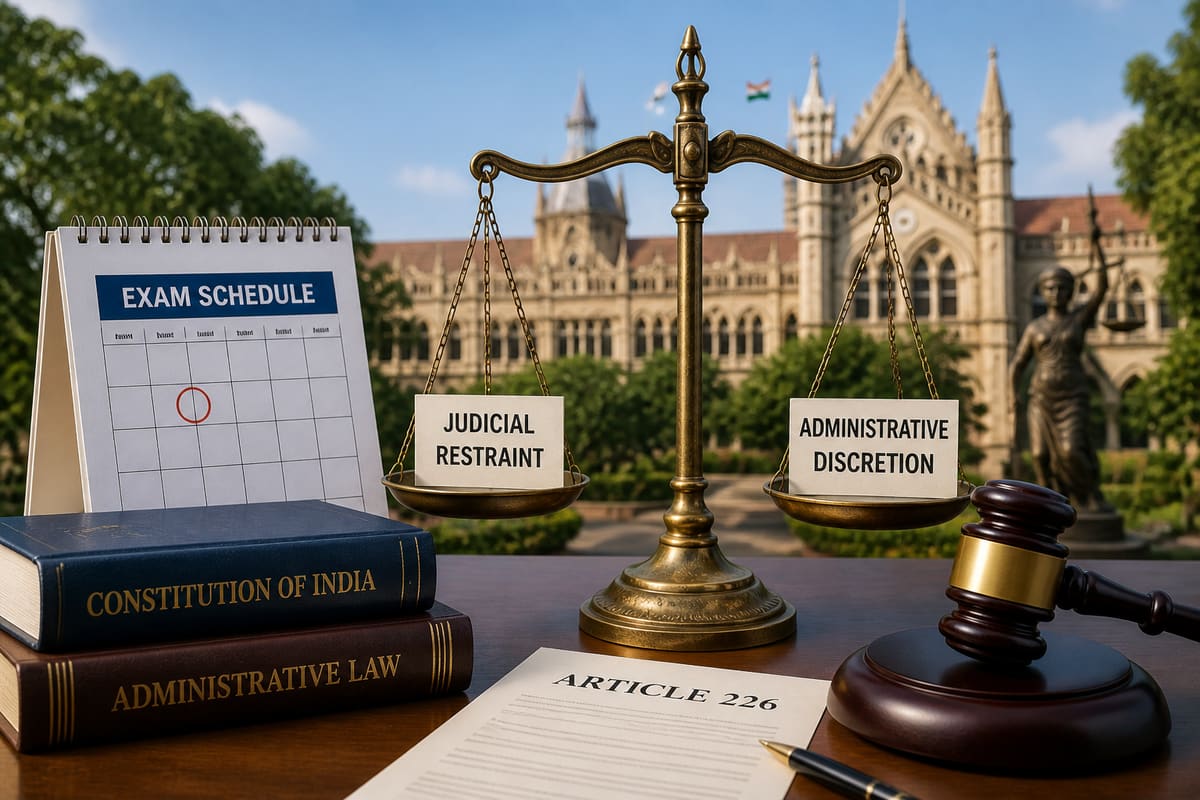
Article 226 | Judicial Restraint in Exam Scheduling: MP HC Upholds Administrative Discretion Over Reasonable Gap Challenge
Case Law Analysis
|Madhya Pradesh High Court

Article 226 | Judicial Restraint in Exam Scheduling: MP HC Upholds Administrative Discretion Over Reasonable Gap Challenge

The Madhya Pradesh High Court dismissed a writ petition challenging the scheduling of the Sub-Inspector Mains Exam merely two days after the MPPSC Prelims, reaffirming that courts will not interfere with administrative discretion in recruitment timelines unless arbitrary. The ruling underscores the limited scope of judicial review under Article 226 for logistical scheduling disputes.

Limitation Bar on Mutation Challenges | Revenue Courts Cannot Adjudicate Title Disputes After 30 Years: MP HC Gwalior
Case Law Analysis
|Madhya Pradesh High Court

Limitation Bar on Mutation Challenges | Revenue Courts Cannot Adjudicate Title Disputes After 30 Years: MP HC Gwalior

MP High Court rules that challenges to mutation entries after 30+ years are barred by limitation, reinforcing that revenue courts lack jurisdiction to determine title disputes. The ruling preserves civil court remedies while emphasizing the finality of long-standing revenue records, impacting landowners and legal heirs contesting decades-old mutations.