Madhya Pradesh High Court judgments

1273 Madhya Pradesh High Court judgments explained in plain English: what was decided, the law applied and why it matters. Page 21 of 54.

Section 41-A MP Municipalities Act | Only State Government Can Remove Nagar Parishad President: MP HC Stays Collector’s Action
Case Law Analysis
|Madhya Pradesh High Court

Section 41-A MP Municipalities Act | Only State Government Can Remove Nagar Parishad President: MP HC Stays Collector’s Action

Madhya Pradesh High Court ruled that under Section 41-A of the MP Municipalities Act, 1961, the power to remove a Nagar Parishad President rests exclusively with the State Government, not the Collector. The court stayed proceedings initiated by the Collector, emphasizing jurisdictional overreach and violation of statutory authority.


Section 528 BNSS | Right to Lead Evidence in Maintenance Cases Cannot Be Terminated Without Hearing: MP HC Indore
Case Law Analysis
|Madhya Pradesh High Court

Section 528 BNSS | Right to Lead Evidence in Maintenance Cases Cannot Be Terminated Without Hearing: MP HC Indore

The Madhya Pradesh High Court has ruled that Family Courts cannot shut down a petitioner’s right to present evidence in maintenance proceedings merely for non-appearance, without verifying legitimate hardship or offering a meaningful opportunity to be heard. This reinforces natural justice under BNSS and protects vulnerable litigants from summary dismissal in long-pending family disputes.

BNSS Section 483 | Consent and Adult Agency Override Presumption of Guilt in Obscene Content Bail : MP HC Jabalpur
Case Law Analysis
|Madhya Pradesh High Court

BNSS Section 483 | Consent and Adult Agency Override Presumption of Guilt in Obscene Content Bail : MP HC Jabalpur

MP High Court grants bail in a case involving sharing of intimate photographs, holding that consent and adult agency negate automatic denial of bail under Bharatiya Nagarik Suraksha Sanhita. The ruling emphasizes that pre-trial detention is unjustified where the prosecutrix was a consenting party, reinforcing bail as a rule under Article 21.

Section 5 Limitation Act | Appellate Court Must Offer Condonation Opportunity Even If No Application Filed : MP HC Gwalior
Case Law Analysis
|Madhya Pradesh High Court

Section 5 Limitation Act | Appellate Court Must Offer Condonation Opportunity Even If No Application Filed : MP HC Gwalior

MP High Court rules that appellate courts must proactively afford parties a chance to file condonation applications for delayed appeals, even if none was initially submitted. The decision reinforces procedural fairness by mandating courts to not dismiss appeals on limitation grounds without this opportunity, impacting civil litigation strategy and appellate practice.

Service Law | Erroneous Pay Fixation Recovery from Retiral Dues of Class-III Employees Impermissible : MP HC Mandates Refund with 6% Interest
Case Law Analysis
|Madhya Pradesh High Court

Service Law | Erroneous Pay Fixation Recovery from Retiral Dues of Class-III Employees Impermissible : MP HC Mandates Refund with 6% Interest

MP High Court rules that recovery of erroneous pay fixation from retiral benefits of Class-III employees violates service law principles, directing refund of Rs. 1.27 lakh with 6% interest. The judgment reaffirms that indemnity bonds or consent letters cannot override judicial precedents protecting lower-tier employees from administrative errors.

EPFO Enhanced Pension Cut-off Date | Pre-1.9.2014 Retirees Ineligible but Entitled to Refund of Voluntary Deposits : MP HC
|Madhya Pradesh High Court

EPFO Enhanced Pension Cut-off Date | Pre-1.9.2014 Retirees Ineligible but Entitled to Refund of Voluntary Deposits : MP HC

The Madhya Pradesh High Court ruled that pensioners retiring before 1 September 2014 are ineligible for EPFO’s enhanced pension under the Sunil Kumar B. precedent, but must be refunded voluntary deposits made in reliance on earlier EPFO communications. The judgment underscores equitable estoppel, mandating restitution for pensioners who acted on official representations.

Section 483 BNSS | Bail Granted Despite Rs. 2.27 Crore Cyber Fraud Allegations: MP HC Emphasizes Socio-Economic Factors Over Gravity of Offence
Case Law Analysis
|Madhya Pradesh High Court

Section 483 BNSS | Bail Granted Despite Rs. 2.27 Crore Cyber Fraud Allegations: MP HC Emphasizes Socio-Economic Factors Over Gravity of Offence

MP High Court grants bail to a 21-year-old student accused of facilitating mule accounts in a Rs. 2.27 crore cyber fraud, holding that socio-economic circumstances, absence of criminal antecedents, and non-beneficiary role outweigh the gravity of the offence. The ruling underscores that prolonged pre-trial detention without custodial interrogation necessity cannot be justified solely on the scale of financial loss.

Section 129 MP Land Revenue Code | Government-Allotted Land Transfer Without Collector's Permission Void Ab Initio : MPHC Gwalior
Case Law Analysis
|Madhya Pradesh High Court

Section 129 MP Land Revenue Code | Government-Allotted Land Transfer Without Collector's Permission Void Ab Initio : MPHC Gwalior

MP High Court rules that any transfer of government-allotted land without prior Collector approval under Section 129 of the MP Land Revenue Code is null and void from the outset, even if registered or mutated. The judgment reinforces statutory safeguards against unauthorized alienation of state-granted land, impacting allottees, purchasers, and revenue authorities.

Procedural Flexibility in Custody Disputes | Court Must Consider Alternative Provisions Under Guardians and Wards Act : MP HC Gwalior
|Madhya Pradesh High Court

Procedural Flexibility in Custody Disputes | Court Must Consider Alternative Provisions Under Guardians and Wards Act : MP HC Gwalior

MP High Court rules that courts cannot dismiss custody applications merely on technical grounds like misfiled provisions. Instead, they must examine if relief can be granted under alternative sections of the Guardians and Wards Act to uphold the child's best interests, setting a precedent for procedural fairness in family law matters.

Section 127 CrPC | Cost of Living Increase Alone Justifies Maintenance Enhancement Without Proving Husband’s Income : MP HC Indore
Case Law Analysis
|Madhya Pradesh High Court

Section 127 CrPC | Cost of Living Increase Alone Justifies Maintenance Enhancement Without Proving Husband’s Income : MP HC Indore

The Madhya Pradesh High Court ruled that a wife need not prove her husband’s income to secure maintenance enhancement under Section 127 CrPC - rising cost of living since the original order is sufficient grounds. This shifts the burden away from the economically vulnerable spouse and affirms that maintenance must keep pace with inflation, setting a precedent for low-income women across India seeking fair support.

Order 22 Rule 5 CPC | Appellate Courts Must Adjudicate Legal Representative Status When Will Is Alleged, Not Just Class I Heirs : MP HC Jabalpur
Case Law Analysis
|Madhya Pradesh High Court

Order 22 Rule 5 CPC | Appellate Courts Must Adjudicate Legal Representative Status When Will Is Alleged, Not Just Class I Heirs : MP HC Jabalpur

When a will is invoked in a pending appeal, appellate courts cannot limit their inquiry to Class I legal heirs under succession law - they are obligated under Order 22 Rule 5 CPC to examine and determine the validity of testamentary claims before deciding who may be impleaded. This ruling ensures that testamentary beneficiaries are not arbitrarily excluded from litigation merely because they are not direct heirs, safeguarding the integrity of probate claims in civil appeals.

Constitution (Scheduled Tribes) Order, 1950 Entry 16 | Mogia Community Recognized as ST; Mechanical Denial of Certificate Quashed : MP HC Gwalior
Case Law Analysis
|Madhya Pradesh High Court

Constitution (Scheduled Tribes) Order, 1950 Entry 16 | Mogia Community Recognized as ST; Mechanical Denial of Certificate Quashed : MP HC Gwalior

The Madhya Pradesh High Court has affirmed that the Mogia community is constitutionally recognized as a Scheduled Tribe under Entry 16 of the 1950 Order, striking down administrative denials of caste certificates as legally unsustainable. This ruling reinforces binding precedent and protects the rights of thousands of Mogia families seeking affirmative action benefits under India’s constitutional framework.

NSA Section 3 | Mandatory Detention Period Specification in Initial Order: MP HC Voids Detention for Procedural Non-Compliance
Case Law Analysis
|Madhya Pradesh High Court

NSA Section 3 | Mandatory Detention Period Specification in Initial Order: MP HC Voids Detention for Procedural Non-Compliance

Madhya Pradesh High Court rules that an initial detention order under the National Security Act must explicitly specify the detention period to be valid. Failure to comply renders the order void ab initio, setting aside both the detention and subsequent extension orders. The judgment reinforces procedural safeguards against arbitrary detention, impacting all NSA detentions in the state.

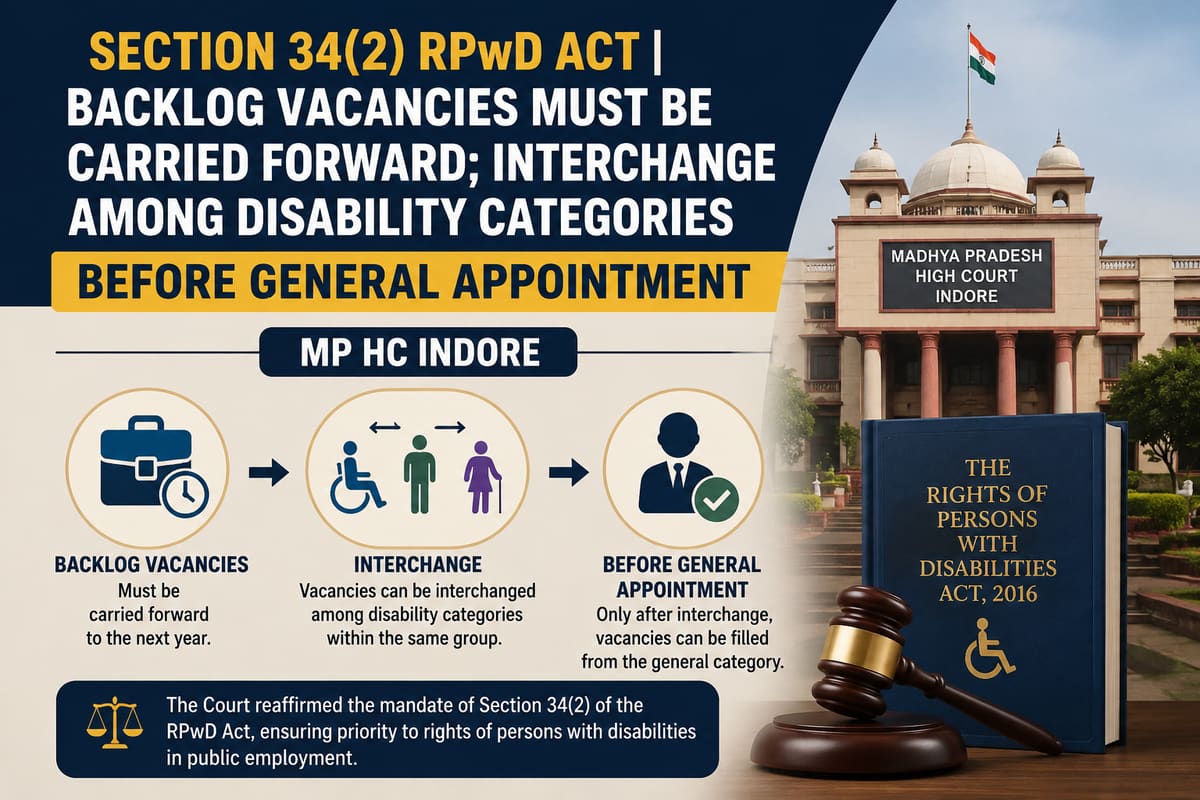
Section 34(2) RPwD Act | Backlog Vacancies Must Be Carried Forward; Interchange Among Disability Categories Before General Appointment : MP HC Indore
Case Law Analysis
|Madhya Pradesh High Court

Section 34(2) RPwD Act | Backlog Vacancies Must Be Carried Forward; Interchange Among Disability Categories Before General Appointment : MP HC Indore

Madhya Pradesh High Court reinforces that unfilled vacancies for persons with benchmark disabilities under Section 34(2) of the RPwD Act must be carried forward to succeeding recruitment years. If no suitable candidate is found, interchange among the five disability categories is mandatory before appointing a non-disabled person. The ruling ensures statutory compliance with reservation provisions and protects employment rights of disabled candidates.

Section 13-B(2) HMA | 23-Month Separation with No Reconciliation Prospects Justifies Cooling-Off Period Waiver : MP HC
Case Law Analysis
|Madhya Pradesh High Court

Section 13-B(2) HMA | 23-Month Separation with No Reconciliation Prospects Justifies Cooling-Off Period Waiver : MP HC

MP High Court holds that a mandatory 6-month cooling-off period under Section 13-B(2) of the Hindu Marriage Act can be waived where parties have lived apart for 23 months with no cohabitation, no children, and mutual consent. The ruling emphasizes judicial discretion in cases of irretrievably broken marriages, setting a precedent for expedited divorce proceedings in similar fact-patterns.

Section 168 MV Act | Minimum Wages Act Mandatory for Income Assessment in Absence of Proof : MP HC Gwalior Enhances Compensation Under Pranay Sethi Framework
Case Law Analysis
|Madhya Pradesh High Court

Section 168 MV Act | Minimum Wages Act Mandatory for Income Assessment in Absence of Proof : MP HC Gwalior Enhances Compensation Under Pranay Sethi Framework

MP High Court rules that in motor accident compensation cases, the deceased's income must be assessed at minimum wage rates under the Minimum Wages Act when no documentary proof is available. The court enhanced compensation by applying the Pranay Sethi framework, mandating Rs. 40,000 consortium per survivor and 40% future prospects for dependents.

RTI Act Section 19(3) | Second Appeal Must Be Decided Within Statutory Timeline; MP HC Directs Expedited Disposal : MPHC Gwalior
Case Law Analysis
|Madhya Pradesh High Court

RTI Act Section 19(3) | Second Appeal Must Be Decided Within Statutory Timeline; MP HC Directs Expedited Disposal : MPHC Gwalior

Madhya Pradesh High Court reinforces that second appeals under the RTI Act must be decided within the prescribed statutory timeline, directing the appellate authority to dispose of the pending appeal within two weeks. The ruling underscores that writ jurisdiction cannot be invoked for factual disputes where statutory remedies remain available, ensuring compliance with the RTI Act’s mandate for timely information access.