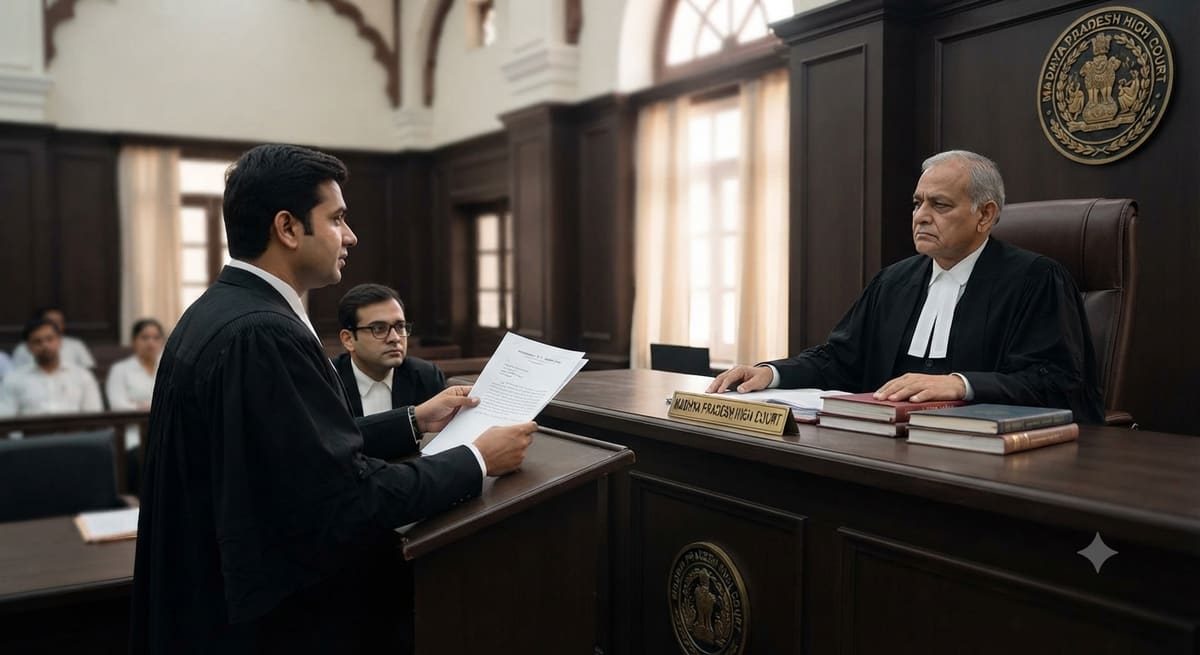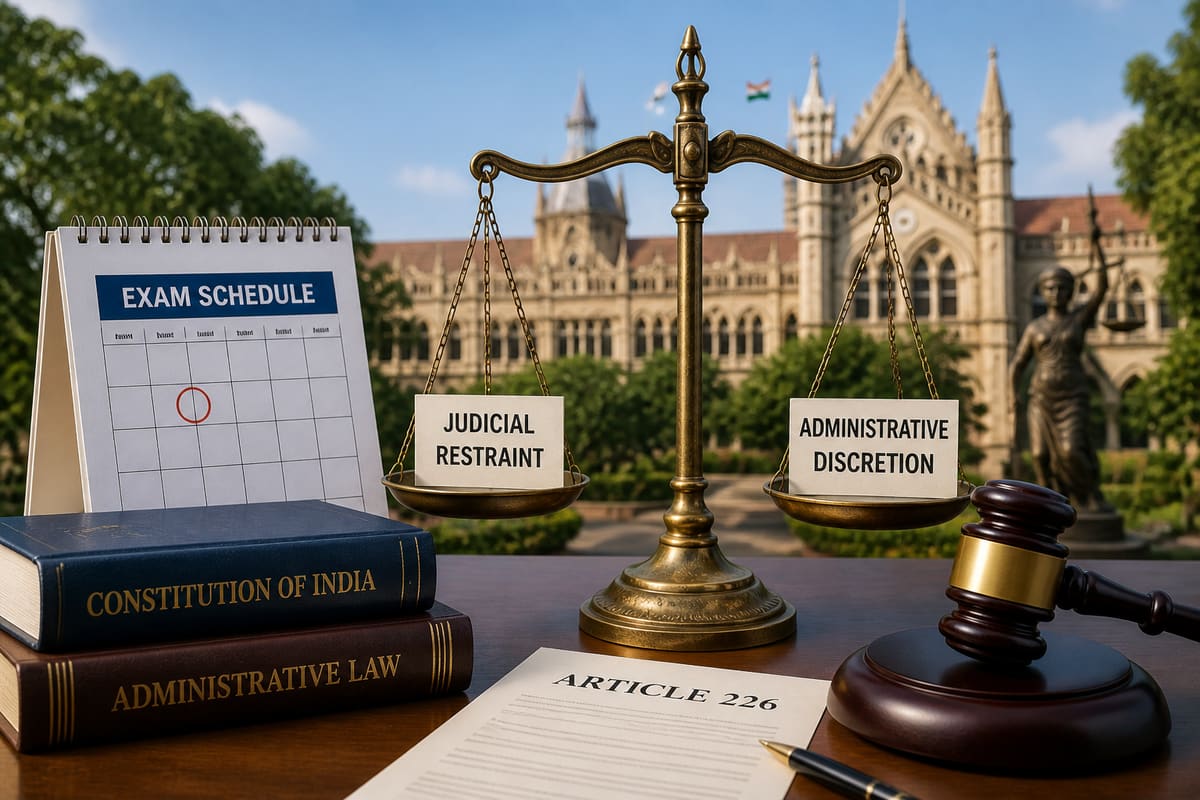
The Madhya Pradesh High Court has reaffirmed the principle of judicial restraint in matters of administrative discretion, dismissing a writ petition that sought postponement of the Sub-Inspector Mains Examination scheduled merely two days after the MPPSC Preliminary Examination. The Court held that courts must avoid interfering with examination schedules determined by expert bodies, emphasizing that personal inconvenience does not constitute a violation of statutory or constitutional rights.
Background & Facts
The Dispute
The petitioners, aspirants for public employment in Madhya Pradesh, challenged the scheduling of the Sub-Inspector Cadre Recruitment Mains Examination, 2025, on 29.04.2026, which coincided with the MPPSC Preliminary Examination scheduled on 26.04.2026. The petitioners contended that the two-day gap between the examinations was arbitrary and unreasonable, depriving them of a fair opportunity to prepare and travel between examination centres.
Key Facts
The MPPSC issued its examination calendar on 31.12.2025, scheduling the Preliminary Examination on 26.04.2026
The petitioners applied for the MPPSC Preliminary Examination and submitted online applications
The Sub-Inspector/Subedar Recruitment Examination (first phase/online examination) was conducted between 16.01.2026 to 21.01.2026, with results declared on 12.03.2026
The petitioners qualified the preliminary stage and became eligible for the Mains Examination
The respondents issued a notification scheduling the Mains Examination on 29.04.2026
The petitioners submitted a combined representation requesting postponement, but no action was taken
The petitioners filed the present writ petition under Article 226 of the Constitution of India, seeking rescheduling of the Mains Examination
Procedural History
31.12.2025: MPPSC examination calendar issued
16.01.2026 to 21.01.2026: Sub-Inspector Recruitment Examination (first phase) conducted
12.03.2026: Results of the first phase declared
29.04.2026: Sub-Inspector Mains Examination scheduled
26.04.2026: MPPSC Preliminary Examination scheduled
Prior to 18.04.2026: Petitioners submitted representation for postponement
18.04.2026: Writ Petition (WP No. 13534/2026) reserved for orders
29.04.2026: Judgment delivered, dismissing the writ petition
Relief Sought
The petitioners sought:
Issuance of an appropriate writ or direction to postpone or reschedule the Sub-Inspector Mains Examination
A reasonable time gap between the MPPSC Preliminary Examination and the Sub-Inspector Mains Examination
Imposition of costs and any other appropriate relief
The Legal Issue
The central question before the Court was whether the scheduling of the Sub-Inspector Mains Examination on 29.04.2026, merely two days after the MPPSC Preliminary Examination on 26.04.2026, constituted an arbitrary exercise of administrative discretion warranting judicial intervention under Article 226 of the Constitution of India.
Arguments Presented
For the Petitioners
The impugned schedule was arbitrary and unreasonable, as it failed to consider the MPPSC examination calendar
The two-day gap between examinations prevented adequate preparation, travel, and recovery from mental stress and physical fatigue
A large number of candidates appearing in both examinations faced foreseeable hardship due to overlapping schedules
The respondents failed to act in a fair and reasonable manner while exercising administrative discretion
The extensive syllabus, negative marking, and the eight-year gap since the last examination demanded adequate preparation time
For the Respondents
The Court possesses extremely limited jurisdiction to interfere in administrative decisions and schedules fixed by examining bodies
The administrative machinery for the examination had already been mobilized, with admit cards issued or in the process of being issued
Rescheduling at this advanced stage would result in severe misuse of public funds and administrative chaos
A two-day gap was sufficient for candidates to travel between centres and manage logistics
The impugned scheduling did not violate any statutory law or fundamental rights of the petitioners
The Court's Analysis
The Court began by outlining the contours of judicial review under Article 226 in matters pertaining to academic or recruitment examinations. Relying on the landmark judgment in Maharashtra State Board of Secondary and Higher Secondary Education v. Paritosh Bhupeshkumar Sheth, the Court emphasized the need for judicial restraint:
"29. Far from advancing public interest and fair play to the other candidates in general, any such interpretation of the legal position would be wholly defeasive of the same. As has been repeatedly pointed out by this Court, the Court should be extremely reluctant to substitute its own views as to what is wise, prudent and proper in relation to academic matters in preference to those formulated by professional men possessing technical expertise and rich experience of actual day-to-day working of educational institutions and the departments controlling them. It will be wholly wrong for the Court to make a pedantic and purely idealistic approach to the problems of this nature, isolated from the actual realities and grass root problems involved in the working of the system and unmindful of the consequences which would emanate if a purely idealistic view as opposed to a pragmatic one were to be propounded. It is equally important that the Court should also, as far as possible, avoid any decision or interpretation of a statutory provision, rule or bye-law which would bring about the result of rendering the system unworkable in practice."
Applying these principles, the Court noted that the administrative process was at its final stage, with admit cards issued or being issued and examination centres allotted. Rescheduling the examination at this stage would derail the entire process and lead to substantial misuse of public funds.
The Court further observed that the respondents' submission regarding the sufficiency of a two-day gap for travel and logistical arrangements was reasonable. Personal inconvenience or anxiety of a few candidates could not dictate the public employment calendar. The Court reiterated that for a writ of mandamus to be issued, the petitioners must demonstrate a clear breach of a statutory or constitutional right. The right to participate in an examination is governed strictly by the rules of the examining body, and the scheduling of two distinct examinations with a two-day gap did not constitute any violation of law or fundamental rights.
The Verdict
The Court dismissed the writ petition, holding that:
The impugned scheduling of the Sub-Inspector Mains Examination did not constitute arbitrariness or jurisdictional error
The petitioners were not entitled to the reliefs claimed
No costs were awarded
Pending applications, if any, were disposed of accordingly
What This Means For Similar Cases
Judicial Restraint in Administrative Discretion
Courts will exercise immense restraint in interfering with schedules and policies determined by examining bodies, recognizing their administrative expertise
Article 226 petitions challenging examination schedules must demonstrate a clear breach of statutory or constitutional rights, not merely personal inconvenience
The principle of judicial deference to administrative decisions is firmly established, particularly in matters involving recruitment and academic examinations
Practical Considerations for Litigants
Timing of Representations: Litigants must submit representations well in advance of the finalization of administrative processes, such as the issuance of admit cards or allotment of examination centres
Evidence of Arbitrariness: To succeed in a challenge under Article 226, petitioners must provide concrete evidence of arbitrariness, unreasonableness, or violation of fundamental rights, beyond mere hardship or inconvenience
Public Interest vs. Individual Hardship: Courts will balance individual hardship against the public interest and the potential for administrative chaos, often favoring the latter in cases of late-stage rescheduling requests