Income Tax Appellate Tribunal judgments

893 Income Tax Appellate Tribunal judgments explained in plain English: what was decided, the law applied and why it matters. Page 6 of 38.

Section 145(3) IT Act | Statistical Deviations Alone Cannot Justify Rejection of Audited Books : ITAT Jaipur
Case Law Analysis
|Income Tax Appellate Tribunal

Section 145(3) IT Act | Statistical Deviations Alone Cannot Justify Rejection of Audited Books : ITAT Jaipur

The ITAT Jaipur deleted a Rs. 40.82 lakh addition for unexplained cash deposits, ruling that mere deviations in cash sales or bank deposits-even amid demonetization-are insufficient to reject duly audited books of accounts. This reinforces that tax authorities must identify specific, material defects in accounting records, not rely on speculative patterns, protecting compliant businesses from arbitrary assessments.


Section 153C Income Tax Act | Assessment Invalid Without Incriminating Material Belonging to Assessee Found During Third-Party Search : ITAT Delhi
Case Law Analysis
|Income Tax Appellate Tribunal

Section 153C Income Tax Act | Assessment Invalid Without Incriminating Material Belonging to Assessee Found During Third-Party Search : ITAT Delhi

The ITAT Delhi has ruled that an assessment under Section 153C cannot stand unless incriminating material directly belonging to the assessee is discovered during a search of a third party. This clarifies a critical jurisdictional limit on the tax department’s power to reassess unrelated taxpayers, reinforcing natural justice and statutory compliance in income tax proceedings.

Section 147 Income Tax Act | Reassessment Invalid Without Recorded Reasons & Section 151 Approval: ITAT Delhi Reduces Addition from Rs. 35 Lakh to Rs. 3 Lakh
Case Law Analysis
|Income Tax Appellate Tribunal

Section 147 Income Tax Act | Reassessment Invalid Without Recorded Reasons & Section 151 Approval: ITAT Delhi Reduces Addition from Rs. 35 Lakh to Rs. 3 Lakh

The ITAT Delhi set aside a Rs. 35 lakh addition for unexplained cash deposits during demonetization because the reassessment under Section 147 lacked mandatory reasons and failed to secure prior approval under Section 151. Only Rs. 3 lakh was upheld after scrutiny, reinforcing that procedural compliance is non-negotiable in reassessments - a critical safeguard for taxpayers facing post-demonetization scrutiny.

Section 263 IT Act | Limitation Period for Revisionary Powers Runs from Original Assessment, Not Reassessment Order : ITAT Delhi
Case Law Analysis
|Income Tax Appellate Tribunal

Section 263 IT Act | Limitation Period for Revisionary Powers Runs from Original Assessment, Not Reassessment Order : ITAT Delhi

The ITAT Delhi holds that the two-year limitation under Section 263 begins from the date of the original assessment order, not the subsequent reassessment, when the revision challenges errors inherent in the initial assessment. This clarifies a critical procedural trap for tax authorities and protects assessees from delayed revisionary attacks on stale assessments, directly impacting how revenue departments strategize revisionary proceedings.

Section 48 Income Tax Act | Registered Valuer’s Report Must Prevail Over Arbitrary AO Valuation for Indexed Cost of Acquisition : ITAT Delhi
Case Law Analysis
|Income Tax Appellate Tribunal

Section 48 Income Tax Act | Registered Valuer’s Report Must Prevail Over Arbitrary AO Valuation for Indexed Cost of Acquisition : ITAT Delhi

The ITAT Delhi has held that an Assessing Officer cannot substitute a registered valuer’s report with an arbitrary, unsupported methodology to compute indexed cost of acquisition under Section 48. This reinforces the legal primacy of expert valuation in capital gains assessments and protects taxpayers from speculative adjustments by revenue authorities.

Section 144C(13) IT Act | Strict One-Month Limit for Final Assessment Order Mandatory: ITAT Delhi Quashes Time-Barred Order
Case Law Analysis
|Income Tax Appellate Tribunal

Section 144C(13) IT Act | Strict One-Month Limit for Final Assessment Order Mandatory: ITAT Delhi Quashes Time-Barred Order

ITAT Delhi ruled that the final assessment order under Section 144C(13) of the Income Tax Act must be passed within one month of receiving DRP directions, failing which it is barred by limitation. The decision reinforces procedural compliance in transfer pricing assessments, impacting taxpayers and revenue authorities alike.

Section 272A(1)(d) IT Act | Reasonable Cause Exempts Penalty for Non-Compliance with Notices : ITAT Lucknow
Case Law Analysis
|Income Tax Appellate Tribunal

Section 272A(1)(d) IT Act | Reasonable Cause Exempts Penalty for Non-Compliance with Notices : ITAT Lucknow

ITAT Lucknow sets aside a ₹40,000 penalty under Section 272A(1)(d) after finding the assessee had valid grounds for failing to comply with notices under Sections 142(1) and 143(2). The ruling reinforces that penalties cannot be sustained without disproving the assessee’s reasonable cause defence, offering relief to taxpayers facing procedural non-compliance.

Section 154 IT Act | Delay in Rectification Appeal Condonable If Merits Remain Unadjudicated: ITAT Ahmedabad
Case Law Analysis
|Income Tax Appellate Tribunal

Section 154 IT Act | Delay in Rectification Appeal Condonable If Merits Remain Unadjudicated: ITAT Ahmedabad

ITAT Ahmedabad condones a 485-day delay in appealing a rectification order under Section 154 of the Income Tax Act, holding that natural justice mandates de novo adjudication where the substantive merits of the case remain unresolved. The ruling underscores that procedural delays cannot bar substantive justice if broader tax issues (e.g., Section 56(2) additions) are still pending.

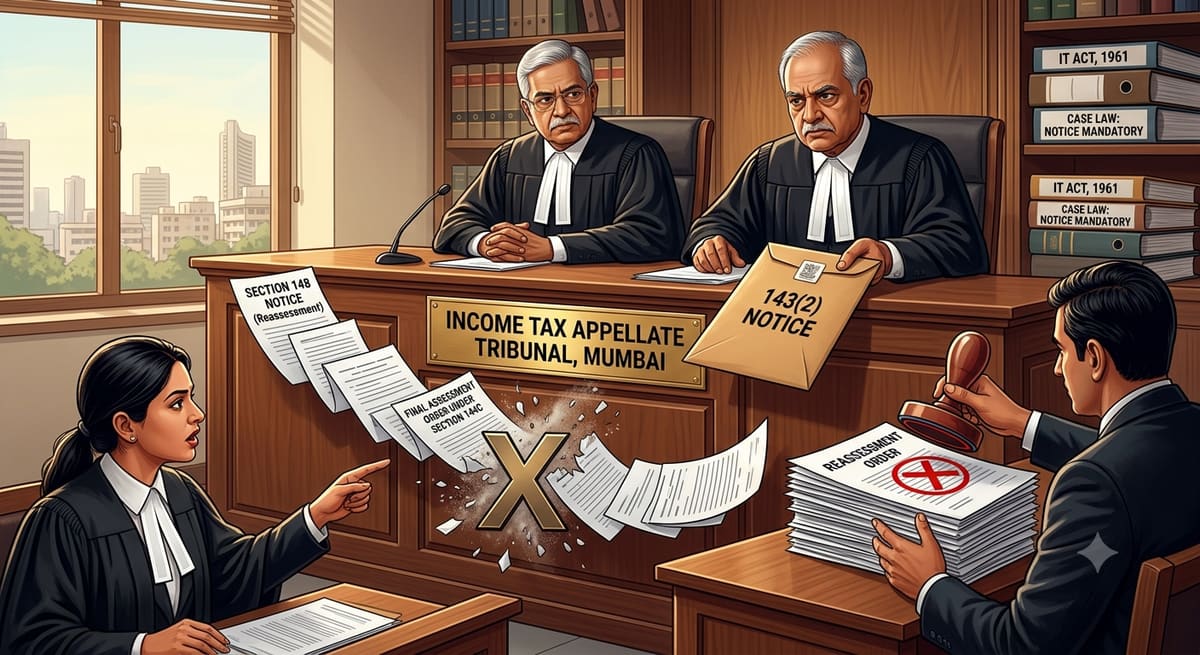
Section 143(2) Notice Mandatory for Reassessment | Non-Compliance Vitiates Assessment Under Section 144C : ITAT Mumbai
Case Law Analysis
|Income Tax Appellate Tribunal

Section 143(2) Notice Mandatory for Reassessment | Non-Compliance Vitiates Assessment Under Section 144C : ITAT Mumbai

ITAT Mumbai rules that failure to issue a mandatory notice under Section 143(2) during reassessment proceedings renders the entire assessment void ab initio. The tribunal held that issuing a demand notice alongside a draft assessment order under Section 144C without adhering to procedural safeguards constitutes a jurisdictional error, impacting all taxpayers undergoing reassessment.

Section 148A IT Act | Condonation of Delay & Reassessment Validity Require Independent Adjudication : ITAT Mumbai
Case Law Analysis
|Income Tax Appellate Tribunal

Section 148A IT Act | Condonation of Delay & Reassessment Validity Require Independent Adjudication : ITAT Mumbai

ITAT Mumbai rules that the Commissioner of Income-tax (Appeals) must independently adjudicate both the condonation of delay in filing appeals and the validity of reassessment proceedings under Section 148A of the Income Tax Act. The order sets aside the CIT(A)'s failure to apply this dual-test standard, restoring the appeal for fresh consideration and reinforcing procedural safeguards in tax disputes.

DTAA Supremacy Over Domestic Law | ITAT Mumbai Caps Dividend Distribution Tax at Treaty Rate Under Section 90(2) : ITAT
Case Law Analysis
|Income Tax Appellate Tribunal

DTAA Supremacy Over Domestic Law | ITAT Mumbai Caps Dividend Distribution Tax at Treaty Rate Under Section 90(2) : ITAT

ITAT Mumbai rules that Dividend Distribution Tax (DDT) under Section 115-O cannot exceed the lower rate prescribed in the India-Switzerland Double Taxation Avoidance Agreement (DTAA). The decision reinforces treaty supremacy under Section 90(2) of the Income Tax Act, directly impacting multinational corporations distributing dividends to foreign shareholders.

Section 9(1)(v)(c) IT Act | Interest from Nostro Accounts Not Taxable Under Mutuality Principle : ITAT Mumbai
Case Law Analysis
|Income Tax Appellate Tribunal

Section 9(1)(v)(c) IT Act | Interest from Nostro Accounts Not Taxable Under Mutuality Principle : ITAT Mumbai

ITAT Mumbai rules that interest earned by Indian branches of foreign banks from their head office or overseas branches is not taxable under Section 9(1)(v)(c) of the Income Tax Act, as it constitutes payment to self rather than income. The decision reinforces the mutuality principle, shielding such transactions from domestic tax liability for foreign banks operating in India.

Section 147 Income Tax Act | Reassessment Beyond 4 Years Void Without Fresh Tangible Material : ITAT Surat
Case Law Analysis
|Income Tax Appellate Tribunal

Section 147 Income Tax Act | Reassessment Beyond 4 Years Void Without Fresh Tangible Material : ITAT Surat

ITAT Surat holds that reassessment proceedings under Section 147 of the Income Tax Act beyond four years from the end of the assessment year are invalid unless new tangible material justifying escapement of income is discovered. The ruling quashes reassessment orders for AY 2011-12 and 2014-15, reinforcing the limitation period for tax authorities and protecting assessees from arbitrary reopening of cases.

Section 11(1)(c) IT Act | Scholarship Disbursed in India for Overseas Study Not 'Application Outside India' : ITAT Delhi Upholds Tax Exemption
Case Law Analysis
|Income Tax Appellate Tribunal

Section 11(1)(c) IT Act | Scholarship Disbursed in India for Overseas Study Not 'Application Outside India' : ITAT Delhi Upholds Tax Exemption

ITAT Delhi clarifies that scholarships disbursed in India for overseas education do not violate Section 11(1)(c) of the Income Tax Act, preserving tax exemption for charitable trusts. The ruling underscores that the 'application of income' test is met where funds are released domestically, even if utilized abroad, offering critical relief for educational trusts.

Section 5 Limitation Act | Liberal Interpretation of 'Sufficient Cause' Mandates Condonation of Delay in Tax Appeals : ITAT Pune
|Income Tax Appellate Tribunal

Section 5 Limitation Act | Liberal Interpretation of 'Sufficient Cause' Mandates Condonation of Delay in Tax Appeals : ITAT Pune

ITAT Pune rules that delays in filing tax appeals must be condoned if the assessee demonstrates a reasonable cause, emphasizing substantive justice over procedural technicalities. The Tribunal set aside an ex-parte order, directing lower authorities to reconsider the appeal on merits, reinforcing the liberal construction of 'sufficient cause' under Section 5 of the Limitation Act for income tax proceedings.

Section 282 Income Tax Act | ITBA Portal Upload Alone Does Not Constitute Valid Service of Assessment Order : ITAT Bangalore
Case Law Analysis
|Income Tax Appellate Tribunal

Section 282 Income Tax Act | ITBA Portal Upload Alone Does Not Constitute Valid Service of Assessment Order : ITAT Bangalore

ITAT Bangalore holds that mere uploading of an assessment order on the ITBA portal does not meet the service requirements under Section 282 of the Income Tax Act. The ruling mandates physical or legally recognized service for procedural compliance, impacting tax assessees and revenue authorities in appeal timelines and adjudication.

Section 153C ITA | Jurisdiction Triggered by Handover Date of Incriminating Material, Not Search Date: ITAT Delhi Sets Precedent
Case Law Analysis
|Income Tax Appellate Tribunal

Section 153C ITA | Jurisdiction Triggered by Handover Date of Incriminating Material, Not Search Date: ITAT Delhi Sets Precedent

ITAT Delhi rules that proceedings under Section 153C of the Income Tax Act are invalid if incriminating material is handed over after 01.04.2021, even if the search occurred earlier. This holding establishes that the jurisdictional trigger is the date of handover, not the search date, impacting all pending assessments under the repealed provision.

Section 115BBE IT Act | Recorded Cash Sales Taxable at 30%, Not 60%, If Not Falling Under Sections 68-69D: ITAT Delhi
Case Law Analysis
|Income Tax Appellate Tribunal

Section 115BBE IT Act | Recorded Cash Sales Taxable at 30%, Not 60%, If Not Falling Under Sections 68-69D: ITAT Delhi

ITAT Delhi clarifies that income from cash sales properly recorded in books and supported by invoices/GST returns cannot be taxed at the punitive 60% rate under Section 115BBE. The 30% tax rate applies unless the income falls under unexplained credits (Sections 68-69D), offering relief to businesses with documented cash transactions.