Income Tax Appellate Tribunal judgments

893 Income Tax Appellate Tribunal judgments explained in plain English: what was decided, the law applied and why it matters. Page 5 of 38.

Section 87A Rebate Applies to STCG Under Section 111A Even Under New Tax Regime: ITAT Pune
Case Law Analysis
|Income Tax Appellate Tribunal

Section 87A Rebate Applies to STCG Under Section 111A Even Under New Tax Regime: ITAT Pune

ITAT Pune holds that the rebate under Section 87A of the Income Tax Act extends to short-term capital gains (STCG) taxable under Section 111A, even for assessees opting for the new tax regime. The ruling overturns CPC's denial of the full rebate, reinforcing that tax rebates must be applied to all eligible income heads without arbitrary restrictions.


Section 271(1)(c) IT Act | Penalty Inapplicable on Ad-hoc Additions Even for Alleged Bogus Purchases: ITAT Surat
Case Law Analysis
|Income Tax Appellate Tribunal

Section 271(1)(c) IT Act | Penalty Inapplicable on Ad-hoc Additions Even for Alleged Bogus Purchases: ITAT Surat

ITAT Surat holds that penalties under Section 271(1)(c) of the Income Tax Act cannot be levied on ad-hoc or estimated additions, even in cases of alleged bogus purchases. The ruling reinforces that penalty provisions require concrete evidence of concealment, not mere presumptive additions, impacting tax assessments involving disputed transactions.

Section 80GGC | Cash-Back Political Donations Are Bogus Entries, Disallowing Deduction: ITAT Ahmedabad
Case Law Analysis
|Income Tax Appellate Tribunal

Section 80GGC | Cash-Back Political Donations Are Bogus Entries, Disallowing Deduction: ITAT Ahmedabad

The ITAT Ahmedabad has ruled that donations to political parties accompanied by cash-back arrangements constitute accommodation entries with no genuine economic substance, rendering them ineligible for tax deduction under Section 80GGC. This sets a critical precedent for the Income Tax Department to scrutinize politically linked donations and crack down on shell transactions disguised as electoral funding.

Section 271(1)(b) Penalty Deletion & Condonation of 578-Day Delay | ITAT Surat Rules NRI Residence Abroad as 'Sufficient Cause' for Non-Compliance : ITAT Surat
Case Law Analysis
|Income Tax Appellate Tribunal

Section 271(1)(b) Penalty Deletion & Condonation of 578-Day Delay | ITAT Surat Rules NRI Residence Abroad as 'Sufficient Cause' for Non-Compliance : ITAT Surat

ITAT Surat condoned a 578-day delay in appeal filing, holding that an assessee's residence abroad constitutes 'sufficient cause' for non-compliance with tax notices. The Tribunal deleted the penalty under Section 271(1)(b) and remanded the ex-parte assessment of NRE account credits, reinforcing leniency for NRIs in tax proceedings.

Natural Justice Mandate | ITAT Pune Quashes Assessment Order for Non-Disclosure of Third-Party Replies Under Section 133(6) IT Act : ITAT Pune
Case Law Analysis
|Income Tax Appellate Tribunal

Natural Justice Mandate | ITAT Pune Quashes Assessment Order for Non-Disclosure of Third-Party Replies Under Section 133(6) IT Act : ITAT Pune

ITAT Pune ruled that income tax assessments are vitiated if the Assessing Officer fails to provide the assessee with third-party replies obtained under Section 133(6) of the Income Tax Act, 1961. The Tribunal emphasized that non-disclosure violates principles of natural justice, setting aside the assessment order and reinforcing procedural fairness in tax proceedings.

Condonation of Delay | Reliance on Unverified RMS-NMS Data Constitutes Sufficient Cause Under Limitation Act: ITAT Pune
Case Law Analysis
|Income Tax Appellate Tribunal

Condonation of Delay | Reliance on Unverified RMS-NMS Data Constitutes Sufficient Cause Under Limitation Act: ITAT Pune

ITAT Pune condoned a 79-day delay in filing an income tax appeal, holding that reliance on unverified data from the RMS-NMS insight portal constitutes sufficient cause under the Limitation Act. This ruling empowers taxpayers who act in good faith based on flawed government-generated alerts, reinforcing procedural fairness over technical non-compliance.

Section 148 IT Act | Reassessment Notice Based on Unverified Insight Portal Data Invalid Without Independent Verification: ITAT Pune
Case Law Analysis
|Income Tax Appellate Tribunal

Section 148 IT Act | Reassessment Notice Based on Unverified Insight Portal Data Invalid Without Independent Verification: ITAT Pune

ITAT Pune holds that reassessment notices under Section 148 of the Income Tax Act, 1961, relying solely on unverified Insight Portal data without independent verification, are invalid. The ruling reinforces CBDT Circular compliance, mandating AO scrutiny beyond automated alerts to protect taxpayers from arbitrary proceedings.

Section 270A IT Act | Penalty for Misreporting Requires Cogent Evidence of False Particulars : ITAT Ahmedabad
Case Law Analysis
|Income Tax Appellate Tribunal

Section 270A IT Act | Penalty for Misreporting Requires Cogent Evidence of False Particulars : ITAT Ahmedabad

ITAT Ahmedabad sets a precedent that penalties under Section 270A for misreporting income cannot be imposed without concrete proof of false particulars or deliberate suppression, even if a deduction is disallowed. This ruling reinforces natural justice principles, protecting taxpayers from arbitrary penalties based solely on disallowed claims.

Section 69A IT Act | Mere Mobile Phone Estimates Without Corroborative Evidence Insufficient for Unexplained Investment Addition : ITAT Jaipur
Case Law Analysis
|Income Tax Appellate Tribunal

Section 69A IT Act | Mere Mobile Phone Estimates Without Corroborative Evidence Insufficient for Unexplained Investment Addition : ITAT Jaipur

ITAT Jaipur holds that rough estimates of jewellery purchases found on a mobile phone, without proof of actual transactions or physical possession, cannot justify additions under Section 69A of the Income Tax Act. The ruling reinforces strict evidentiary standards for unexplained investments, protecting assessees from double taxation based on loose notings.

Section 80P(2)(a)(i) | Co-operative Societies Entitled to Deduction on Interest Income from Member Loans : ITAT Pune
Case Law Analysis
|Income Tax Appellate Tribunal

Section 80P(2)(a)(i) | Co-operative Societies Entitled to Deduction on Interest Income from Member Loans : ITAT Pune

ITAT Pune reaffirms that co-operative societies engaged in providing credit facilities exclusively to members are eligible for deduction under Section 80P(2)(a)(i) on interest income, distinguishing the Totgars precedent. The ruling reinforces binding judicial consistency for salary earners' credit societies, impacting tax liability calculations for similar entities.

Section 37 IT Act | Margin Penalties for Commodity Trading Shortfalls Are Compensatory, Not Prohibited Expenditure : ITAT Jaipur
Case Law Analysis
|Income Tax Appellate Tribunal

Section 37 IT Act | Margin Penalties for Commodity Trading Shortfalls Are Compensatory, Not Prohibited Expenditure : ITAT Jaipur

ITAT Jaipur holds that margin penalties levied by NCDEX for shortfalls in commodity trading are compensatory in nature and not prohibited under Section 37 of the Income Tax Act. The ruling deletes the 10% ad hoc disallowance under Section 36(1)(iii), setting a precedent for the tax treatment of such penalties in business expenditure claims.

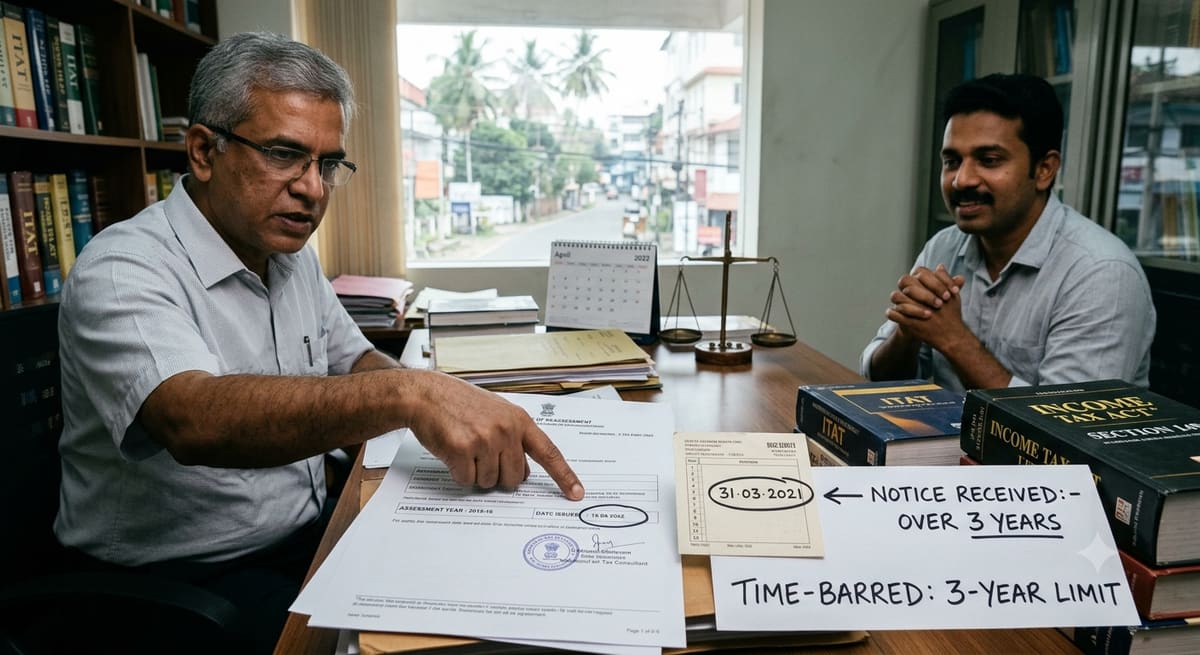
Section 149(1) First Proviso | Reassessment Notice Issued After 31.03.2022 for AY 2015-16 Barred by 3-Year Limit: ITAT Cochin
Case Law Analysis
|Income Tax Appellate Tribunal

Section 149(1) First Proviso | Reassessment Notice Issued After 31.03.2022 for AY 2015-16 Barred by 3-Year Limit: ITAT Cochin

ITAT Cochin has ruled that a reassessment notice issued on 06.05.2022 for AY 2015-16 is time-barred because the income escaped assessment did not exceed ₹50 lakh, triggering the three-year limitation under Section 149(1). This reinforces that post-2022 notices for pre-2019 assessments cannot be revived unless the monetary threshold is crossed, protecting taxpayers from arbitrary reopening.

Section 35(1)(ii) IT Act | Weighted Deduction for Scientific Research Permitted Against Other Heads of Income When Business Income Is Insufficient : ITAT Kolkata
Case Law Analysis
|Income Tax Appellate Tribunal

Section 35(1)(ii) IT Act | Weighted Deduction for Scientific Research Permitted Against Other Heads of Income When Business Income Is Insufficient : ITAT Kolkata

The ITAT Kolkata has ruled that a taxpayer claiming weighted deduction under Section 35(1)(ii) for scientific research may offset the full Rs. 1.57 crore claim against income from other sources if business income is inadequate to absorb the deduction. This clarifies that the deduction is not capped by business profits, significantly benefiting R&D investors with diversified income streams and aligning with the legislative intent to incentivize innovation.

Section 271AAC(1) & 272A(1)(d) NI Act | Penalty Invalid If Underlying Unexplained Income Addition Is Deleted on Appeal : ITAT Jaipur
Case Law Analysis
|Income Tax Appellate Tribunal

Section 271AAC(1) & 272A(1)(d) NI Act | Penalty Invalid If Underlying Unexplained Income Addition Is Deleted on Appeal : ITAT Jaipur

When an appellate authority deletes an addition of unexplained income under Section 69A, penalties imposed under Sections 271AAC(1) and 272A(1)(d) automatically lapse - the penalty cannot stand without its foundational tax liability. This ruling protects cooperative societies and other assessees from punitive measures rooted in nullified assessments, reinforcing that penalties are consequential, not independent, under the Income Tax Act.

Section 11 Income Tax Act | Exemption Denial Limited to Diverted Amounts Only - No Full Disallowance for Transactions with Specified Concerns : ITAT Delhi
Case Law Analysis
|Income Tax Appellate Tribunal

Section 11 Income Tax Act | Exemption Denial Limited to Diverted Amounts Only - No Full Disallowance for Transactions with Specified Concerns : ITAT Delhi

The ITAT Delhi has ruled that a charitable trust’s exemption under Section 11 cannot be entirely revoked merely due to transactions with specified concerns; the disallowance must be confined strictly to the actual diverted funds. This clarifies a critical safeguard for trusts, ensuring proportionality in tax scrutiny and preventing punitive overreach under Section 13.

Section 249(3) Income Tax Act | 175-Day Delay in Appeal Condoned on Substantial Justice Over Technicality : ITAT Delhi
Case Law Analysis
|Income Tax Appellate Tribunal

Section 249(3) Income Tax Act | 175-Day Delay in Appeal Condoned on Substantial Justice Over Technicality : ITAT Delhi

ITAT Delhi has ruled that a 175-day delay in filing an income tax appeal must be condoned when the delay stems from genuine hardship, affirming that procedural rigidity cannot override the core principle of substantial justice. This reinforces that appellate authorities must interpret condonation provisions liberally to ensure access to justice for taxpayers, especially where no prejudice is shown to the revenue.

Section 80P(2)(d) IT Act | Interest from Cooperative Banks Eligible for Deduction by Primary Credit Societies : ITAT Pune
Case Law Analysis
|Income Tax Appellate Tribunal

Section 80P(2)(d) IT Act | Interest from Cooperative Banks Eligible for Deduction by Primary Credit Societies : ITAT Pune

Primary credit cooperative societies can claim tax deductions under Section 80P(2)(d) for interest earned on deposits with other cooperative banks, affirming that such income qualifies as business income derived from cooperative activities. This ruling reinforces the scope of cooperative-specific tax benefits and provides clarity for thousands of rural financial institutions across India.