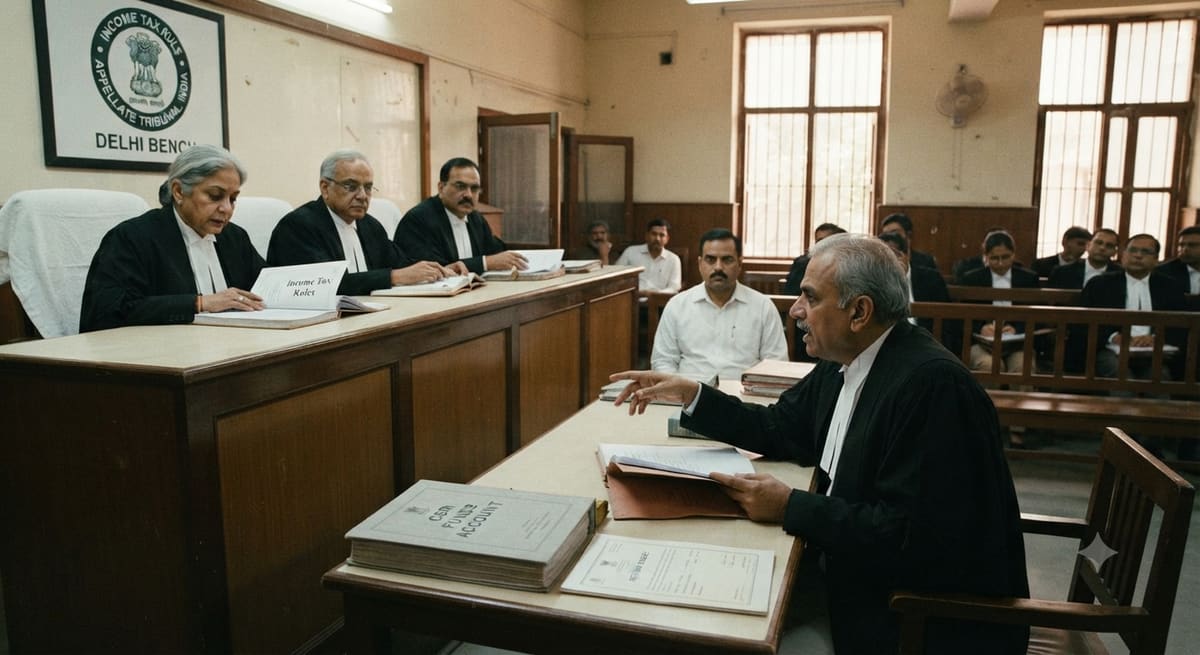
The Income Tax Appellate Tribunal, Delhi, has clarified a critical ambiguity in charitable trust taxation by holding that disbursing scholarships within India to students for overseas education does not constitute application of income outside India under Section 11(1)(c) of the Income Tax Act. This ruling affirms the legitimacy of India-based charitable trusts supporting global academic pursuits without forfeiting tax exemptions.
Background & Facts
The Dispute
The appellant, Oxford and Cambridge Society of India (OCSI), is a registered society since 1982, established to promote merit-based scholarships for Indian students pursuing postgraduate studies at the University of Oxford or the University of Cambridge in the United Kingdom. The Society receives voluntary contributions from alumni and maintains a dedicated scholarship fund. In 2023, it was granted provisional registration under Section 12A(1)(ac)(vi) of the Income Tax Act, 1961, with a Unique Registration Number AAAAT8223BE2022, valid for three assessment years from AY 2023-24 to AY 2025-26. On 27.03.2026, the Commissioner of Income Tax (Exemptions), Delhi, issued two orders rejecting OCSI’s application for permanent registration under Section 12AB and cancellation of its provisional registration, and denying registration under Section 80G. The rejection was based on four alleged grounds: (i) scholarships were applied outside India in violation of Section 11(1)(c); (ii) selection lacked financial hardship criteria; (iii) selection process was opaque; and (iv) no follow-up with scholarship recipients after completion of studies.
Key Facts
- OCSI was registered as a Society in 1982 with the primary object of awarding scholarships to Indian students for higher education at Oxford or Cambridge.
- Scholarships are disbursed exclusively in Indian Rupees (INR) to beneficiaries’ Indian bank accounts or those of their parents/guardians within India.
- No funds are transferred directly to Oxford, Cambridge, or any foreign educational institution.
- The selection committee evaluates candidates on both merit and financial need; applicants must submit income certificates and detailed financial disclosures.
- The Society’s scholarship disbursements occur annually between May and July.
- The Society does not require recipients to become members upon graduation; membership is voluntary.
- The Society maintains audited accounts and files Form 10BB annually.
- The Society has operated continuously for over 40 years with documented scholarship awards to hundreds of students.
- The Society attempts to maintain contact with alumni via LinkedIn, social media, and events upon their return to India.
- Foreign universities, bound by India’s and the UK’s data protection laws (including GDPR and DPDP Act), do not share student graduation details with OCSI.
- The Society planned to raise funds for the 2026-27 scholarship cycle in April-May 2026, with disbursement due by July 2026.
Procedural History
- 1982: Oxford and Cambridge Society of India registered as a Society.
- 2023: Provisional registration granted under Section 12A(1)(ac)(vi) with Unique Registration Number AAAAT8223BE2022, valid for AY 2023-24 to AY 2025-26.
- 27.03.2026: Ld. CIT(E) issued orders rejecting permanent registration under Section 12AB and denying registration under Section 80G.
- 22.06.2026: Hearing held before ITAT Delhi.
- 30.06.2026: Judgment pronounced.
The Parties' Positions
For the Appellant (OCSI)
- Argued that scholarships are disbursed within India, and thus the application of income occurs in India, not abroad.
- Cited multiple ITAT precedents: Jhaverbhai Patel Research Centre v. CIT(E), R. Mangaldas Charitable Trust v. CIT(E), and Jamsetji Tata Trust v. JCIT(E), all holding that Indian disbursement for overseas study does not violate Section 11(1)(c).
- Emphasized that financial need is a mandatory criterion in selection, supported by documentation.
- Explained that data protection laws in India and the UK prevent foreign universities from sharing post-graduation details, making follow-up impossible without violating privacy.
- Stated that the Society gains no profit and operates purely for charitable educational purposes.
For the Respondent (CIT)
- Contended that since the scholarships enable study in the UK, the income is effectively applied outside India, triggering Section 11(1)(c).
- Asserted that the selection process lacked transparency and financial criteria were not adequately documented.
- Questioned the genuineness of charitable intent due to absence of post-graduation tracking.
- Maintained that rejection of Section 12AB registration justified denial of Section 80G registration.
Relief Sought
The appellant sought: (i) restoration of provisional registration under Section 12A; (ii) grant of permanent registration under Section 12AB; (iii) grant of registration under Section 80G; and (iv) direction to allow future scholarship disbursements without impediment.
The Legal Issue
The central question was whether disbursing scholarships in India to Indian students for higher education at foreign universities constitutes application of income "outside India" under Section 11(1)(c) of the Income Tax Act, thereby disqualifying the trust from exemption under Section 11 and registration under Sections 12AB and 80G.
Arguments Presented
For the Appellant
The appellant relied on the plain language of Section 11(1)(c), which bars exemption only where income is applied "to such purposes outside India." It argued that since the funds are paid in INR to Indian bank accounts, the application of income occurs within India. The appellant cited three binding ITAT precedents: Jhaverbhai Patel Research Centre v. CIT(E), R. Mangaldas Charitable Trust v. CIT(E), and Jamsetji Tata Trust v. JCIT(E), all holding that the destination of the student’s study does not alter the situs of disbursement. It further submitted that financial need is evaluated through income certificates and committee interviews, and that privacy laws prevent post-graduation tracking. The Society’s 40-year track record and compliance with Form 10BB were presented as evidence of genuine charitable intent.
For the Respondent
The respondent maintained that the ultimate purpose of the funds is to support education abroad, and therefore the income is effectively applied outside India. It argued that the absence of detailed selection records and lack of follow-up with alumni indicated non-compliance with charitable objectives. It contended that Section 80G registration was rightly denied due to the rejection of Section 12AB registration.
The Court's Analysis
The Tribunal undertook a textual and contextual interpretation of Section 11(1)(c), emphasizing that the provision targets income "applied to such purposes outside India." It observed that the phrase refers to the location where the charitable purpose is executed, not the beneficiary’s subsequent location. The Tribunal noted that the scholarship amount is paid in India, in Indian currency, to Indian residents, and never transferred to any foreign institution. The fact that the recipient later travels abroad to study does not transform the disbursement into an application of income outside India.
"The scholarship is granted by a charitable institution in accordance with their objects, whereby such financial assistance is provided in India in Indian rupees and that too, to Indian student, such application of income will happen for educational purposes in India. The financial assistance so provided will be utilized by students for abroad cannot be read and understood as providing financial assistance outside India and consequent upon application of income outside India."
The Tribunal further held that the CIT(E)’s concerns regarding selection process and follow-up were speculative and not substantiated by evidence. The Society’s use of financial documentation and committee interviews satisfied the requirement of due diligence. The inability to track alumni was attributed to legal restrictions under data protection laws, not negligence. The Tribunal also noted that the Society had filed Form 10BB, maintained audited accounts, and operated for over four decades, all indicative of genuine charitable activity.
The Tribunal distinguished the present case from situations where funds are directly remitted to foreign institutions, which would clearly trigger Section 11(1)(c). It held that the precedents cited by the appellant were directly on point and binding. The rejection of Section 80G registration was found to be contingent on the Section 12AB rejection, which the Tribunal had now set aside.
The Verdict
The appellant succeeded on both appeals. The ITAT Delhi set aside the orders dated 27.03.2026, directed the grant of permanent registration under Section 12AB of the Income Tax Act, and granted registration under Section 80G. The Tribunal ordered that the provisional registration under Section 12A (Unique Registration Number AAAAT8223BE2022) be restored and deemed valid for the period AY 2023-24 to AY 2025-26. The Society is permitted to proceed with scholarship disbursements for the 2026-27 cycle without delay.
What This Means For Similar Cases
Charitable Disbursements Are Defined by Siting, Not Destination
- Practitioners representing charitable trusts must argue that the location of fund disbursement, not the beneficiary’s subsequent use, determines compliance with Section 11(1)(c).
- Trusts supporting overseas education can continue to disburse funds in India without fear of automatic disqualification.
- Documentation of disbursement (bank statements, beneficiary details, payment receipts) is critical to prove situs of application.
Privacy Laws Are a Valid Defense Against Follow-Up Demands
- Charitable organizations can rely on India’s Digital Personal Data Protection Act, 2023, and the UK’s GDPR to explain the absence of post-graduation tracking.
- Evidence of attempts to maintain contact via public platforms (LinkedIn, alumni portals) should be submitted to demonstrate good faith.
- Regulatory authorities cannot demand access to private student data held by foreign institutions.
Precedents Are Binding Across Benches
- ITAT rulings from Mumbai and other benches on identical facts are binding on coordinate benches under the doctrine of consistency.
- Advocates must cite Jhaverbhai Patel, R. Mangaldas, and Jamsetji Tata Trust as controlling authority.
- CIT(E) orders rejecting registration on the basis of overseas study alone are now legally unsustainable.