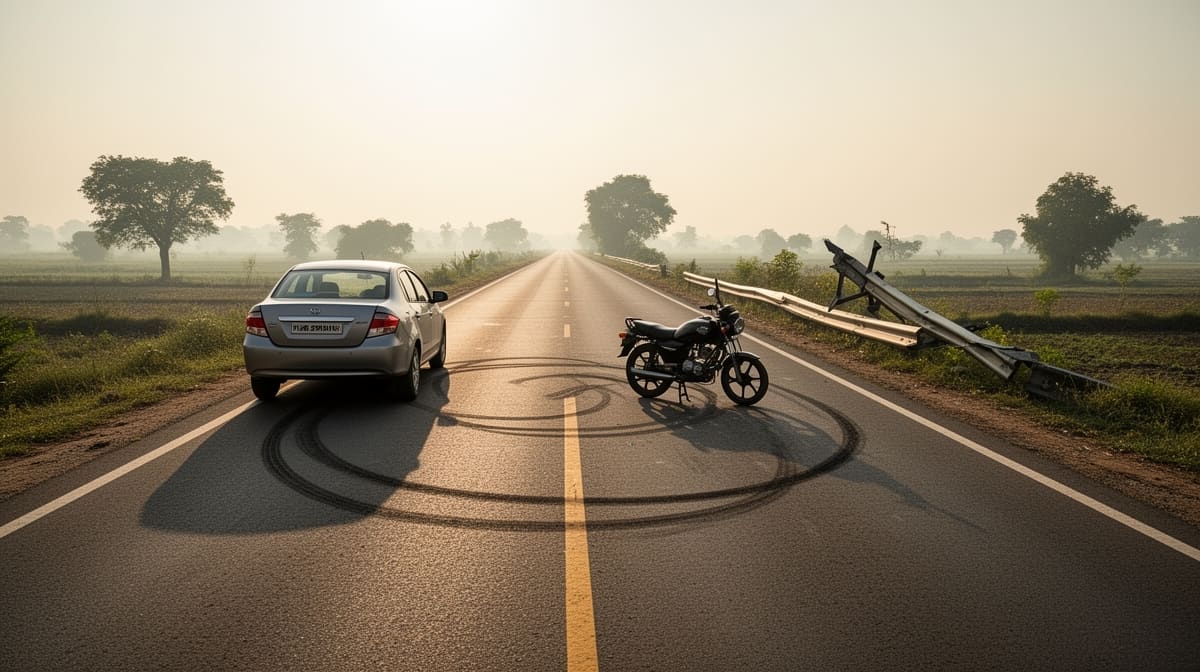
The Bombay High Court has delivered a significant clarification on the legal standard for establishing contributory negligence in motor accident claims, reinforcing that such fault cannot be inferred from circumstantial assumptions or minor infractions like non-helmet use. The judgment underscores the necessity of direct or corroborative evidence to apportion blame, particularly when documentary records clearly indicate the primary cause of the accident lies with the offending vehicle.
Background & Facts
The Dispute
The appellants, family members of deceased Sampat Pandurang Shinde, filed a claim petition seeking compensation after he died on the spot in a collision between his motorcycle and a bus operated by the respondents. The accident occurred on June 19, 2007, on the Nashik-Pune Road when the bus, traveling in the opposite direction, encroached approximately four feet onto the wrong side of the road while taking a turn and struck the deceased’s motorcycle.
Procedural History
- June 19, 2007: Fatal accident occurred; deceased died instantly.
- 2007: Claim petition filed before Motor Accident Claims Tribunal, Ahmednagar, seeking Rs. 9 lakhs.
- April 6, 2011: Tribunal awarded Rs. 2,92,000/- with interest, finding both parties contributorily negligent (25% on deceased, 75% on bus driver).
- 2011: First Appeal filed before Bombay High Court challenging the inadequacy of compensation and the apportionment of fault.
The Parties' Positions
- Appellants: Argued that the deceased had multiple income sources (agriculture, milk sales, electrical work), was 40 years old, and bore no fault in the accident. They sought enhancement of compensation based on Pranay Sethi, Sarla Verma, and Magma General Insurance precedents.
- Respondents: Contended that the deceased was driving rashly, failed to wear a helmet, and was therefore partially responsible. They defended the Tribunal’s income assessment and 1/3rd deduction for personal expenses.
Relief Sought
The appellants sought: (1) enhancement of annual income to Rs. 6,000/month based on agricultural earnings; (2) 50% future prospects addition; (3) multiplier of 15 instead of 12; (4) Rs. 40,000 per dependent for consortium; (5) reduction of personal expense deduction to 1/4th due to four dependents; and (6) complete removal of contributory negligence.
The Legal Issue
The central question was whether contributory negligence can be attributed to a motorcyclist based solely on the absence of a helmet and the position of vehicles post-collision, or whether cogent evidence is required to establish that the victim’s conduct materially contributed to the accident.
Arguments Presented
For the Appellant
The appellants relied on Kumari Kiran v. Sajjan Singh (2015) and Juju Kuruvila v. Kunjujamma Mohan (2013) to argue that contributory negligence cannot be presumed from speculative inferences. They emphasized that the spot panchnama, a contemporaneous document, clearly showed the bus encroached onto the wrong side. They further cited Pranay Sethi for 50% future prospects for a 40-year-old self-employed person, Sarla Verma for 1/4th deduction (four dependents), and Magma General Insurance for Rs. 40,000 per dependent for consortium.
For the Respondent
The respondents contended that the deceased’s failure to wear a helmet indicated negligence, and the collision occurring mid-road suggested shared fault. They argued that the Tribunal’s income assessment was conservative and justified, and that the 1/3rd deduction was standard under Trilok Chandra. They relied on the wife’s testimony about the helmet as sufficient to justify apportionment.
The Court's Analysis
The Court undertook a meticulous review of the evidence, distinguishing between causation and consequence. It held that the spot panchnama, prepared immediately after the accident, was a reliable document establishing that the bus encroached four feet onto the wrong side of the road - a clear breach of duty by the driver of a heavy vehicle.
"The mere position of the vehicles after accident, as shown in a scene mahazar, cannot give a substantial proof as to the rash and negligent driving on the part of one or the other."
The Court emphasized that the Supreme Court in Juju Kuruvila had explicitly rejected reliance on vehicle positioning alone to infer negligence. In this case, there was no eyewitness testimony, toxicology report, or mechanical failure evidence implicating the deceased. The absence of a helmet, while a violation of traffic rules, had no causal link to the collision - it affected injury severity, not the occurrence of the accident.
The Court further held that deduction of 1/3rd income for personal expenses was legally untenable given four dependents, citing Sarla Verma’s directive that 1/4th applies where dependents number four to six. The Tribunal’s failure to consider future prospects at 50% for a 40-year-old self-employed person was also a clear error under Pranay Sethi. The multiplier of 12 was replaced with 15, consistent with the deceased’s age and life expectancy.
The Court concluded that contributory negligence must be established by positive evidence, not conjecture. The Tribunal’s inference was speculative and legally unsustainable.
The Verdict
The appellants won. The Court held that contributory negligence cannot be presumed in the absence of direct or corroborative evidence linking the victim’s conduct to the accident’s cause. The compensation was enhanced to Rs. 15,35,000/- with interest at 7.5% per annum, and the bus operator was held solely liable.
What This Means For Similar Cases
Contributory Negligence Requires Positive Proof
- Practitioners must now challenge any apportionment of fault based solely on vehicle position, helmet use, or absence of license.
- The burden remains on the respondent to prove the victim’s negligence materially contributed to the collision.
- Spot panchnamas and post-mortem reports alone cannot substitute for eyewitness or forensic evidence of victim misconduct.
Future Prospects and Multiplier Are Mandatory for Self-Employed
- For deceased aged 40 - 50 years, 50% future prospects must be added unless exceptional circumstances exist.
- Multiplier of 15 is the norm for those aged 40, per Pranay Sethi and Sarla Verma.
- Income from agriculture, if supported by oral testimony (even if partially retracted), must be considered if plausible and consistent with local conditions.
Personal Expense Deduction Must Align With Number of Dependents
-
1/3rd deduction applies only to families with 2 - 3 dependents.
-
For 4 - 6 dependents, 1/4th is the correct standard.
-
Tribunals must state reasons for deviation from these settled norms.
-
Actionable Takeaway: In every motor accident claim, file a detailed affidavit mapping the deceased’s dependents and income sources. Oppose contributory negligence claims unless the respondent produces direct evidence of the victim’s causal negligence - e.g., speeding, drunk driving, or lane violation captured in CCTV or eyewitness.