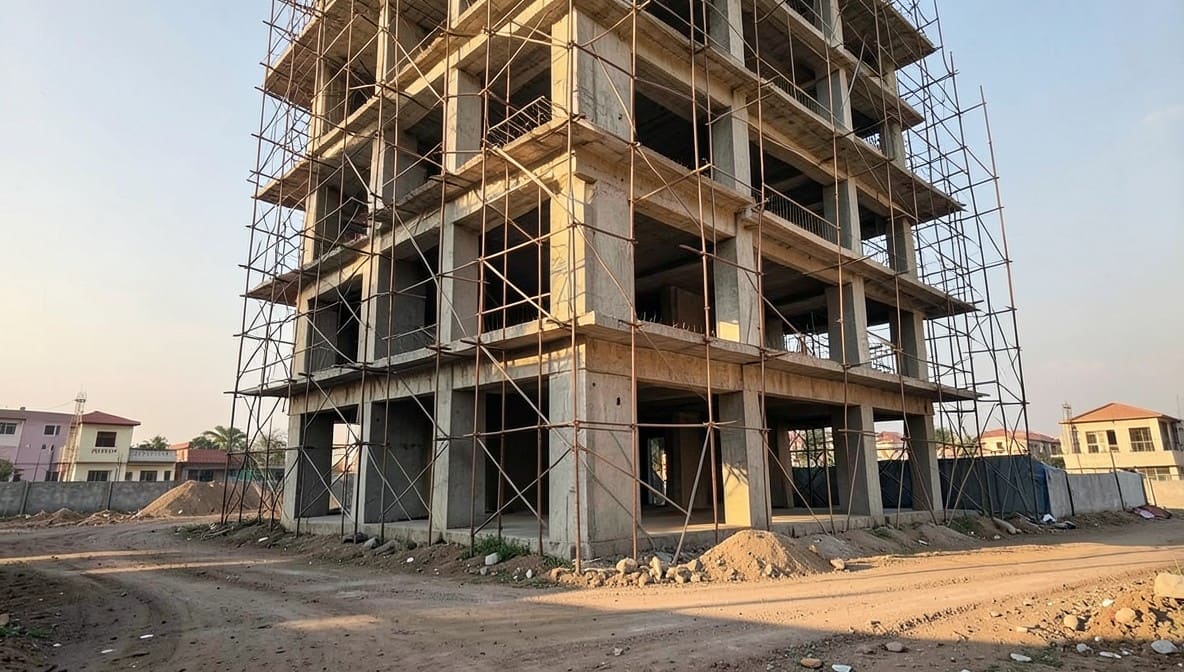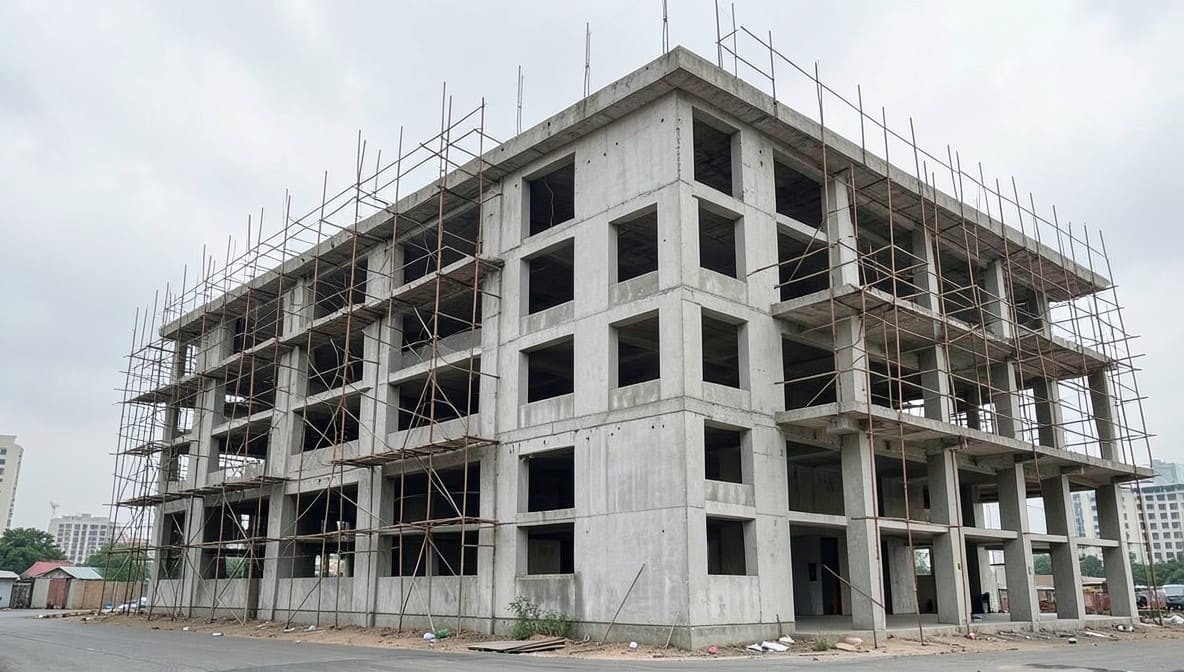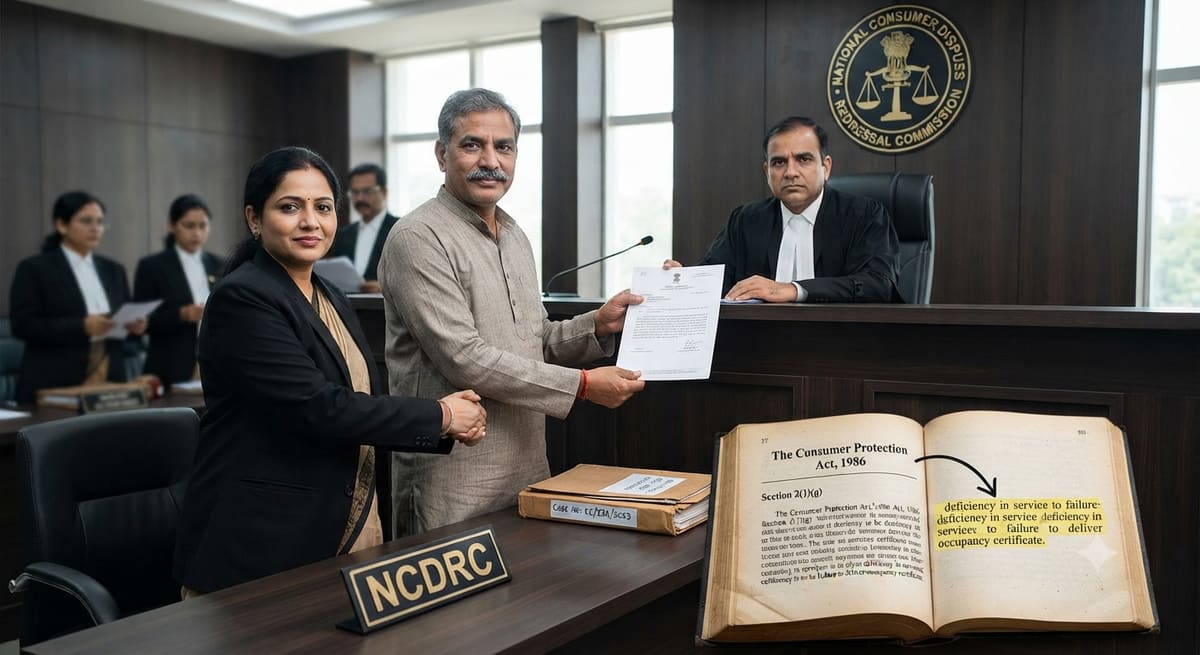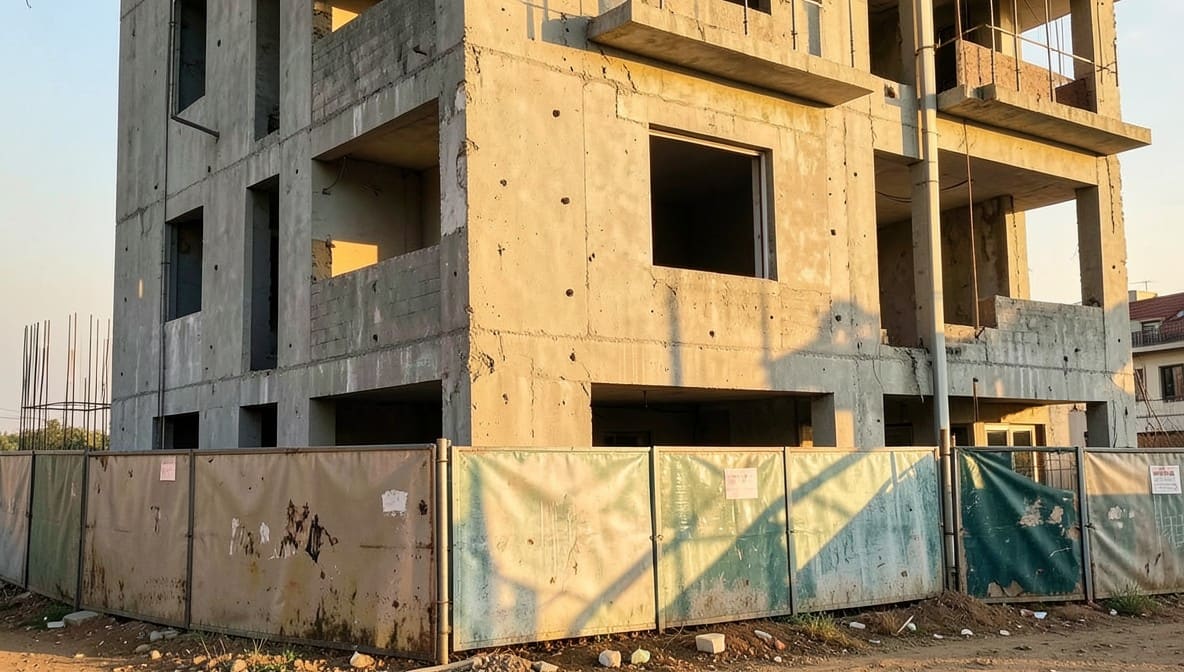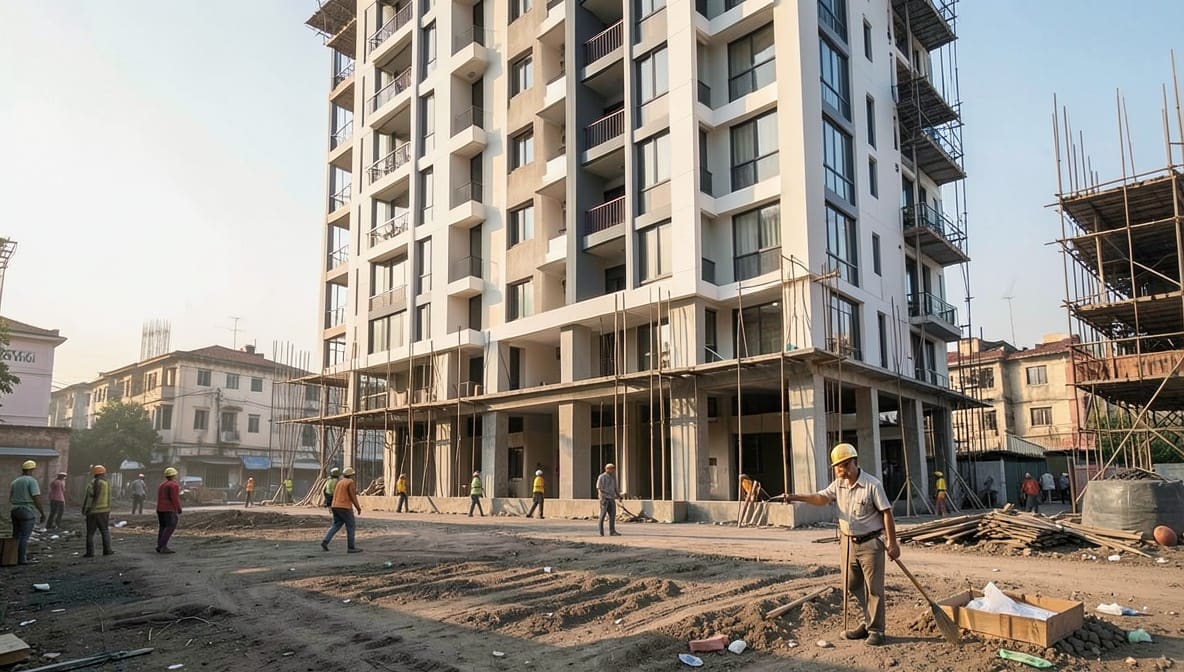
The West Bengal State Consumer Disputes Redressal Commission has clarified that a builder’s failure to obtain a Completion Certificate from municipal authorities constitutes a clear deficiency in service under the Consumer Protection Act, 1986. This ruling reinforces the legal obligation of developers to ensure statutory compliance, not merely to deliver possession but to provide legally recognized occupancy rights.
Background & Facts
The Dispute
The complainants, Kapil Singhania and Kanchan Singhania, entered into an agreement for sale on 04.02.2014 with Southfield Developers Pvt. Ltd. (later converted to Southfield Developers LLP), along with individual landowners Manjushree Mitra, Bhaskar Mitra, and Rajashree Mitra, to purchase Flat C3 (1011 sq. ft.) with one covered car parking space in the Axis Arrosa housing project located at 141, Hari Seva Math, Kolkata. The total consideration was Rs. 35,85,200, with additional payments of Rs. 22,409 and Rs. 88,374 towards service tax, and Rs. 50,000 in cash for ancillary charges (gym, transformer, etc.), though no receipts were issued.
Key Facts
- The complainants were provided a brochure for a different project, "Axis Garden," at Usha Park, which depicted amenities including a gym, community hall, and children’s park.
- The Agreement for Sale (Exhibit Annexure C) and Deed of Conveyance (Exhibit Annexure G), both dated 28.03.2014, did not contain any clause obligating the developer to construct or install gym equipment, community hall, or children’s park.
- The Third Schedule of the Agreement only promised "space" for these facilities, not their construction or equipment.
- The complainants paid the full consideration and took possession on 28.03.2014.
- The complainants alleged structural defects, including use of inferior TMT rods, poor plastering, leaky water tanks, and non-compliance with KMC sanctioned plans.
- No expert report, architectural certification, or photographic evidence was submitted to substantiate claims of substandard construction materials.
- The complainants were never provided the Completion Certificate (CC) from the Kolkata Municipal Corporation (KMC), despite repeated requests.
- The developer, in a letter dated 08.01.2015, stated that obtaining the CC was the responsibility of the flat owners and that the property was sold "as is, where is."
Procedural History
- 23.09.2015: Complaint filed before West Bengal State Consumer Disputes Redressal Commission (CC No. SC/19/CC/365/2015).
- 13.10.2015: Complaint admitted by the Commission.
- 28.03.2014: Possession handed over; Deed of Conveyance executed.
- 06.01.2015: Service Tax notice issued to the developer.
- 08.12.2014: Letter from Axis Flat Owners’ Welfare Association seeking CC.
- 08.01.2015: Developer’s response denying responsibility for CC.
- 19.06.2026: Judgment delivered.
- Notice issued to all opposite parties; served only on Southfield Developers Pvt. Ltd. (OP No. 4).
- OP Nos. 1 - 3 failed to respond; case proceeded ex-parte against them.
- OP No. 4 initially failed to file written version but was later permitted to file after paying Rs. 50,000 as cost to complainants, following an order from the National Consumer Disputes Redressal Commission.
The Parties' Positions
Complainants’ Position: The developer failed to provide essential amenities promised in the brochure, used substandard materials, did not obtain the Completion Certificate, and refused to issue receipts for cash payments. These acts amounted to deficiency in service and unfair trade practice.
Opposite Party (OP No. 4) Position: The Agreement and Deed of Conveyance are the sole binding documents; the brochure was for a different project and irrelevant. The developer provided only the space for amenities, not the fixtures. The CC is the responsibility of the owner under KMC rules. The property was handed over on an "as is, where is" basis, and no deficiency in service exists.
Relief Sought
The complainants sought:
- Direction to construct and equip gym, community hall, and children’s park.
- Compensation for defective construction and mental agony.
- Litigation costs.
- Refund of service tax and cash payments.
The Legal Issue
The central question was whether the failure of a developer to obtain a Completion Certificate from municipal authorities, despite statutory obligation, constitutes a deficiency in service under the Consumer Protection Act, 1986, and whether the complainants are entitled to compensation for such failure.
Arguments Presented
For the Appellant/Petitioner
The complainants relied on Faqir Chand Gulati v. Uppal Agencies Pvt. Ltd. (2005) to argue that obtaining the Completion Certificate is an implied obligation of the builder under the Act. They contended that the developer’s refusal to secure the CC, despite being legally mandated under KMC Rules 27 and 28, rendered the property legally non-compliant and deprived them of essential rights such as utility connections, bank loans, and resale eligibility. They emphasized that the Supreme Court has held that construction is a service, and failure to comply with statutory norms amounts to denial of service.
For the Respondent/State
OP No. 4 argued that the Agreement and Deed of Conveyance are the only binding contracts, and neither document required the developer to obtain the CC. They cited Section 403 of the Kolkata Municipal Corporation Act, 1980, asserting that the owner is responsible for applying for the CC. They further claimed the property was handed over on an "as is, where is" basis and that the complainants had no evidence of substandard materials or structural defects.
The Court's Analysis
The Commission undertook a detailed analysis of the statutory framework governing construction and consumer rights. It noted that while the brochure for "Axis Garden" was irrelevant to the Axis Arrosa project, the absence of any contractual obligation to construct amenities did not absolve the developer of statutory duties.
"The obligation on the part of the builder to secure a sanctioned plan and construct a building, carries with it an implied obligation to comply with the requirements of municipal and building laws and secure the mandatory permissions/certificates."
The Court emphasized that the Supreme Court in Faqir Chand Gulati had unequivocally held that a Completion Certificate is not merely an administrative formality but a legal necessity for lawful occupation. The developer cannot discharge its duty by merely applying for the CC; it must ensure its issuance by rectifying deviations and complying with KMC regulations.
The Commission rejected the developer’s reliance on Section 403 of the KMC Act, noting that while the section places a duty on the owner, it does not negate the builder’s primary responsibility under the law and the consumer protection regime. The builder, as the entity that undertook construction, is best positioned to ensure compliance.
The Court further held that the complainants failed to substantiate allegations of inferior TMT rods or structural defects due to absence of expert reports or photographic evidence. However, the failure to provide the Completion Certificate was independently established through the developer’s own admission and KMC rules.
The Commission concluded that withholding the CC, a document essential for legal occupancy, utility connections, and property registration, constitutes a clear deficiency in service under Section 2(1)(r) of the Consumer Protection Act, 1986.
The Verdict
The complainants succeeded on the issue of the Completion Certificate. The Commission ordered Southfield Developers LLP to deliver the Completion Certificate to the complainants within 45 days of the order. Additionally, the developer was directed to pay Rs. 2,00,000 as compensation for mental agony and harassment, and Rs. 25,000 as litigation costs, both payable within 45 days. The claims regarding gym, community hall, and children’s park were dismissed due to lack of contractual obligation. All other claims were rejected for want of evidence.
What This Means For Similar Cases
Builder’s Duty to Secure Completion Certificate Is Non-Negotiable
- Practitioners must now argue that builders cannot evade statutory obligations by claiming "as is, where is" transfers.
- The burden shifts to the developer to prove compliance with municipal regulations, not the buyer to enforce them.
- Failure to obtain CC is actionable under the Consumer Protection Act, regardless of contractual silence.
Evidence Standards for Construction Defects Remain Strict
- Allegations of substandard materials require expert reports, architectural certifications, or photographic documentation.
- Oral testimony or general complaints without technical substantiation will not suffice.
- Consumers must engage qualified professionals before filing complaints to avoid dismissal on evidentiary grounds.
Brochures Are Not Contractual Documents
- Marketing brochures for unrelated projects cannot be used to enforce contractual obligations.
- Only terms in the Agreement for Sale and Deed of Conveyance are legally binding.
- Practitioners should advise clients to insist on written inclusion of amenities in sale documents, not rely on promotional material.