The National Consumer Disputes Redressal Commission has reaffirmed that utility providers cannot impose retrospective charges on consumers without prior disclosure, establishing that such conduct constitutes deficiency in service under the Consumer Protection Act. This judgment reinforces the sanctity of procedural fairness and the limited scope of revisional jurisdiction in consumer disputes.
Background & Facts
The Dispute
The respondents, Jagdish Singh Rajpurohit and his wife Antro Devi, applied for electricity connections under the NDS Scheme in 2011. They were assured by the Jodhpur Vidyut Vitran Nigam Ltd. that two separate applications - one for domestic and one for commercial use - would be required, and that the cost of the transformer would be borne by the department. Acting on this assurance, they deposited ₹1,24,500 and ₹1,500 respectively. Connections were released in October 2011, and bills were paid regularly until December 2013.
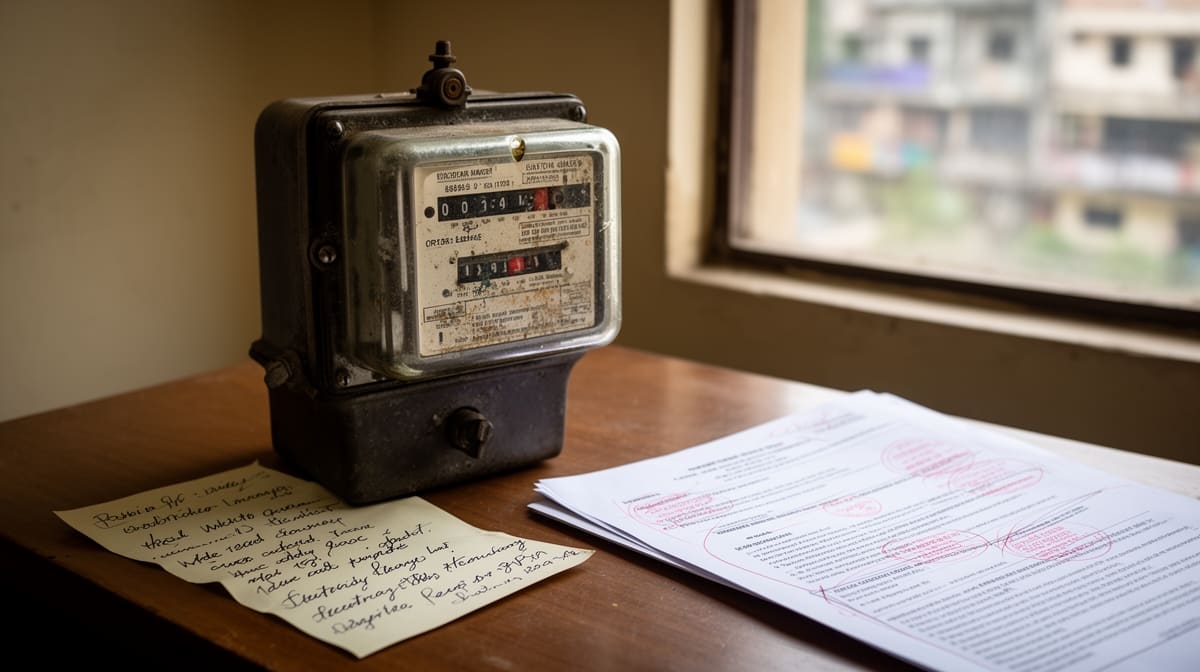
In February 2014, a new bill was issued demanding ₹25,125 under the head of transformer cost, which had never been mentioned in any prior notice. When the respondents challenged this, the utility disconnected their supply in March 2014 without providing any substantiated legal basis.
Procedural History
The case progressed through three forums:
- 2014: Complaint filed before District Forum, Barmer under Section 12 of the Consumer Protection Act, 1986
- 2016: District Forum held the demand illegal, ordered bill rectification, restoration of supply, and compensation of ₹5,000 each for mental agony and ₹3,000 for litigation expenses
- 2021: Rajasthan State Commission dismissed the utility’s appeal, upholding the District Forum’s findings as well-reasoned and based on evidence
- 2021: Revision Petition filed before NCDRC challenging the concurrent findings
Relief Sought
The petitioners sought to set aside the orders of the District Forum and State Commission, arguing that the respondents were not consumers under the Act and that the transformer cost was recoverable under the Electricity Act, 2003 and the self-financing scheme. They sought dismissal of the complaint with costs.
The Legal Issue
The central question was whether a utility’s subsequent demand for transformer cost, raised after connection was granted and not disclosed in the original demand notice, constitutes deficiency in service under the Consumer Protection Act, 1986, and whether such concurrent factual findings by lower fora can be disturbed in revisional jurisdiction.
Arguments Presented
For the Petitioner
The utility argued that:
- The respondents used the connection for commercial purposes and thus fell outside the definition of "consumer" under Section 2(1)(d) of the Act, relying on U.P. Power Corporation Ltd. v. Anees Ahmad
- The transformer cost was recoverable under Section 42(5) of the Electricity Act, 2003 and Regulation 559 of the self-financing scheme
- The internal audit report was conclusive evidence of liability, and the lower fora erred in disregarding it in favor of unsubstantiated oral assurances
- Allowing such claims would encourage frivolous litigation based on verbal promises
For the Respondent
The consumers contended that:
- The original demand notice made no mention of transformer charges, and payment was made in full reliance on the department’s assurance
- No documentary evidence was produced to prove prior disclosure of transformer cost liability
- The disconnection without notice or opportunity to explain constituted clear deficiency in service
- The concurrent findings of two fora, based on evidence and credibility assessment, are protected under Section 21(b) of the Act
The Court's Analysis
The NCDRC emphasized that revisional jurisdiction under Section 21(b) of the Consumer Protection Act, 1986 is not an appellate forum. Interference is permissible only where there is jurisdictional error, illegality, or material irregularity - not merely because another view is possible.
"The revisional power does not extend to re-appreciation or reassessment of evidence merely because another view may also be possible."
The Commission distinguished U.P. Power Corporation Ltd. v. Anees Ahmad, noting that case involved unauthorized use of electricity and assessment under Section 126 of the Electricity Act, whereas this dispute concerned a unilateral post-facto demand after connection was granted. The respondents had paid all bills in good faith and had no notice of any outstanding transformer liability.
The Commission held that the absence of any affidavit, document, or prior communication establishing that transformer cost was to be borne by the consumers rendered the department’s claim legally unsustainable. The internal audit, conducted years after the fact, could not override the established course of conduct between the parties.
"Once the department itself issued a demand notice specifying the payable amount and granted the electricity connection upon payment of the said amount, a subsequent unilateral demand raised on the basis of an internal audit without prior disclosure in the original demand notice cannot automatically bind the consumer."
The Court also relied on Rubi (Chandra) Dutta v. M/s United India Insurance Co. Ltd. and Rajiv Shukla v. Gold Rush Sales and Services Ltd. to underscore that concurrent findings on evidence appreciation are sacrosanct in revisional jurisdiction unless vitiated by illegality.
The Verdict
The petitioners lost. The NCDRC dismissed the revision petition, upholding the concurrent findings of the District Forum and State Commission. The Court held that the subsequent demand for transformer cost, without prior disclosure, amounted to deficiency in service under the Consumer Protection Act, 1986, and that revisional jurisdiction could not be invoked to re-appreciate evidence.
What This Means For Similar Cases
Subsequent Demands Require Prior Notice
- Practitioners must argue that any post-grant demand for additional charges must be disclosed at the time of application or connection release
- Utilities cannot rely on internal audits to impose retrospective liabilities without documentary proof of prior communication
- Failure to disclose charges upfront constitutes actionable deficiency in service
Concurrent Findings Are Protected
- Lower fora’s factual findings based on witness credibility and documentary evidence are binding unless proven illegal or arbitrary
- Revision petitions cannot be used as disguised appeals to re-evaluate evidence
- Legal teams must focus on jurisdictional flaws, not evidentiary disagreements, when challenging consumer orders
Oral Assurances Can Be Credible in Absence of Documentation
- Where a public utility makes representations to consumers and acts on them, oral assurances may be accepted if consistent with conduct and unchallenged by contemporaneous documents
- The burden shifts to the utility to prove prior disclosure; silence or inaction cannot be weaponized against consumers
- Practitioners should document all verbal assurances through written follow-ups or witness testimony to strengthen consumer claims