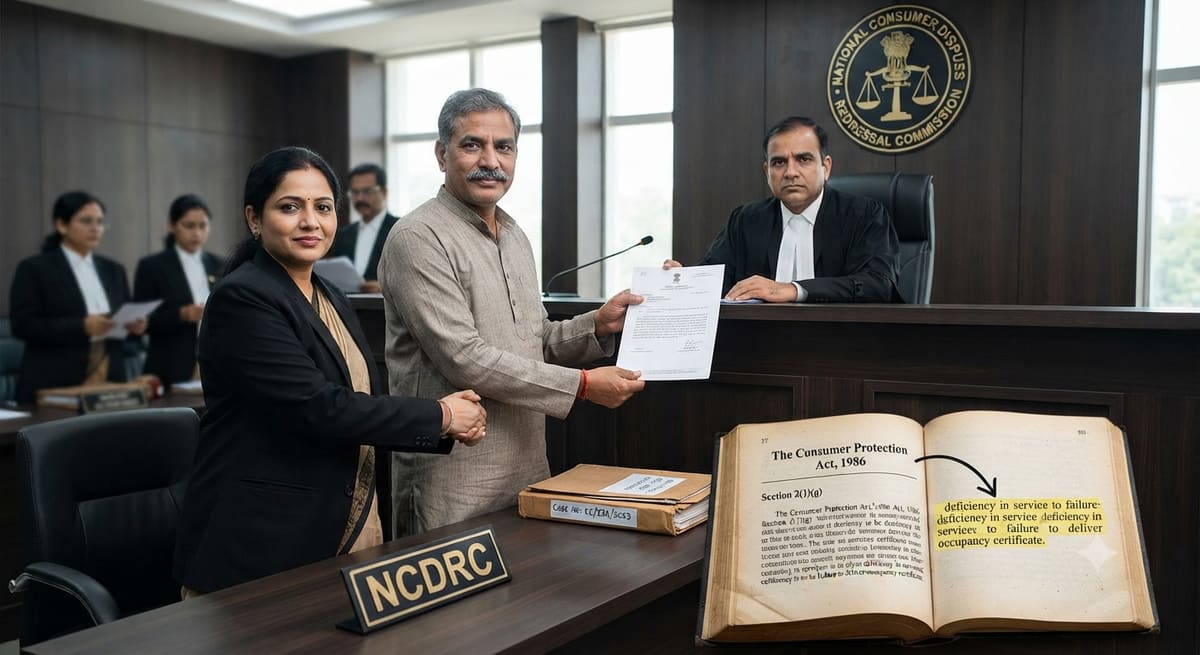
The National Consumer Disputes Redressal Commission has clarified that developmental authorities cannot impose non-construction fees on plot allottees unless actual possession has been delivered. This judgment reinforces the principle that consumer protection forums retain jurisdiction over statutory demands when they arise from contractual and procedural failures by public authorities, provided the complainant remains a consumer under the Act.
Background & Facts
The Dispute
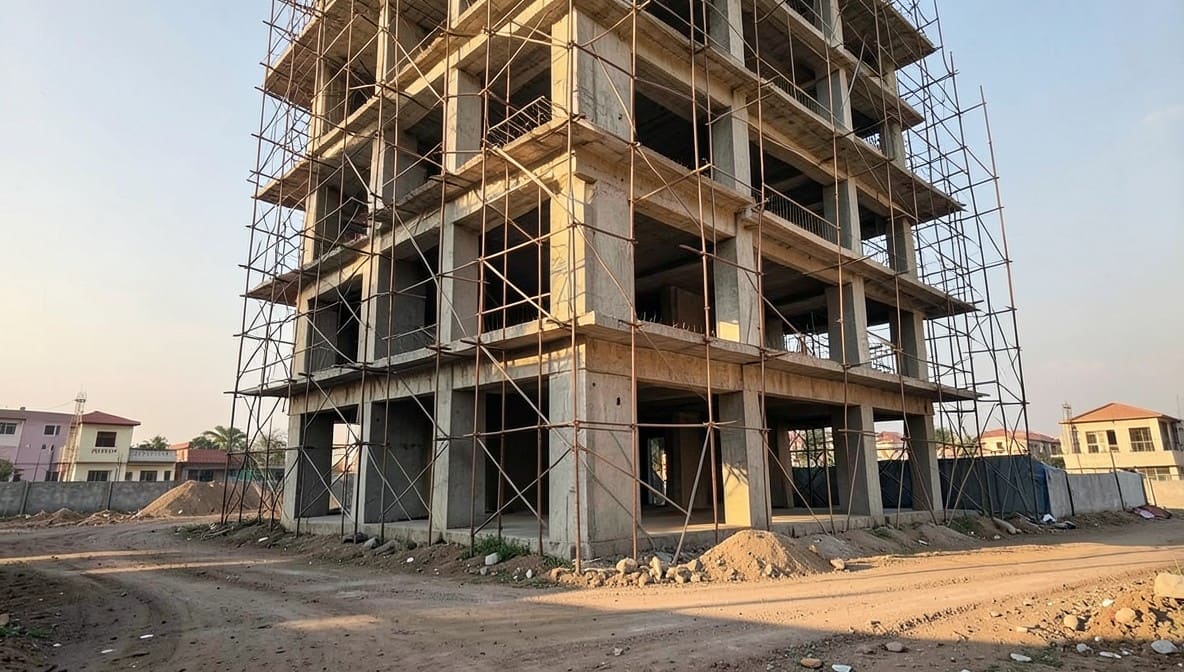
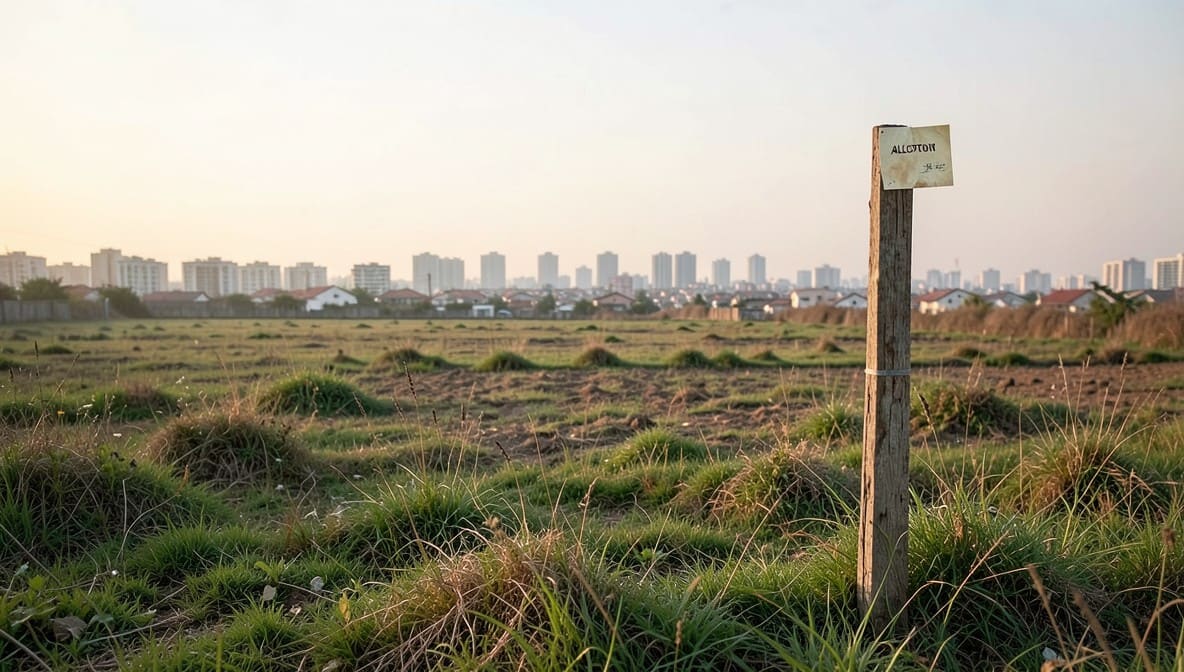
The dispute arose between the Greater Mohali Area Development Authority (GMADA), a statutory urban planning body, and Harinder Kaur, a plot allottee under its oustees policy. GMADA demanded Rs. 18,12,139/- as a non-construction fee under Clause 11 of the allotment letter, alleging that Harinder Kaur had failed to construct a building on her allotted plot within three years of allotment. Harinder Kaur challenged this demand before the District Consumer Forum, arguing that she had never been handed physical possession of the plot and that the demand was illegal, arbitrary, and contrary to statutory rules.
Key Facts
- Plot No. 3650, Sector 69, Mohali, measuring 400 sq. yards, was allotted to Harinder Kaur on 01.08.1995 under the oustees policy at a rate of Rs. 3,600/- per sq. yard.
- On 21.08.1997, the allotment letter was issued, but the rate was unilaterally increased to Rs. 3,600/- per sq. yard from the originally promised Rs. 1,400/- per sq. yard.
- Harinder Kaur filed Consumer Complaint No. 64/1998 before the State Commission on 23.10.1998 challenging the rate hike.
- The State Commission ordered a refund with interest on 30.06.1999, but this was set aside by the National Commission on 20.08.2004.
- The Supreme Court, by order dated 10.08.2011, set aside the National Commission’s order and remanded the matter to the State Commission.
- On 02.04.2012, the State Commission held that the plot price should be fixed at Rs. 1,800/- per sq. yard, based on the rate prevailing on 06.11.1996.
- Harinder Kaur made payment as directed and applied for a No Dues Certificate (NDC) on 17.09.2012.
- Instead of issuing the NDC, GMADA issued a demand letter dated 17.09.2012 for Rs. 18,12,139/- as non-construction fee.
- Harinder Kaur filed Consumer Complaint No. 467/2012 before the District Forum challenging this demand.
- On 10.10.1998 and 17.02.1999, Harinder Kaur executed two Agreements to Sell the plot to Sh. Bachan Singh, who later filed a Civil Suit for specific performance.
- The Civil Court, by order dated 31.05.2018, decreed the suit in favor of Bachan Singh, and the Appellate Court upheld it on 25.08.2025.
- However, at the time of the District Forum’s order (24.06.2013) and State Commission’s order (30.09.2016), the Civil Suit was still pending and no transfer of title had occurred.
Procedural History
- 01.08.1995: Plot allotted to Harinder Kaur under oustees policy.
- 21.08.1997: Allotment letter issued with revised rate.
- 23.10.1998: First consumer complaint filed before State Commission.
- 30.06.1999: State Commission ordered refund with interest.
- 20.08.2004: National Commission dismissed complaint.
- 10.08.2011: Supreme Court set aside National Commission’s order and remanded.
- 02.04.2012: State Commission fixed plot price at Rs. 1,800/- per sq. yard.
- 17.09.2012: GMADA issued demand letter for non-construction fee.
- 24.06.2013: District Forum allowed complaint, directed withdrawal of demand, issuance of NDC, and awarded Rs. 1,00,000/- for mental harassment and Rs. 10,000/- as litigation costs.
- 30.09.2016: State Commission dismissed GMADA’s appeal, upholding District Forum’s order.
- 20.02.2017: Notice issued in Revision Petition No. 333/2017.
- 01.06.2026: Judgment reserved by NCDRC.
- 30.06.2026: Judgment pronounced dismissing the Revision Petition.
The Parties' Positions
For the Petitioner (GMADA)
- Argued that Clause 10 and 11 of the allotment letter imposed a duty on the allottee to take possession within 90 days and complete construction within 3 years.
- Contended that non-construction fee is a statutory levy under the Punjab Urban Planning and Development Act, 1995, and Rule 13 of the 1995 Rules.
- Asserted that the consumer fora lack jurisdiction to interfere with statutory demands by public authorities.
- Claimed Harinder Kaur ceased to be a consumer after entering into Agreements to Sell in 1998 and 1999.
- Invoked Order II Rule 2 CPC to argue that the second complaint was barred as it arose from the same cause of action.
- Relied on HUDA v. Sunita (2005) and Prashant Kumar Sahi v. Ghaziabad Development Authority (2000) to argue that consumer fora cannot adjudicate statutory fees.
For the Respondent (Harinder Kaur)
- Argued that possession was never handed over, making the construction obligation inoperative.
- Stated that the dispute over price remained pending until 02.04.2012, preventing approval of building plans and thus making compliance with Clause 11 impossible.
- Contended that the demand was arbitrary, unsupported by any calculation or statutory basis.
- Cited Narinder Singh Nanda v. PUDA (2009) to argue that consumer fora have jurisdiction when statutory authorities act ultra vires.
- Highlighted that the Civil Court decrees were subsequent to the consumer forum orders and could not invalidate her consumer status at the time of filing.
- Emphasized that mere Agreements to Sell do not extinguish consumer status unless actual transfer occurs.
Relief Sought
Harinder Kaur sought:
- Withdrawal of the demand letter dated 17.09.2012.
- Issuance of No Dues Certificate after payment of Rs. 1,800/- per sq. yard.
- Payment of Rs. 1,00,000/- as compensation for mental harassment.
- Payment of Rs. 10,000/- as litigation costs.
GMADA sought:
- Dismissal of the consumer complaint as barred by Order II Rule 2 CPC.
- Declaration that consumer fora lack jurisdiction to interfere with statutory non-construction fees.
- Setting aside of the orders of the District Forum and State Commission.
The Legal Issue
The central question was whether a developmental authority can levy a non-construction fee under its statutory rules against an allottee who has not been handed physical possession of the plot, and whether the complainant retains consumer status under the Consumer Protection Act, 1986 when the property has only been subject to an uncompleted Agreement to Sell.
Arguments Presented
For the Appellant/Petitioner
GMADA contended that Clause 11 of the allotment letter imposed a clear obligation to construct within three years, and failure to do so triggered the levy of non-construction fees under Rule 13 of the 1995 Rules. It argued that the consumer fora have no jurisdiction to question statutory levies, citing HUDA v. Sunita. It further claimed that Harinder Kaur ceased to be a consumer upon entering into Agreements to Sell in 1998 and 1999, as she had divested her beneficial interest. GMADA relied on Virgo Industries to argue that the second complaint was barred under Order II Rule 2 CPC, as it arose from the same cause of action - the allotment terms.
For the Respondent/State
Harinder Kaur countered that possession was never delivered, making the construction obligation unenforceable. She argued that the price dispute remained unresolved until 02.04.2012, and without payment of dues, building plan approval was impossible. She cited Narinder Singh Nanda v. PUDA to assert that consumer fora have jurisdiction when statutory authorities act beyond their delegated powers. She emphasized that Agreements to Sell do not extinguish consumer status unless actual transfer occurs, and since the Civil Court decrees were subsequent, her status at the time of filing remained intact.
The Court's Analysis
The National Commission undertook a detailed analysis of the factual and legal matrix. It noted that the core issue was not the validity of the non-construction fee per se, but whether it could be imposed without actual possession. The Court observed:
"It is only when after making the payment in accordance with the above said order of the State Commission that complainant respondent sought NDC from the petitioner authority, the said letter dated 17.09.2012 was got issued."
The Court held that Clause 11 of the allotment letter required construction to be completed "after getting the plans of the proposed building approved from the Estate Officer." Since the price dispute was pending until 2012, no plan approval could have been obtained. The Court further noted that GMADA had not produced any evidence of having offered or handed over possession at any point after 02.04.2012.
The Commission rejected GMADA’s argument that the complainant was not a consumer. It held that mere execution of Agreements to Sell, without actual transfer of title or possession, does not extinguish consumer status under the Consumer Protection Act, 1986. The Court emphasized:
"Being an allottee of plot by Petitioner Authority, the Complainant satisfies the definition of being Consumer under the Consumer Protection Act."
It also declined to interfere with the concurrent findings of the District Forum and State Commission, noting that revisional jurisdiction under Section 21 is extremely limited and can only be invoked where there is a jurisdictional error, illegality, or perversity. The Court found no such grounds, stating:
"There is no illegality or material irregularity or jurisdictional error in the orders of the State Commission."
The Court distinguished HUDA v. Sunita, holding that the judgment did not bar consumer fora from examining whether statutory levies were applied lawfully or arbitrarily, particularly when the authority failed to follow its own rules or provide justification.
The Verdict
The Revision Petition was dismissed. The National Commission upheld the orders of the District Forum dated 24.06.2013 and the State Commission dated 30.09.2016. GMADA was directed to withdraw the demand letter dated 17.09.2012, issue the No Dues Certificate upon payment of Rs. 1,800/- per sq. yard, pay Rs. 1,00,000/- as compensation for mental harassment, and Rs. 10,000/- as litigation costs. The Commission clarified that the Civil Court decrees dated 31.05.2018 and 25.08.2025, while binding on the parties, did not invalidate the consumer forum’s findings as they were rendered after the fact.
What This Means For Similar Cases
Possession Is a Prerequisite for Construction Obligations
- Practitioners must now argue that statutory or contractual construction timelines cannot be enforced unless physical possession has been formally handed over.
- Developmental authorities must maintain documentary proof of possession handover; mere clause references in allotment letters are insufficient.
Consumer Status Survives Pending Transfer
- Execution of an Agreement to Sell does not automatically extinguish consumer status under the Consumer Protection Act, 1986.
- Only actual transfer of title or possession terminates consumer rights; pending litigation over sale agreements does not disqualify the original allottee.
Consumer Fora Can Review Statutory Levies for Legality
-
The judgment affirms that consumer fora have jurisdiction to examine whether statutory fees are imposed in accordance with the parent statute and rules.
-
Authorities cannot shield arbitrary demands behind the label of "statutory"; they must demonstrate compliance with procedural and substantive requirements.
-
Always verify whether possession was delivered before enforcing construction deadlines.
-
In consumer complaints against public authorities, plead the absence of possession as a jurisdictional and factual defense.
-
Cite Narinder Singh Nanda v. PUDA to counter claims of lack of jurisdiction over statutory levies.