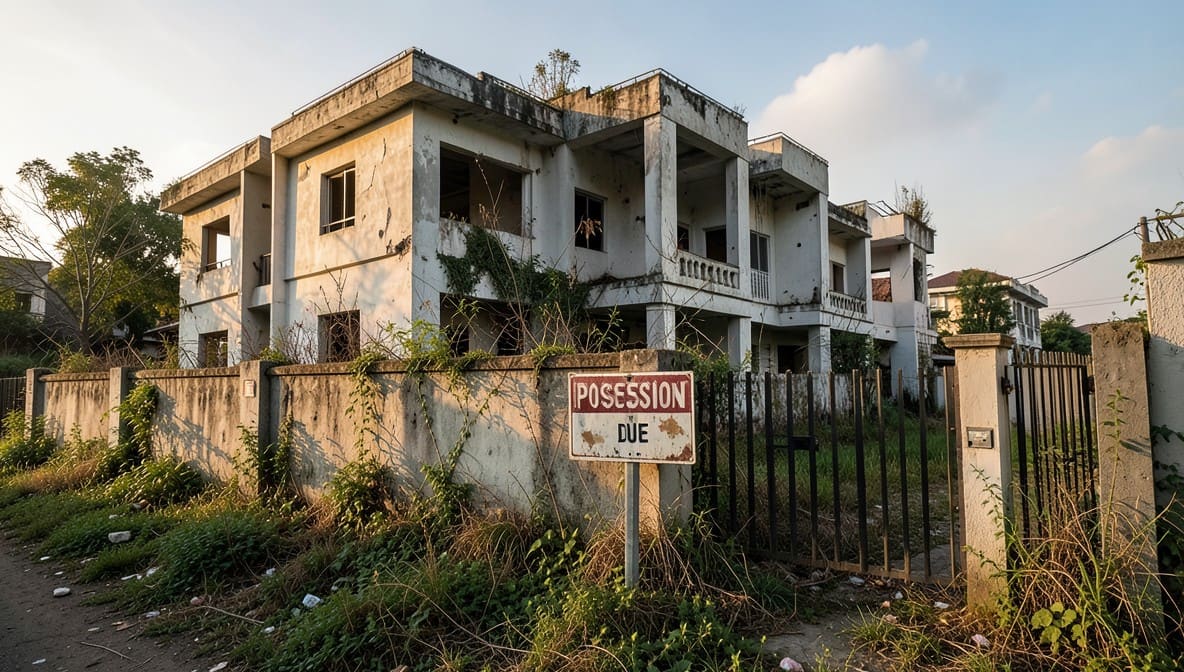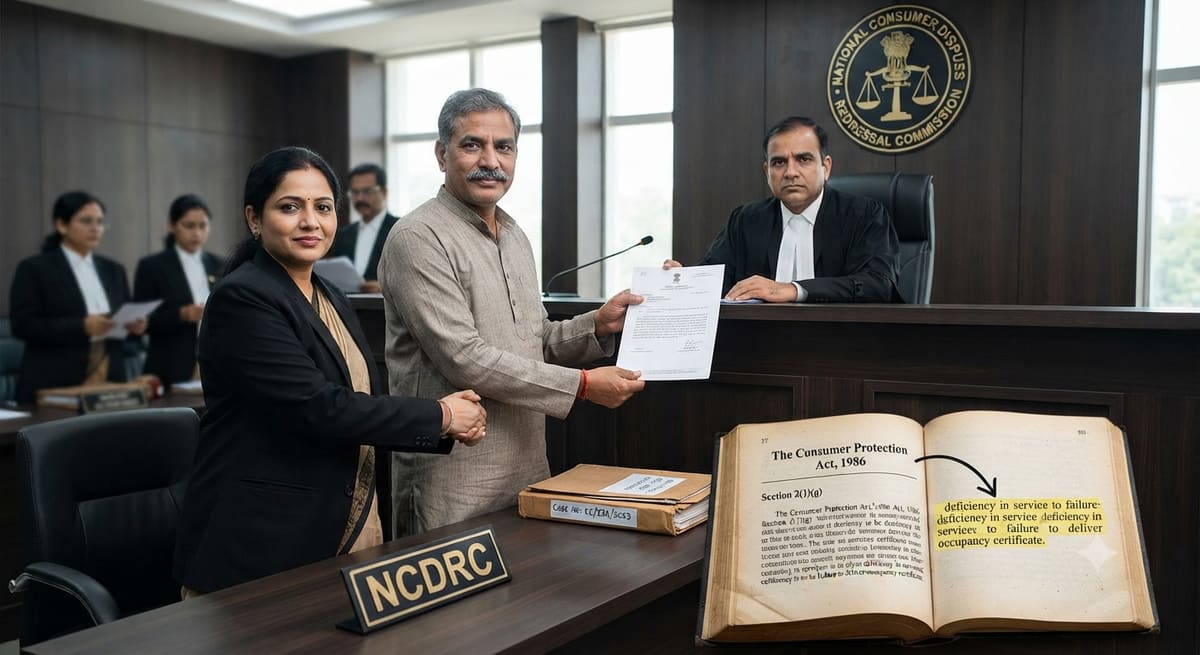
The National Consumer Disputes Redressal Commission has reaffirmed that builders who fail to deliver possession within the contracted timeline cannot rely on one-sided contractual clauses to avoid meaningful compensation. In a significant ruling, the Commission held that consumers are entitled to interest on amounts paid, not merely nominal delay compensation, when builders default on delivery timelines.
Background & Facts
The Dispute
The respondents, Sakshi Abraham and Eddy Abraham, purchased an apartment (CD-AS-01-102) in the project "The Corridors" in Sector 67-A, Gurgaon, from the appellant, Ireo Grace Realtech Pvt. Ltd. The apartment was booked in 2013, and an Apartment Buyer Agreement (ABA) was executed on 25.04.2014. The appellant assured possession within 42 months from the date of approval of building plans or fulfillment of preconditions, with an additional 6-month grace period, implying a deadline of January 2017 or July 2017 at the latest.
Key Facts
- The building plans were sanctioned on 23.07.2013.
- The Fire NOC, a mandatory precondition under the Haryana Fire Service Act, 2009, was granted only on 27.11.2014.
- The ABA’s Clause 13.3 tied the 42-month commitment period to the fulfillment of preconditions, including Fire NOC.
- The respondents made all payments as demanded, totaling Rs. 2,13,42,408 by 10.05.2018.
- Despite repeated inquiries, the appellant provided no substantive updates on construction progress after May 2018.
- The appellant issued a Notice of Possession on 13.06.2019, over 30 months after the committed date of 27.11.2018.
- The Occupation Certificate for Phase-I (including the respondents’ unit) was granted on 31.05.2019.
- The respondents filed a consumer complaint on 04.09.2020, alleging deficiency in service and failure to deliver possession.
- The appellant admitted in its review application that it had erroneously cited Phase-II dates (27.01.2022 and 16.02.2022) for possession and OC, later correcting this as a typographical error.
Procedural History
- 04.09.2020: Consumer Complaint (CC No. 205 of 2020) filed before the State Consumer Disputes Redressal Commission, Delhi.
- 15.04.2024: State Commission allowed the complaint, directing refund of Rs. 2,13,42,408 with interest at 6% p.a. from each payment date till 15.04.2024, and 9% p.a. thereafter if unpaid by 15.06.2024. Additional compensation of Rs. 5,00,000 for mental agony and Rs. 50,000 for litigation costs was awarded.
- 15.07.2024: State Commission dismissed the appellant’s review application (RA No. 10/2024).
- 29.08.2024: Delhi High Court dismissed the appellant’s writ petition, directing it to approach the National Commission under Section 51 of the Consumer Protection Act, 2019.
- 06.12.2024: Supreme Court directed deposit of Rs. 1 crore as a condition for stay of execution.
- 20.01.2025: Supreme Court declined to entertain the SLP, reaffirming the statutory remedy before the National Commission.
- 07.02.2025: First Appeal (FA No. 257 of 2025) filed before the National Commission, after deposit of Rs. 2,13,42,408.
- 29.05.2025: National Commission condoned the delay in filing the appeal, noting the matter had been before the Supreme Court and the respondent did not oppose condonation.
- 30.06.2026: Judgment pronounced by the National Commission.
Relief Sought
The respondents sought refund of Rs. 2,13,42,408 with interest, compensation for mental agony, and litigation costs. The appellant sought to set aside the State Commission’s order, arguing that the respondents were bound by the ABA’s delay compensation clause of Rs. 7.50 per sq. ft. per month and were obligated to take possession, not seek refund.
The Legal Issue
The central question was whether a consumer, whose builder fails to deliver possession within the stipulated period, is entitled to interest on the amount paid as compensation for delay, or whether the consumer is restricted to the contractual delay compensation rate of Rs. 7.50 per sq. ft. per month, even when such rate is demonstrably inadequate and the contractual terms are one-sided.
Arguments Presented
For the Appellant
The appellant relied on Ireo Grace Realtech Pvt. Ltd. v. Abhishek Khanna and Ireo Grace Realtech Pvt. Ltd. v. Sanjay Gopinath to argue that the respondents, as Chart-A allottees, were obligated to take possession upon issuance of the Occupation Certificate and were entitled only to delay compensation at Rs. 7.50 per sq. ft. per month as per Clause 13.4 of the ABA. It contended that the State Commission’s direction for refund with interest violated judicial comity and the binding precedent of the Supreme Court. The appellant further argued that the respondents had continued making payments until May 2018, indicating acceptance of the project’s status, and that the delay was attributable to force majeure and regulatory delays, which were covered under Clause 13.6 of the ABA. It also asserted that the complaint was premature since possession was offered on 13.06.2019.
For the Respondent
The respondents argued that the ABA’s delay compensation clause was oppressive and one-sided, constituting an unfair trade practice under Section 2(1)(r) of the Consumer Protection Act, 1986. They relied on Pioneer Urban Land & Infrastructure Ltd. v. Geetu Gidwani Verma and Arifur Rahman Khan v. DLF Southern Homes to assert that consumer fora have the power to award just and reasonable compensation beyond contractual limits when terms are unconscionable. They emphasized that the Rs. 7.50 per sq. ft. rate (equivalent to 0.9%-1% p.a.) was grossly inadequate compared to the 7.9% p.a. interest they paid on home loans. They also cited Newtech Promoters & Developers Pvt. Ltd. v. State of Uttar Pradesh to argue that under the Consumer Protection Act, the right to refund is absolute when possession is not delivered within the stipulated time.
The Court's Analysis
The National Commission undertook a detailed analysis of the Supreme Court’s judgment in Ireo Grace Realtech Pvt. Ltd. v. Abhishek Khanna, which had categorised allottees into Chart-A (where possession was offered) and Chart-B (where it was not). The Commission noted that while Abhishek Khanna held that Chart-A allottees must take possession, it also unequivocally rejected the Rs. 7.50 per sq. ft. delay compensation as inadequate, observing that it translated to only 0.9%-1% p.a., which bore no relation to the commercial realities of the market or the financial burden borne by homebuyers.
"The Delay Compensation specified in the Apartment Buyer's Agreement of Rs 7.5 per square foot which translates to 0.9% to 1% p.a. on the amount deposited by the Apartment Buyer cannot be accepted as being adequate compensation for the delay in the construction of the project."
The Commission further noted that in Sanjay Gopinath, the Supreme Court modified the NCDRC’s order to award Rs. 7.50 per sq. ft. only because the NCDRC had erroneously awarded 9% interest without considering the binding precedent. The Supreme Court did not lay down a new principle that Rs. 7.50 per sq. ft. was the only permissible compensation.
The Commission held that the ABA’s terms were oppressive and one-sided, violating the principle of fair bargaining. Clause 13.2 imposed holding charges of Rs. 7.50 per sq. ft. per month on buyers for delayed possession, while Clause 13.4 capped the developer’s liability at the same rate for its own delay. This asymmetry, coupled with the absence of interest on refunds and forfeiture of earnest money for buyer defaults, rendered the contract unconscionable under Section 2(1)(r) of the Consumer Protection Act, 1986.
The Commission also rejected the appellant’s reliance on Bharti Knitting Co. v. DHL Worldwide Courier, noting that contractual terms cannot override statutory consumer rights when they are manifestly unfair. The Commission emphasized that the Supreme Court in Abhishek Khanna had already recognized the inadequacy of the contractual rate and had awarded 9% interest to Chart-B allottees. It reasoned that denying similar relief to Chart-A allottees would create an arbitrary distinction without legal basis.
The Commission further held that the delay in possession - 6.5 months from 27.11.2018 to 13.06.2019 - was substantial and not mitigated by the issuance of the Occupation Certificate. The respondents had not waived their right to seek compensation merely because they did not immediately reject the possession notice.
The Verdict
The National Commission allowed the appeal in part and set aside the State Commission’s order dated 15.04.2024. The appellant was directed to hand over possession of the apartment within 45 days, complete with all promised amenities and facilities. A joint inspection of the unit was mandated within 15 days of the order, with defects to be recorded and rectified within one month. The appellant was also directed to pay delay compensation to the respondents at the rate of 6% simple interest per annum on the total amount paid (Rs. 2,13,42,408) for the period of delay from 27.11.2018 to 13.06.2019. The appellant was further directed to pay litigation costs of Rs. 25,000 to the respondents. The amount of Rs. 2,13,42,408 deposited with the Commission shall be adjusted against any outstanding dues after accounting for the delay compensation.
What This Means For Similar Cases
Delay Compensation Must Reflect Market Realities
- Practitioners must argue that contractual delay compensation rates below 6% p.a. are prima facie inadequate and constitute unfair trade practices under the Consumer Protection Act.
- Courts and forums must consider the actual financial burden on homebuyers, including home loan EMIs, when determining fair compensation.
- The Rs. 7.50 per sq. ft. rate, while common in builder agreements, is no longer a safe harbor for developers.
Refund Is Not the Only Remedy, But Interest Is Mandatory
- Even when possession is offered, consumers are not barred from claiming interest on amounts paid during the period of delay.
- Builders cannot use the issuance of an Occupation Certificate as a shield to avoid meaningful compensation.
- The Abhishek Khanna precedent does not restrict relief to Rs. 7.50 per sq. ft. but mandates a fair, market-aligned remedy.
Contractual Terms Are Not Absolute
- Builders cannot enforce one-sided clauses that disproportionately penalize buyers while limiting their own liability.
- Consumer fora have the statutory power under Section 14 of the Consumer Protection Act, 1986, to declare such terms void as unfair trade practices.
- Legal arguments must focus on the imbalance of risk and reward in builder-buyer agreements, not merely on technical compliance with deadlines.