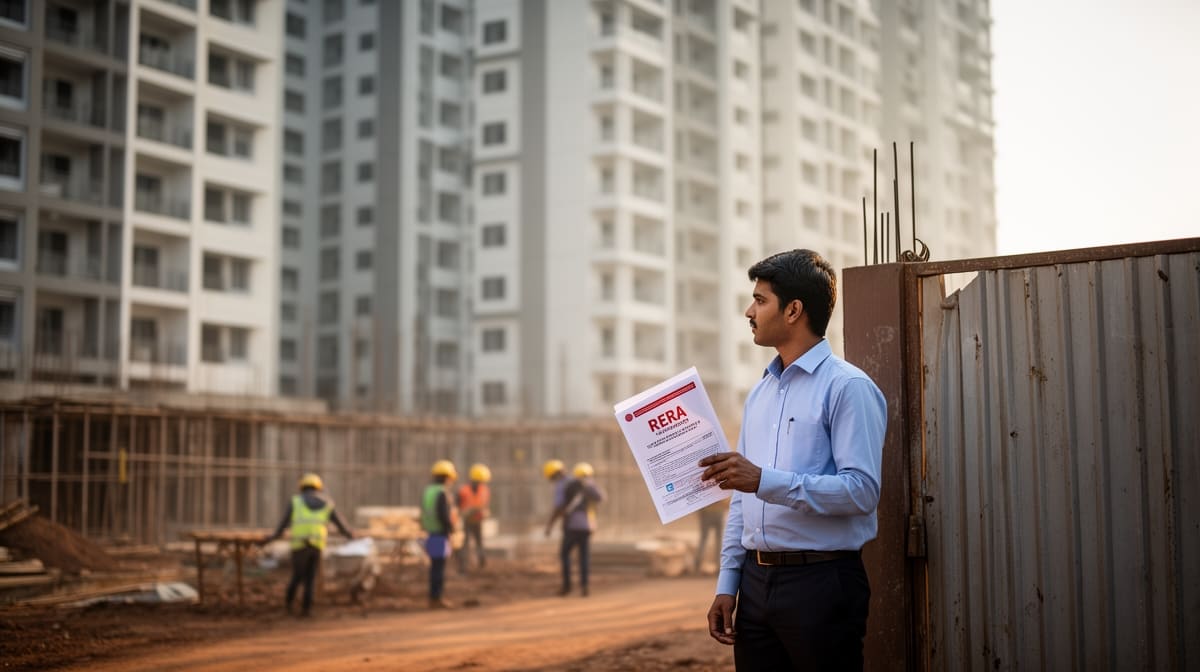
The National Consumer Disputes Redressal Commission has clarified that a developer cannot lawfully offer possession of residential units without a valid Occupancy Certificate, even if such an offer was previously deemed compliant. This judgment reinforces the statutory primacy of regulatory clearances under RERA and limits liability for delay compensation to the period before the OC was invalidated.
Background & Facts
The Dispute
The complainants, home allottees in a residential project developed by M/s JKG Construction Pvt. Ltd. and four other entities, filed a consumer complaint alleging failure to deliver possession of units despite full payment of consideration. The dispute arose from the developer’s offer of possession in July 2019, which the complainants rejected due to alleged illegal charges in the Final Statement of Accounts (FSA) and the use of a conditional Occupancy Certificate (OC) later cancelled by authorities in 2022.
Key Facts
- The original sale agreements were executed between 2014 and 2016.
- The complainants paid the full consideration as per the allotment letters.
- The developer offered possession in July 2019, citing a conditional OC issued under Uttar Pradesh RERA Rules, 2016.
- The complainants objected to the FSA, which included additional charges for delay fit-out, farmer compensation, and maintenance fees not stipulated in the agreement.
- The conditional OC was cancelled by the competent authority in 2022 due to non-compliance with revised regulatory norms.
- The developer issued revised FSAs in 2023, adjusting delay compensation but retaining disputed levies.
- The Uttar Pradesh RERA Office Order dated 29.05.2024 prohibited possession without a formal CC/OC, superseding the earlier deemed approval regime.
- GNIDA (Greater Noida Industrial Development Authority) imposed additional farmer compensation dues, pending adjudication before the Allahabad High Court.
- The developer claimed it could not obtain a valid OC until GNIDA dues were cleared, which required payment by allottees under Clause 31 of the allotment letter.
Procedural History
- 07.2019: Developer offered possession with conditional OC and FSA; allottees refused due to illegal charges.
- 02.05.2023: NCDRC passed order in Consumer Complaint No. 75 of 2018, directing the developer to hand over possession complete in all respects and pay delay compensation at 9% p.a. from 01.01.2016 till the date of offer of possession.
- 24.06.2023: Developer issued revised FSAs and demand letters to allottees.
- 02.07.2023: Execution Application (EA/670/2023) filed by complainants seeking enforcement of the 2023 order.
- 29.05.2024: UPRERA issued Office Order prohibiting possession without formal CC/OC.
- 2024: Multiple interlocutory applications filed for waiver of costs, exemption from typed copies, and interim relief.
- 02.06.2026: Hearing concluded; matter reserved.
- 01.07.2026: Judgment pronounced.
The Parties' Positions
For the Complainants (DHs):
- The offer of possession in July 2019 was invalid due to illegal FSA charges and an OC later cancelled in 2022.
- The developer’s subsequent attempts to enforce payment of disputed levies were coercive and contrary to the NCDRC’s 2023 order.
- The complainants are willing to pay the balance consideration and GNIDA dues, but only upon receipt of a valid OC and without additional charges.
- They seek enforcement of the original order: possession complete in all respects, with delay compensation continuing until actual handover.
For the Respondents (JDs):
- Possession was lawfully offered in July 2019 under the regulatory framework then in force.
- The OC was valid at the time of offer and was the basis for the NCDRC’s determination of delay compensation up to 31.07.2019.
- Subsequent changes in law (UPRERA Office Order 29.05.2024) and pending litigation over GNIDA dues rendered compliance impossible without court intervention.
- The developer is ready to refund amounts with interest if possession cannot be delivered.
- The liability for GNIDA dues is contractually borne by the allottees under Clause 31 of the allotment letter.
Relief Sought
- Complainants: Enforcement of possession with delay compensation until actual handover, cancellation of illegal FSA charges, and execution of conveyance deeds.
- Respondents: Modification of the 2023 order to permit refund of amounts with interest, and exemption from coercive enforcement due to impossibility of compliance.
The Legal Issue
The central question was whether a developer can be compelled to hand over possession under a consumer decree when the Occupancy Certificate relied upon for the offer has been cancelled and statutory law now prohibits possession without a valid OC, and whether delay compensation must continue accruing beyond the date of the invalidated offer.
Arguments Presented
For the Appellant/Petitioner
The complainants argued that the offer of possession in July 2019 was legally invalid because it was based on a conditional OC later cancelled in 2022. They contended that the FSA contained unauthorized charges not contemplated in the agreement, rendering the offer non-compliant with the NCDRC’s order. Relying on Brakewel Automotive Components (India) Pvt. Ltd. v. P.R. Selvam Alagappan, they asserted that the executing forum cannot impose new conditions or alter the decree’s terms. They maintained that the developer’s failure to secure a valid OC constituted wilful non-compliance, and delay compensation must continue until actual possession is delivered.
For the Respondent/State
The developer argued that the 2023 order was based on the factual premise that a valid OC existed at the time of the July 2019 offer. The subsequent cancellation of the OC and the 2024 UPRERA directive were supervening events beyond its control. Citing Maurice W. Innis vs. Lily Kazrooni, the developer contended that the executing forum cannot enforce impossible compliance. It emphasized that Clause 31 of the allotment letter made the allottees liable for statutory levies, and the inability to obtain OC was directly linked to unresolved GNIDA dues, which were sub judice. The developer offered to refund amounts with interest to resolve the matter.
The Court's Analysis
The Commission emphasized that the scope of execution is strictly confined to enforcing the decree as it stands, without revisiting its merits or introducing new conditions. As held in Brakewel Automotive Components, an executing court cannot go behind the decree or alter its terms. The 2023 order explicitly recognized the July 2019 offer of possession as the cutoff point for delay compensation. The Commission noted that the complainants did not challenge the validity of the OC at the time of the original hearing, nor did they seek clarification or review of the order despite knowing of its cancellation in 2022.
"The Commission considered that the OC based on which the offer was made in July 2019 remained valid and thus determined the liabilities of the parties. However, while the OC had already lapsed as on 02.05.2023, neither of the parties notified this fact to this Commission."
The Court acknowledged that the UPRERA Office Order dated 29.05.2024 introduced a material change in law, making possession without a formal OC unlawful. The developer’s inability to secure the OC was tied to pending litigation over GNIDA dues, which were contractually attributable to the allottees under Clause 31. The Commission found no evidence of mala fide intent by the developer, but also rejected the complainants’ demand for possession without a valid OC as legally untenable.
The Court held that while the developer must pay delay compensation up to 31.07.2019 as originally ordered, it cannot be compelled to deliver possession without a valid OC. The onus now lies on the developer to obtain the OC within 180 days, and on the complainants to pay the balance consideration upon notification. The Commission explicitly barred the developer from levying any additional charges beyond those stipulated in the original agreement.
The Verdict
The complainants succeeded in part. The NCDRC directed the developer to pay delay compensation at 9% per annum on the respective amounts deposited by the complainants from 01.01.2016 to 31.07.2019, to be paid within 30 days of the order. In case of delay, interest shall accrue at 12% per annum. The developer shall not levy any additional charges such as retention, maintenance, or delay fit-out fees. The developer must obtain a valid Occupancy Certificate within 180 days, notify the complainants of the balance consideration due, and hand over possession within 30 days of receipt of payment. Both parties are granted liberty to seek review or clarification of the 2023 order with full documentation.
What This Means For Similar Cases
Possession Without Valid OC Is Legally Void
- Practitioners must now treat any offer of possession without a formally issued and subsisting Occupancy Certificate as legally invalid under RERA, regardless of prior regulatory relaxations.
- Delay compensation under consumer decrees cannot extend beyond the date of an invalidated OC offer unless the developer is found to have acted in bad faith.
Developer Cannot Impose Uncontracted Charges in FSA
- Final Statements of Accounts must strictly adhere to the terms of the original allotment agreement.
- Any attempt to impose new levies (e.g., maintenance, fit-out, or GNIDA dues) at the time of possession, absent contractual clarity, constitutes deficiency in service.
Supervening Legal Changes May Justify Non-Compliance
- Where a change in law renders compliance impossible, and the developer acts in good faith, courts may suspend enforcement of possession orders pending resolution.
- Developers must proactively notify courts of supervening legal impediments; failure to do so may be viewed as negligence.
Duty to Seek Clarification Is Procedural Obligation
- Parties must raise material changes in facts or law before the original adjudicating forum through review or clarification applications.
- Failure to do so bars reliance on such changes in execution proceedings.
Refund as Alternative Remedy Is Recognized
- Where possession becomes legally impossible, courts may accept refund of amounts with interest as a viable alternative remedy, provided it is offered in good faith and without delay.