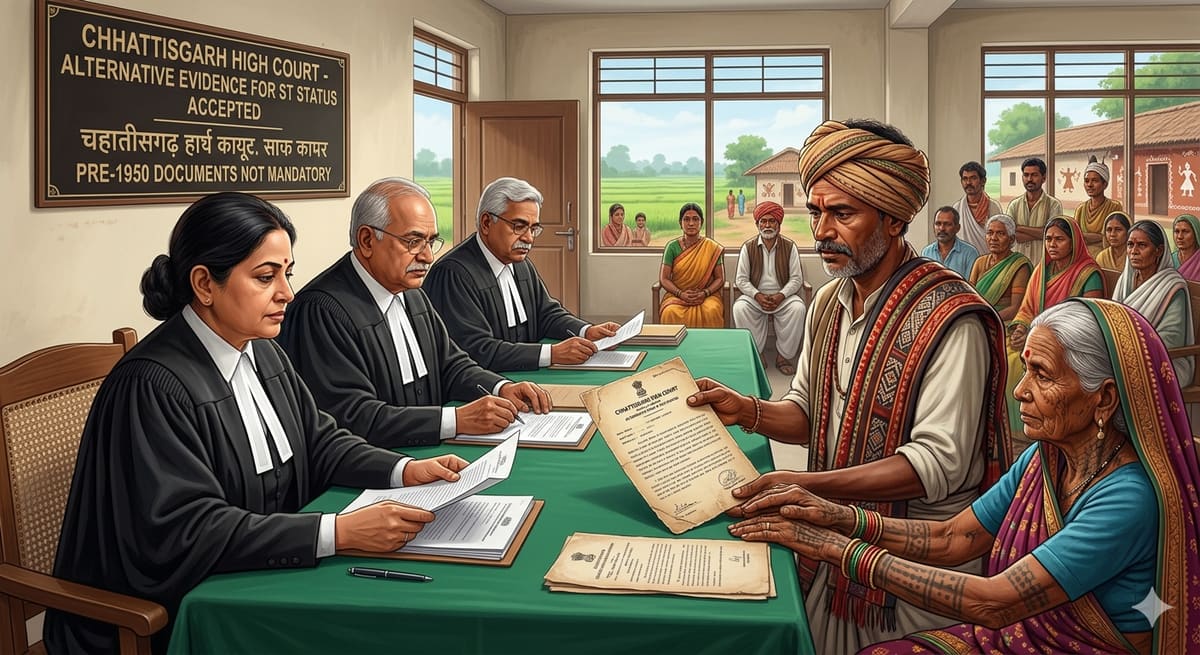
The Madhya Pradesh High Court has reaffirmed that the Mogia community is constitutionally recognized as a Scheduled Tribe under Entry No.16 of the Constitution (Scheduled Tribes) Order, 1950, quashing administrative denials of caste certificates based on flawed or mechanical reasoning.
Background & Facts
The Dispute
The petitioner, Devansh Mogia, sought issuance of a Scheduled Tribe (ST) certificate under Entry No.16 of the Constitution (Scheduled Tribes) Order, 1950, applicable to Madhya Pradesh. Despite clear judicial precedent recognizing the Mogia community as a Scheduled Tribe, the competent authorities - Respondent No.3 (Sub-Divisional Officer, Revenue) and Respondent No.4 (Additional Collector) - denied his application through orders dated 01.07.2024 and 21.06.2024 respectively. The denials were based on an internal research report from the Scheduled Tribe Research and Development Institute, Bhopal, which incorrectly conflated the Mogia community with the similarly named but distinct Moghia community classified as a Scheduled Caste under Entry No.39 of the Constitution (Scheduled Castes) Order, 1950.
Key Facts
- The petitioner belongs to the Mogia community, which is explicitly listed under Entry No.16 of the Constitution (Scheduled Tribes) Order, 1950, as amended for Madhya Pradesh.
- The list includes: "Gond, Arakh, Agaria, Asur, Badi Maraia, Bada Matia, Bhatola, Bhimma, Bhata, Koilalashuta, Koliabhuti, Bhar, Bisonhorn maria, Chota Mrai, Dandami Maria, Dhuru, Dhurwam Dhoba, Dhulia, Dorla, Gaiki, Gutta, Gatti, Gaita, Gond, Gowari, Hill Marai, Kandra, Kalanga, Khatola, Koitr, M Koya, Khirwar, Khirwara, Kucha Maria, Kuchki Maria, Madia, maria, Mana, Mannewar, Moghya, Mogia, Monghya, Mudoia, Muria, Nagarchi, Nagwanshi, Ojha, Raj Gond, Sonjhari Jhareka, Thatoa, Thotya, Wade Mrai, Vade Maria, Daroi."
- The State authorities relied on a 26.11.2007 letter from the Scheduled Tribe Research and Development Institute, Bhopal, which distinguished between "Mogia" (ST) and "Moghia" (SC), yet still denied the petitioner’s claim.
- The petitioner’s application was rejected without conducting a proper affinity test or appreciating pre-Independence documentary evidence, if any.
- The authorities failed to distinguish between the phonetically similar but constitutionally distinct communities: "Mogia" (ST) and "Moghia" (SC).
Procedural History
- 21.06.2024: Order passed by Additional Collector, rejecting ST certificate application.
- 01.07.2024: Order passed by Sub-Divisional Officer (Revenue), rejecting ST certificate application.
- 2024: Writ Petition No.23177 of 2024 filed before the High Court of Madhya Pradesh at Gwalior.
- 06.05.2026: Judgment delivered by the Hon’ble Justice Milind Ramesh Phadke.
The Parties' Positions
For the Petitioner
The petitioner contended that:
- The Mogia community has been unequivocally recognized as a Scheduled Tribe under Entry No.16 of the Constitution (Scheduled Tribes) Order, 1950.
- This position was settled by the Division Bench of this Court in State of M.P. & Others v. Dule Singh Solanki & Others (2014) MPHT 331 (DB).
- A similar petition, Kamaralal Mogia & Others v. State of M.P. & Others (W.P. No.19657 of 2017), was decided in favor of the petitioners on 09.05.2025, quashing identical denials.
- The rejection orders were mechanical, based on an erroneous interpretation of a research report, and ignored binding precedent.
- The authorities failed to conduct a proper verification under the guidelines laid down in Madhuri Patil v. Union of India and Anand v. Committee for Scrutiny and Verification of Tribes Claims.
For the Respondent/State
No reply was filed by the State or any of the respondents despite repeated opportunities granted by the Court.
Relief Sought
The petitioner sought:
- Quashing of the impugned orders dated 01.07.2024 and 21.06.2024.
- A direction to the respondents to issue a Scheduled Tribe certificate to the petitioner.
- Any other relief deemed fit by the Court.
The Legal Issue
The central question was whether the denial of a Scheduled Tribe certificate to a person belonging to the Mogia community, which is explicitly listed under Entry No.16 of the Constitution (Scheduled Tribes) Order, 1950, is lawful when the denial is based on an internal research report and failure to apply binding judicial precedent.
Arguments Presented
For the Petitioner
The petitioner relied on two binding precedents: State of M.P. & Others v. Dule Singh Solanki & Others (2014) MPHT 331 (DB) and Kamaralal Mogia & Others v. State of M.P. & Others (W.P. No.19657 of 2017, decided 09.05.2025). Both judgments held that the Mogia community is a Scheduled Tribe under Entry No.16 and that no geographical restriction applies. The petitioner argued that the authorities’ reliance on the 2007 research report was legally impermissible, as a Presidential Order cannot be overridden by administrative research. He further contended that the rejection was mechanical, lacked application of mind, and violated the principles laid down in Anand v. Committee for Scrutiny and Verification of Tribes Claims (2012) 1 SCC (L&S) 43, which mandates that documentary evidence - especially pre-Independence documents - must be given primacy, and affinity tests cannot be used as the sole criterion for rejection.
For the Respondent/State
No arguments were presented by the State, as no reply was filed despite ample opportunity.
The Court's Analysis
The Court observed that the issue was no longer res integra and had been conclusively settled by its own Division Bench in Dule Singh Solanki and reaffirmed in Kamaralal Mogia. The Court emphasized that the Constitution (Scheduled Tribes) Order, 1950, is a Presidential Order under Article 342 of the Constitution and holds supreme legal authority. Administrative research, even from specialized institutes, cannot override or reinterpret a Presidential Order.
"The research conducted by the Tribal Development Institute will certainly not supersede the Presidential Order 1950."
The Court noted that the authorities had confused the Mogia community (ST) with the similarly named Moghia community (SC), which is listed under Entry No.39 of the Constitution (Scheduled Castes) Order, 1950. This confusion had previously been addressed by the Division Bench in 2008 in Krishanpal Singh & Ors. v. State of M.P. & Ors., where the Court directed clarification that "Mogia" is ST and "Moghia" is SC.
The Court further held that the rejection orders were passed without application of mind, in violation of the principles in Anand v. Committee for Scrutiny and Verification of Tribes Claims. The Apex Court therein held that while affinity tests may corroborate documentary evidence, they cannot be the sole basis for rejection, especially when pre-Independence documents exist. The Court found no evidence that the petitioner’s documents were forged or that the claim was fraudulent.
The Court also noted the State’s failure to file any reply, which entitled the petitioner to the benefit of the presumption that his claim was valid. The Court concluded that the impugned orders were legally unsustainable and amounted to a denial of constitutional rights under Article 14 and Article 15.
The Verdict
The petitioner succeeded. The Court quashed the impugned orders dated 01.07.2024 and 21.06.2024. The respondents are directed to issue a Scheduled Tribe certificate to the petitioner, recognizing him as belonging to the Mogia community under Entry No.16 of the Constitution (Scheduled Tribes) Order, 1950. The certificate must be issued within three months from the date of receipt of a certified copy of this order.
What This Means For Similar Cases
Constitutional Orders Override Administrative Research
- Practitioners must argue that any administrative circular, research report, or internal policy contradicting a Presidential Order under Article 342 is ultra vires and void.
- In ST/SC certificate disputes, the hierarchy of authority is: Presidential Order > State Government Circulars > Research Institute Reports.
Affinity Test Cannot Be Sole Ground for Rejection
- The Anand v. Committee for Scrutiny and Verification of Tribes Claims guidelines are binding: documentary evidence, especially pre-Independence documents, must be given primacy.
- Affinity tests may be used to corroborate, but not to override, documentary proof.
- Denial based solely on perceived deviation from traditional tribal traits is legally impermissible in modern contexts.
Non-Filing of Reply Entitles Petitioner to Relief
- When the State fails to file a reply despite opportunities, courts may infer the absence of a valid defense.
- This principle reinforces the duty of state authorities to defend administrative actions substantively and timely.