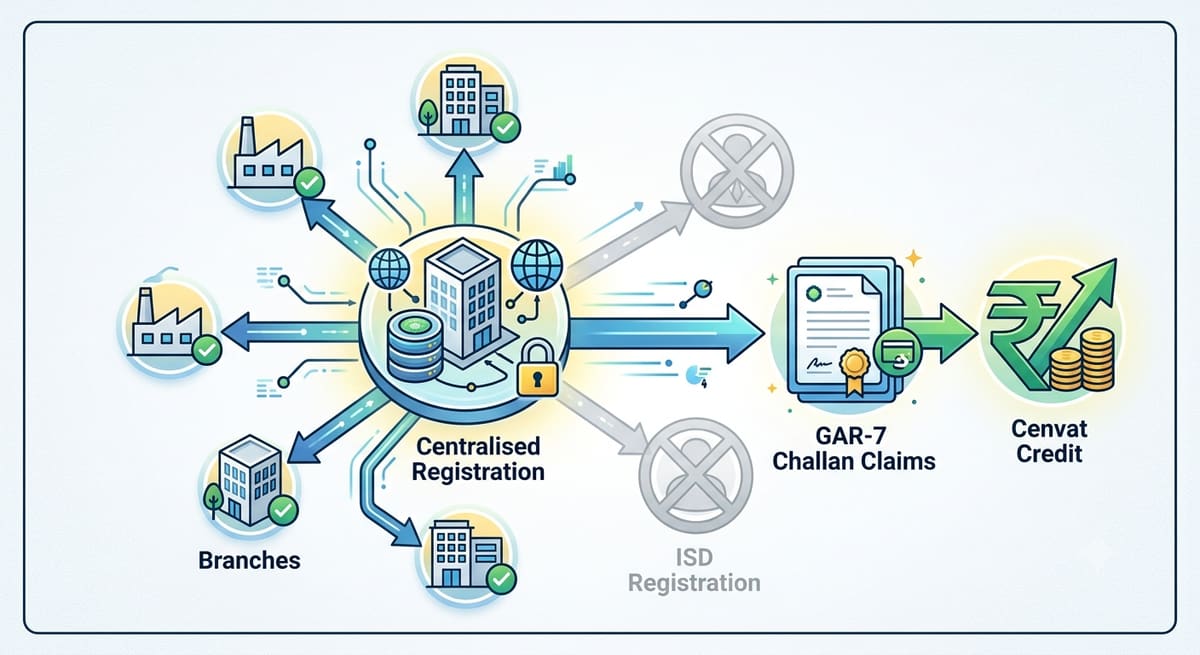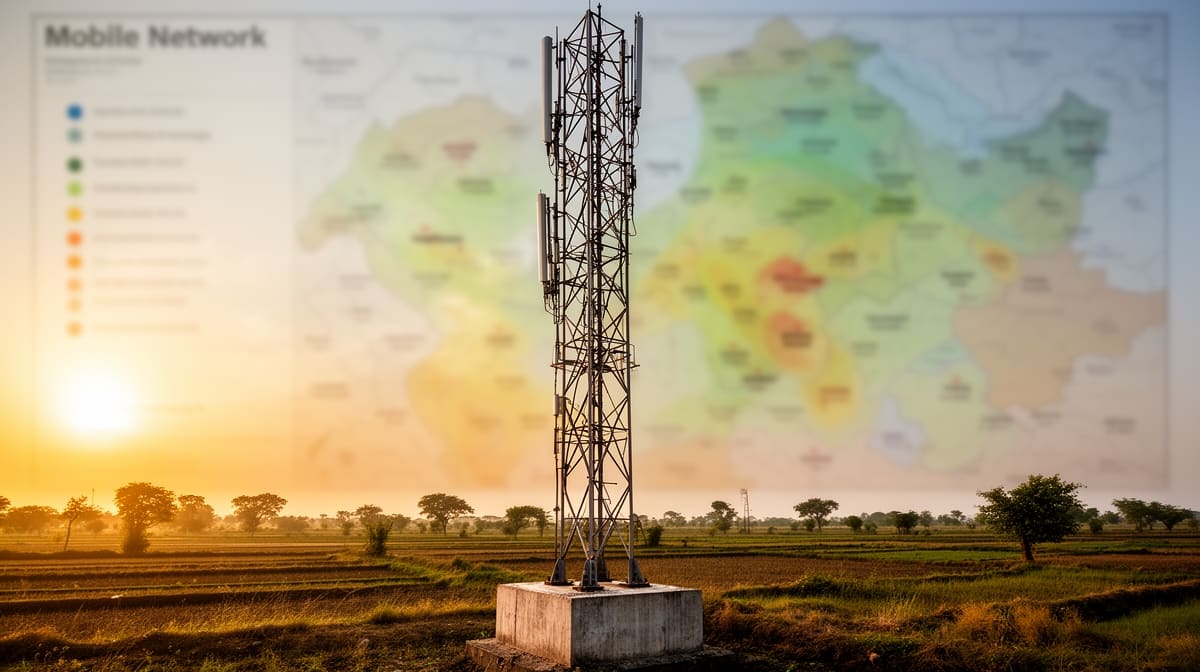
The Customs, Excise and Service Tax Appellate Tribunal (CESTAT) Chandigarh has delivered a landmark ruling affirming that telecom towers and pre-fabricated shelters are movable goods, not immovable property, and thus eligible for CENVAT Credit under the Cenvat Credit Rules, 2004. The Tribunal further held that unutilized CENVAT Credit may be transferred upon shifting centralized registration from one location to another, provided the credit was lawfully availed and no change in business ownership or structure occurred.
Background & Facts
The Dispute
The appellant, M/s Sistema Shyam Teleservices Ltd, a centralized service provider offering telecommunication services, was assessed for alleged inadmissible CENVAT Credit on capital goods, input goods, and input services used in the construction and operation of transmission towers. The Revenue also contested the transfer of unutilized CENVAT Credit from its Jaipur centralized registration to its new centralized registration in Gurgaon. Three appeals were filed: two by the assessee challenging denial of credit, and one by the Revenue challenging the dropping of a demand related to credit transfer.
Key Facts
- The assessee was centrally registered with Service Tax Authorities in Jaipur w.e.f. 10.05.2007 for services including cellular mobile telephony and leased circuits.
- On 22.09.2009, the assessee shifted its centralized accounting and billing functions from Jaipur to Gurgaon and obtained a new centralized registration in Gurgaon.
- The assessee transferred an unutilized CENVAT Credit balance of Rs. 1,71,37,92,147/- from Jaipur to Gurgaon as of 01.10.2009.
- The Revenue issued a show cause notice dated 29.09.2010 proposing denial of CENVAT Credit of Rs. 2,17,21,367/- for the period October 2008 to March 2010, relating to capital goods including towers, air conditioners, DG sets, battery sets, and pre-fabricated structures.
- A second show cause notice dated 19.09.2011 proposed denial of CENVAT Credit of Rs. 2,69,44,687/- for the financial year 2010-11, relating to input services used in the erection of transmission towers.
- The Adjudicating Authority, by Order-in-Original dated 30.03.2011, confirmed the denial of Rs. 2,17,21,367/- with interest and penalties, but dropped the demand of Rs. 1,71,37,92,147/- relating to credit transfer.
- By Order-in-Original dated 15.10.2012, the Adjudicating Authority confirmed the denial of Rs. 2,69,44,687/- with interest and penalties.
- The assessee’s accounts were audited by Jaipur Service Tax authorities and the Office of the Comptroller and Auditor General of India up to September 2009, with no adverse findings.
Procedural History
- 29.09.2010: Show cause notice issued for denial of CENVAT Credit of Rs. 2,17,21,367/- (period: Oct 2008 - Mar 2010)
- 19.09.2011: Show cause notice issued for denial of CENVAT Credit of Rs. 2,69,44,687/- (period: 2010 - 11)
- 30.03.2011: Order-in-Original No. 11/RDN/2011 passed by Commissioner, Service Tax, New Delhi
- Confirmed denial of Rs. 2,17,21,367/- with interest and penalties
- Dropped demand of Rs. 1,71,37,92,147/- relating to credit transfer
- 15.10.2012: Order-in-Original No. 167/ST/PKJ/CCE/Adj/2012 passed by Commissioner, Central Excise (Adj.), New Delhi
- Confirmed denial of Rs. 2,69,44,687/- with interest and penalties
- 18.11.2025: Hearing before CESTAT Chandigarh
- 17.03.2026: Final Order pronounced
The Parties' Positions
For the Assessee
- Argued that telecom towers and pre-fabricated shelters are movable goods, not immovable property, and thus qualify as capital goods or inputs under Rule 2(a) and Rule 2(k) of the Cenvat Credit Rules, 2004.
- Relied on the binding precedent of M/s Bharti Airtel Ltd v. CCE, Pune (2024 (11) TMI 1042 - SC), which held that towers are not permanently affixed to land, can be dismantled and relocated, and are essential for providing mobile telecommunication services.
- Cited multiple High Court and Tribunal decisions following Bharti Airtel, including Vodafone Idea Ltd v. CCE, Meerut and B.S.N.L. v. CCE, Chhattisgarh.
- Argued that input services used for erection of towers are eligible for CENVAT Credit as they are integrally connected to the output service.
- Contended that the transfer of unutilized CENVAT Credit from Jaipur to Gurgaon was lawful because it was merely a shift in centralized accounting, not a transfer or shift of business under Rule 10 of the Cenvat Credit Rules.
- Relied on Central Bank of India v. CC, CE & ST, Bhopal and Mafatlal Industries Ltd v. CCE & ST, Ahmedabad, which held that credit transfer on centralized registration shift cannot be denied if credit was lawfully availed.
For the Revenue
- Argued that towers and shelters are immovable property and thus ineligible for CENVAT Credit under Rule 2(a) and Rule 2(k).
- Contended that Rule 10 of the Cenvat Credit Rules permits credit transfer only in cases of change in ownership, sale, merger, amalgamation, lease, or transfer of business with transfer of liabilities.
- Asserted that shifting centralized accounting without transfer of business or assets does not qualify under Rule 10(2).
- Relied on CCE, New Delhi v. Avis Electronics Pvt Ltd (2000 (117) ELT 571 (Tri. LB)) to argue that credit transfer must strictly comply with Rule 10.
- Claimed that the assessee had not shifted any physical assets (e.g., DG sets, network equipment) from Jaipur to Gurgaon, making Rule 10 inapplicable.
- Argued that the impugned order dropping the demand of Rs. 1,71,37,92,147/- was legally unsustainable.
Relief Sought
- The assessee sought: (1) setting aside of the impugned orders denying CENVAT Credit of Rs. 2,17,21,367/- and Rs. 2,69,44,687/-; (2) restoration of the denied credit with interest; and (3) deletion of penalties.
- The Revenue sought: (1) setting aside of the order dropping the demand of Rs. 1,71,37,92,147/-; (2) recovery of the transferred credit with interest; and (3) imposition of penalties.
The Legal Issue
The central questions were: (1) Whether telecom towers and pre-fabricated shelters qualify as "goods" under the Cenvat Credit Rules, 2004, and are thus eligible for CENVAT Credit; and (2) Whether unutilized CENVAT Credit may be transferred upon shifting centralized registration from one location to another, absent a change in business ownership or structure.
Arguments Presented
For the Appellant/Petitioner
The assessee relied on the Supreme Court’s decision in Bharti Airtel Ltd v. CCE, Pune, which applied the tests of permanency, intendment, functionality, and marketability to conclude that telecom towers are movable property and not immovable. The Court held that such towers are accessories of BTS/antenna systems, essential for providing mobile telecommunication services, and thus fall under "capital goods" under Rule 2(a)(A)(iii) and "inputs" under Rule 2(k). The assessee further cited multiple Tribunal and High Court decisions affirming this interpretation. Regarding credit transfer, the assessee argued that Rule 10 applies only to transfer or shift of business, not to administrative shifts in centralized accounting. It relied on Central Bank of India and Mafatlal Industries, which held that where credit is lawfully availed and no fraud or misuse is shown, procedural non-compliance cannot override substantive rights.
For the Respondent/State
The Revenue contended that towers are immovable property under the Transfer of Property Act and General Clauses Act, and thus ineligible for credit. It argued that Rule 10(2) is exhaustive and permits credit transfer only in cases of business transfer with liability shift, which was absent here. It relied on Avis Electronics to assert that any deviation from Rule 10 is impermissible. The Revenue further claimed that since physical assets like DG sets were not moved, the transfer of credit was not justified. It also argued that the assessee’s reliance on Central Bank of India was misplaced as that case involved inter-branch transfers, not centralized registration shifts.
The Court's Analysis
The Tribunal conducted a detailed review of the Supreme Court’s judgment in Bharti Airtel Ltd v. CCE, Pune, emphasizing its reasoning that towers are not permanently affixed to land, can be dismantled and relocated without damage, and are sold as marketable goods. The Court observed:
"...mobile towers and PFBs are movable properties and hence, 'goods'. ...these items consequently are covered by the definition of 'capital goods' within the meaning of sub-clause (iii) read with sub-clause (i) of Rule 2(a)(A) of CENVAT Rules. ...they would also qualify as 'inputs' under Rule 2(k)..."
The Tribunal noted that this precedent had been uniformly followed by multiple High Courts and Benches of the Tribunal, including the Allahabad, Chennai, Mumbai, and Guwahati Benches. It held that the Revenue’s reliance on the immovability of towers was legally untenable in light of the binding Supreme Court ruling.
Regarding the transfer of CENVAT Credit, the Tribunal examined Rule 10 of the Cenvat Credit Rules, 2004, and found that it explicitly applies only to situations involving change in ownership, sale, merger, amalgamation, lease, or transfer of business with transfer of liabilities. The Tribunal held that shifting centralized accounting and billing functions, without any change in business structure, ownership, or physical assets, does not constitute a "shift or transfer of business" under Rule 10(2). The Adjudicating Authority’s reasoning - that centralized registration is an administrative convenience and not a substantive change in business - was affirmed.
The Tribunal further held that the Revenue could not raise a new ground in appeal that was not pleaded in the show cause notice. The notice had only alleged non-compliance with Rule 10, not that credit transfer was categorically prohibited. The Tribunal relied on CCE, Bhubaneswar-I v. Champdany Industries and CCE & ST, Chandigarh v. Shital International to hold that the Revenue cannot introduce a fresh legal theory in appeal that was not part of the original notice.
The Tribunal also emphasized that CENVAT Credit is a substantive right, not a procedural benefit, and once lawfully availed, it cannot be denied merely due to administrative reorganization.
The Verdict
The appeals filed by the assessee, ST/1017/2011 and ST/55426/2013, are allowed. The impugned orders denying CENVAT Credit of Rs. 2,17,21,367/- and Rs. 2,69,44,687/- are set aside. The credit is restored, and any interest or penalties imposed on these amounts are cancelled. The appeal filed by the Revenue, ST/1242/2011, is dismissed. The demand of Rs. 1,71,37,92,147/- relating to the transfer of unutilized CENVAT Credit from Jaipur to Gurgaon is upheld as lawful. The order dated 30.03.2011 is affirmed in its entirety.
What This Means For Similar Cases
Telecom Infrastructure Qualifies as Capital Goods
- Practitioners may now confidently claim CENVAT Credit on towers, shelters, and related equipment used in telecom services, provided they are not permanently embedded.
- Taxpayers in infrastructure-heavy sectors (e.g., power, railways, broadcasting) may apply the same logic to similar structures.
- Audit teams should reassess past disallowances of credit on telecom infrastructure and consider filing appeals or revisions.
Centralized Registration Shifts Do Not Trigger Rule 10
- Transfer of unutilized CENVAT Credit between centralized registrations within the same legal entity is permissible, even without physical asset movement.
- The burden is on the Revenue to prove that the credit was improperly availed, not that the registration was shifted.
- Companies undergoing operational reorganization (e.g., moving HQs, consolidating accounting) may now transfer credit without fear of disallowance under Rule 10.
Procedural Grounds Cannot Override Substantive Rights
- The Revenue cannot raise new grounds in appeal that were not part of the original show cause notice.
- Courts will protect substantive tax credits even if procedural formalities are imperfect, provided there is no fraud or evasion.
- Taxpayers should document credit availed and audit history meticulously to establish lawful entitlement.