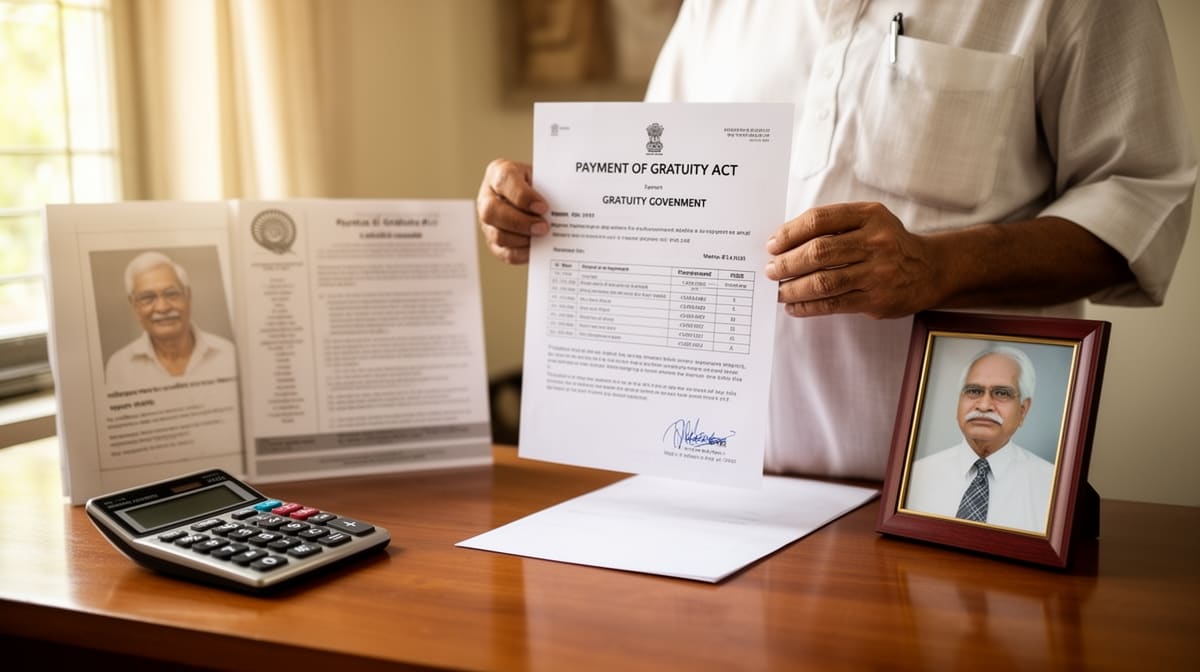
The Supreme Court has definitively clarified that employees of government projects operating under the Department of Atomic Energy, who are governed by special pension rules, are statutorily excluded from the ambit of the Payment of Gratuity Act, 1972. This judgment resolves a long-standing ambiguity regarding the applicability of the PG Act to Central Government servants and reinforces the primacy of specific statutory exclusions over general benefit provisions.
Background & Facts
The Dispute
The dispute centers on whether retired employees of the Heavy Water Plant (HWP) in Tuticorin, operated by the Department of Atomic Energy (DAE), are entitled to gratuity under the Payment of Gratuity Act, 1972 (PG Act). The employees, appointed under Central Civil Services (CCS) Rules, 1972, received retirement benefits including gratuity under those rules. They later claimed that the gratuity paid under CCS Rules was lower than what would be due under the PG Act and sought the differential amount.
Procedural History
The case progressed through multiple forums:
- 2014: Pension and gratuity paid to retired employee N. Manoharan under CCS (Pension) Rules, 1972
- 2015: Employee filed application before Controlling Authority under PG Act, claiming higher gratuity
- 2015: Controlling Authority held PG Act applicable, directing payment of differential gratuity
- 2016: Deputy Chief Labour Commissioner dismissed HWP’s appeal
- 2016: Madras High Court dismissed HWP’s writ petition
- 2021: Madras High Court, in Writ Appeal No. 1687 of 2021, reversed its earlier stance and held PG Act inapplicable
- 2024: Special Leave Petitions filed before Supreme Court by retired employees
Relief Sought
The appellants sought enforcement of gratuity payments under the PG Act, arguing that HWP functioned as an industrial establishment and that no exemption notification under Section 5 had been issued. They contended that the exclusion under Section 2(e) did not apply because HWP was not a formal government department.
The Legal Issue
The central question was whether employees of the Heavy Water Plant, appointed under Central Civil Services Rules and paid gratuity under those rules, are excluded from the definition of "employee" under Section 2(e) of the Payment of Gratuity Act, 1972, despite the absence of a formal exemption notification.
Arguments Presented
For the Appellant/Petitioner
The appellants relied on Municipal Corporation of Delhi v. Dharam Prakash Sharma to argue that adoption of CCS Rules by an autonomous body does not automatically exclude employees from the PG Act. They emphasized that HWP operated with functional autonomy in recruitment and service conditions, and that the absence of an exemption notification under Section 5 rendered the PG Act applicable by default. They contended that Section 14 of the PG Act, which provides for overriding effect, should prevail over the CCS Rules.
For the Respondent/State
The State argued that HWP is not a separate legal entity but an adjunct of the DAE, and that the employees hold "civil posts under the Central Government" as defined in Section 2(e). They stressed that the CCS (Pension) Rules, 1972 constitute a specific statutory framework providing gratuity, thereby triggering the exclusionary clause. The absence of a corporate identity - no registration under the Companies Act, no separate legal personality - confirmed that HWP is not an independent industrial establishment.
The Court's Analysis
The Court undertook a rigorous textual and contextual analysis of Section 2(e) of the Payment of Gratuity Act, 1972. It emphasized that the definition uses the phrase "means... but does not include," which this Court has consistently interpreted as an exhaustive and exclusionary definition. The Court held that the exclusionary limb applies if any one of the four conditions is met: (i) post under Central Government, (ii) post under State Government, (iii) governed by any other Act, or (iv) governed by any rules providing for gratuity.
"The provision contains the words both ‘means’ and ‘does not include’. Under interpretation of statutes, this Court has repeatedly held that coupling the word ‘means’ with ‘does not include’ denotes an exhaustive definition."
The Court rejected the appellants’ reliance on MCD, distinguishing that case on the ground that the Municipal Corporation of Delhi was a statutory corporation that had adopted CCS Rules, whereas HWP employees were originally appointed as Central Government servants under a specific statutory framework. The Court further held that the AE Act, 1962 and the Office Memorandum of 1969 establishing the Heavy Water Projects Board did not create a separate corporate entity. HWP lacked attributes of a PSU - no incorporation, no limited liability, no perpetual succession - and thus remained an ancillary unit of the DAE.
The Court also dismissed the argument that Section 14 could override the exclusion, noting that Section 14 applies only to those who first qualify as "employees" under the PG Act. Since the appellants were excluded at the threshold by Section 2(e), Section 14 had no application. The Court affirmed that jurisdictional facts - such as the nature of appointment and governing rules - determine statutory applicability, not functional autonomy or operational independence.
The Verdict
The Supreme Court dismissed the appeals. It held that employees of the Heavy Water Plant, being appointed under Central Civil Services Rules and receiving gratuity under those rules, are expressly excluded from the definition of "employee" under Section 2(e) of the Payment of Gratuity Act, 1972. The CCS (Pension) Rules, 1972 constitute a specific statutory framework that triggers the exclusion, rendering the PG Act inapplicable.
What This Means For Similar Cases
Exclusion Under Section 2(e) Is Absolute
- Practitioners must now assess whether an employee is governed by any other Act or Rules providing gratuity before invoking the PG Act
- Even if no exemption notification under Section 5 exists, the exclusion under Section 2(e) operates independently
- Government departments and their ancillary units (e.g., research centers, production units) are not automatically subject to the PG Act if governed by civil service rules
Functional Autonomy Does Not Override Statutory Status
- Operational independence or autonomy in recruitment does not transform a government project into a separate industrial establishment
- The legal character of the employer - whether a department, board, or PSU - is decisive, not the degree of administrative freedom
- Courts will examine appointment orders, governing rules, and corporate status, not merely the nature of work performed
CCS Rules as a Statutory Shield
- Employees covered by CCS Rules, State Service Rules, or similar statutory frameworks cannot claim benefits under the PG Act for the same benefit
- The doctrine of estoppel, while not formally invoked, reinforces that accepting benefits under one statutory regime precludes claiming under another for the same purpose
- Employers should ensure consistent application of service rules to avoid future litigation