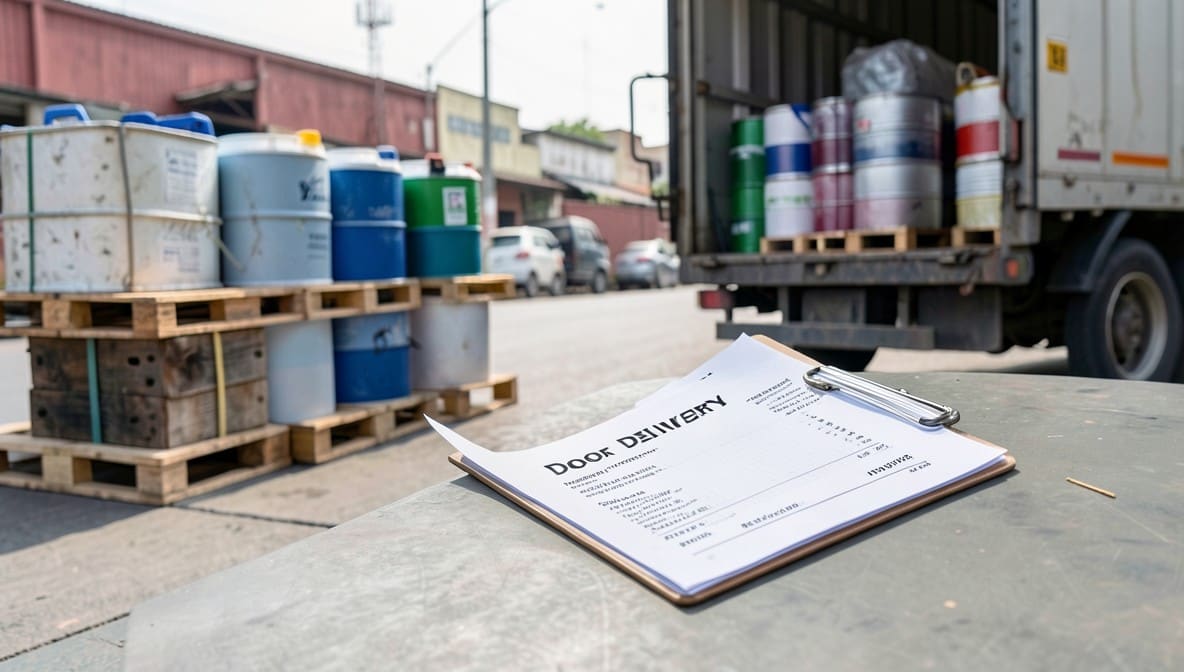
The Customs, Excise & Service Tax Appellate Tribunal has clarified a critical principle in indirect tax law: when goods are sold on a door delivery basis, freight and insurance charges collected from buyers form part of the assessable value for Central Excise duty. This ruling resolves longstanding ambiguity in valuation practices and reinforces the primacy of contractual terms over commercial convenience.
Background & Facts
The Dispute
M/s Nishant Organics Private Limited, a manufacturer of aromatic chemicals including DI ETHYL PHTHALATE and DI METHYL PHTHALATE, was audited by Central Excise authorities for alleged under-invoicing of excisable goods. The dispute centered on whether freight and insurance charges collected from customers for door-to-door delivery of finished goods should be included in the assessable value for Central Excise duty under Section 4 of the Central Excise Act, 1944.
Key Facts
- The appellant manufactured and sold aromatic chemicals to buyers across India
- Sales invoices consistently stated "Door Delivery" as the term of delivery
- Freight and insurance charges were separately listed on invoices but excluded from the assessable value for excise duty calculation
- The appellant collected freight and insurance amounts from buyers and paid them to transporters and insurers
- The appellant also availed Cenvat credit on service tax paid on transportation services
- The period under scrutiny was January 2015 to June 2017
- The appellant merged with M/s Lakshya Enterprises Private Ltd w.e.f. 01.09.2016
Procedural History
- 21.08.2019: Show cause notice issued by Central Excise authorities demanding Rs. 2,69,101/- as Central Excise duty, along with interest and penalty
- 20.12.2019: Assistant Commissioner adjudicated the notice, confirming the demand and imposing penalty equal to the duty under Section 11AC(1)(e)
- 28.03.2020: Commissioner (Appeals) dismissed the appellant’s appeal, upholding the order
- 25.11.2025: Hearing before the CESTAT West Zonal Bench, Ahmedabad
- 07.04.2026: Final order passed by the Tribunal
Relief Sought
The appellant sought:
- Setting aside of the show cause notice and adjudication order
- Exclusion of freight and insurance charges from assessable value
- Cancellation of penalty under Section 11AC
- Declaration that the extended period of limitation was not applicable
- Restoration of Cenvat credit on service tax paid on transportation
The Legal Issue
The central question was whether freight and insurance charges collected by a manufacturer from buyers for door delivery of goods must be included in the assessable value for Central Excise duty under Section 4 of the Central Excise Act, 1944, when the terms of sale clearly indicate delivery at the buyer’s premises.
Arguments Presented
For the Appellant
The appellant relied on multiple Supreme Court and CESTAT precedents including Hind Rectifiers Ltd., Accurate Meters Ltd., and Chamundi Explosives Pvt Ltd., arguing that:
- Freight and insurance were paid on behalf of the buyer under separate arrangements
- The sale was effectively at ex-factory price, with ownership transferring at the factory gate
- The charges were reimbursements, not part of the sale consideration
- The department’s position was internally contradictory - rejecting Cenvat credit on transport services while including freight in excise value
- The extended period of limitation was not applicable as the department had knowledge of the practice
- Penalty under Section 11AC was unjustified due to lack of fraudulent intent
For the Respondent
The Revenue contended that:
- The invoices explicitly stated "Door Delivery", indicating the place of removal was the buyer’s premises
- Under Section 4 and Rule 5 of the Central Excise Valuation Rules, 2000, value includes all costs incurred until the point of transfer of ownership
- The Supreme Court in Roofit Industries Ltd. held that where ownership transfers at the buyer’s premises, transportation and insurance costs form part of the transaction value
- The appellant had no contractual obligation from buyers to arrange transport on their behalf
- The non-disclosure in ER-1 returns demonstrated deliberate concealment
- The extended period of limitation under Section 11A(4) was validly invoked
The Court's Analysis
The Tribunal undertook a detailed examination of the contractual terms, invoice language, and judicial precedents. It distinguished the appellant’s case from those cited in its favor by focusing on the absence of any written agreement or correspondence indicating that the appellant was acting as an agent of the buyer in arranging transport or insurance.
"In the case in hand, it is not in dispute from the copy of invoices that as per terms of delivery, goods were to be handed over to the customer at his premises i.e. 'door delivery'. The payment terms '60 days' also indicates that price of the goods was to be paid after delivery of the goods at the Customer's premises."
The Tribunal emphasized that under Section 4(3)(c) of the Central Excise Act, "place of removal" includes any location from where goods are sold after clearance from the factory. Where delivery is to the buyer’s premises and payment is made only upon receipt, ownership transfers at that point under Section 19 of the Sale of Goods Act, 1930.
"Sale of goods was at the place of buyer on delivery of goods, and not at the factory gate of the assessee. Hence, cost of transportation, loading, transit risk, unloading charges, etc. are includable in the value of goods."
The Tribunal rejected the appellant’s reliance on Hind Rectifiers and Accurate Meters, noting that in those cases, buyers had issued explicit instructions or separate contracts for transport arrangements. Here, no such evidence existed. The invoices themselves, with terms like "Door Delivery" and deferred payment, were conclusive.
Regarding limitation, the Tribunal upheld the Commissioner’s finding that the omission was not inadvertent but concealed through non-disclosure in ER-1 returns. The extended period under Section 11A(4) was therefore validly invoked.
On penalty, while acknowledging the absence of malafide intent, the Tribunal upheld the imposition under Section 11AC(1)(e) but extended an option to pay only 25% of the penalty if the duty and interest were paid within one month.
The Verdict
The appeal was dismissed. The Tribunal upheld the demand of Central Excise duty of Rs. 2,69,101/-, including Education Cess and Secondary & Higher Education Cess, along with interest under Section 11AA. Penalty under Section 11AC(1)(e) was confirmed but reduced to 25% of the original amount, provided the appellant pays the full duty, interest, and reduced penalty within one month from the date of the order. The Cenvat credit claim on transportation services was disallowed.
What This Means For Similar Cases
Door Delivery Triggers Inclusion of Freight in Excise Value
- Practitioners must now treat "door delivery" or "godown delivery" terms on invoices as conclusive evidence that the place of removal is the buyer’s premises
- Any freight, insurance, or handling charges collected from buyers must be included in the assessable value for excise duty
- Excluding such charges on the basis of "reimbursement" or "agency" claims will fail without documentary proof of buyer-initiated arrangements
Documentation Is Critical to Avoid Penalty
- Non-disclosure of freight and insurance in ER-1 returns will be treated as concealment, triggering extended limitation and penalty
- Even if the taxpayer believes the practice is legally sound, failure to disclose exposes them to penalty under Section 11AC
- Taxpayers should maintain internal audit trails showing buyer instructions for transport arrangements to support exclusion claims
Cenvat Credit and Excise Valuation Are Not Interchangeable
- Availing Cenvat credit on service tax paid for transportation does not justify excluding freight from excise value
- The two regimes operate independently - service tax on logistics services and excise duty on goods valuation are governed by separate statutory frameworks
- Taxpayers must maintain separate compliance systems for each