The Karnataka High Court has delivered a decisive ruling affirming that statutory buffer zones around water bodies cannot be circumvented by municipal approvals, even where construction plans appear formally sanctioned. This judgment reinforces the primacy of environmental protection frameworks over procedural compliance by local bodies, setting a critical precedent for urban development litigation across India.
Background & Facts
The Dispute
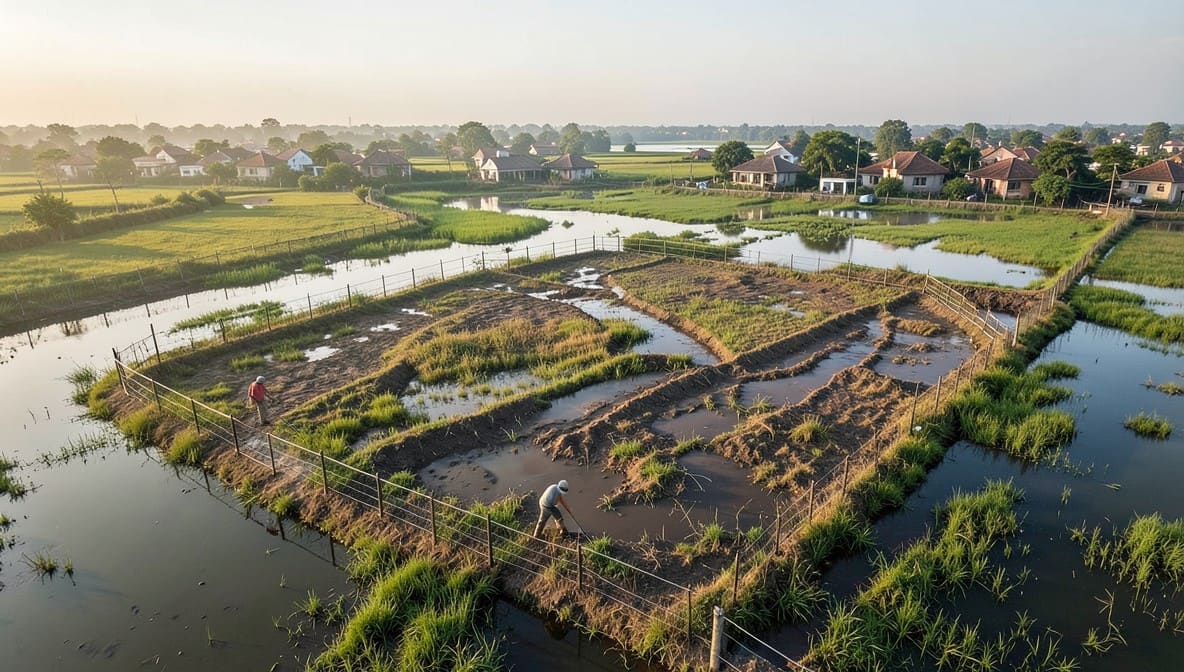
The petitioner, Sarakki Lake Area Improvement Trust, filed a Public Interest Litigation seeking enforcement of a 30-meter buffer zone around Sarakki Lake in Bengaluru, as mandated by the Master Plan-2015. The 13th respondent, Mahavir Developers, constructed a residential complex allegedly within this buffer zone, despite having obtained a sanctioned plan and commencement certificate from the Bruhat Bengaluru Mahanagara Palike (BBMP). The petitioner alleged that the construction violated revenue records, the Karnataka Town and Country Planning Act, 1961 (KTCP Act), and prior court directives.
Procedural History
- 2013: W.P. No. 17464/2013 filed to remove encroachments and rejuvenate Sarakki Lake.
- 05.08.2014: High Court directed removal of encroachments and fencing of lake boundaries.
- 2019: Sanctioned plan granted to Mahavir Developers by BBMP.
- 2020: Commencement certificate issued by BBMP.
- 2023: Present PIL filed after discovery of construction within buffer zone.
- 13.08.2025: Court directed Deputy Commissioner and BBMP to file affidavits with survey maps.
- 17.10.2025 & 14.11.2025: Affidavits filed by Respondents 5 and 6 confirmed encroachment of 1679.38 sq.m. within buffer zone.
Relief Sought
The petitioner sought: (a) immediate stoppage of construction; (b) restoration of lake and buffer zone to revenue-record status; (c) identification and action against violators; and (d) probe into official inaction.
The Legal Issue
The central question was whether a municipal sanction under the Karnataka Municipal Corporations Act, 1976, can override the mandatory 30-meter buffer zone stipulated under the Master Plan-2015 and the KTCP Act, and whether such sanction renders construction lawful despite clear violation of environmental zoning norms.
Arguments Presented
For the Petitioner
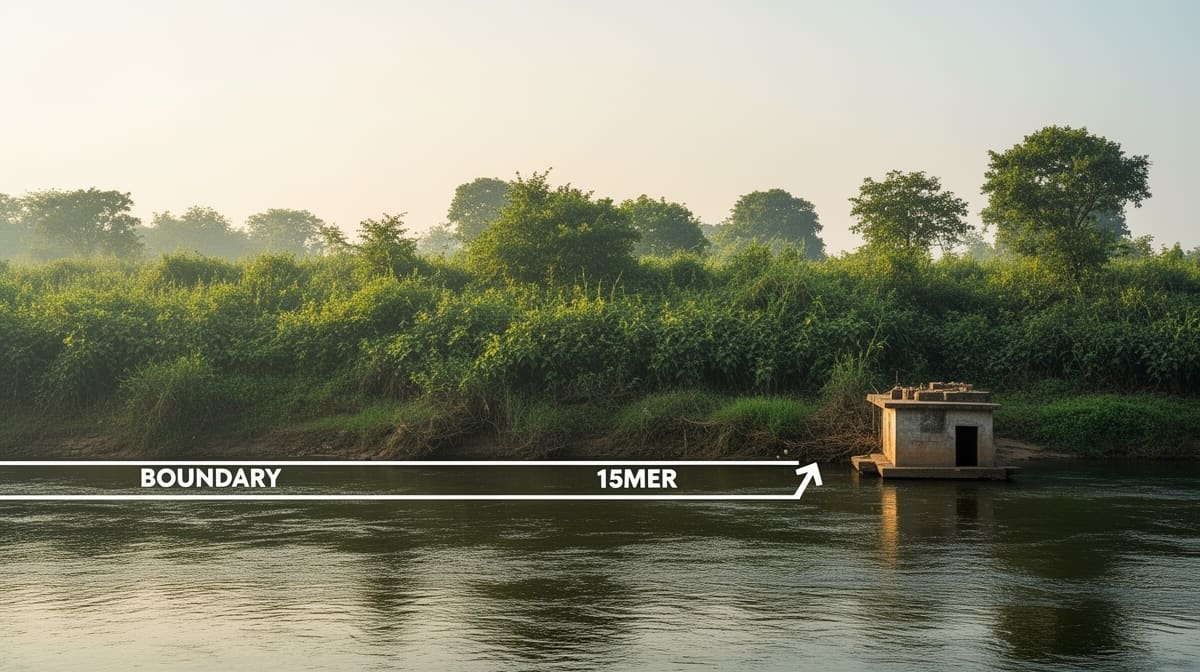
The petitioner relied on Regulation 4.2.2(ii)(iv) of the Master Plan-2015, which mandates a 30-meter non-development buffer zone from the lake’s revenue boundary. It cited affidavits from the Deputy Commissioner and BBMP confirming encroachment, and argued that the sanctioned plan was issued in violation of Section 505 of the KMC Act, which requires conformity with the KTCP Act. The petitioner emphasized that the buffer zone must be measured from the outer revenue boundary, not from a road or temporary fencing, and that prior court orders in W.P. No. 17464/2013 had already mandated protection of the lake’s integrity.
For the Respondent
The 13th respondent contended that its construction was lawful as it had obtained a sanctioned plan and commencement certificate from BBMP. It argued that the road adjacent to the property, existing since time immemorial, formed the de facto boundary, placing the construction beyond the 30-meter buffer. It further claimed that the survey map submitted by the petitioner was inaccurate and that other constructions in the vicinity were similarly situated, suggesting selective enforcement.
The Court's Analysis
The Court undertook a rigorous statutory interpretation of the KTCP Act, the Master Plan-2015, and the KMC Act. It held that Section 505 of the KMC Act explicitly prohibits any municipal sanction if it contravenes the KTCP Act. The Court emphasized that sanctioned plans are not conclusive proof of legality when they violate statutory zoning norms.
"The grant of a sanctioned plan under the KMC Act cannot be construed as a license to violate the buffer zone mandated under the Master Plan or the KTCP Act."
The Court rejected the respondent’s reliance on the road as a boundary, noting that revenue records and the 2013 survey sketch - validated by the Deputy Commissioner - clearly demarcated the lake’s outer boundary. The Court further held that the buffer zone must be measured from the edge of the lake’s revenue boundary, irrespective of physical features like roads or fencing, which may be irregular or illegally altered.
The Court distinguished M/s. SJR Prime Corporation Pvt. Ltd. v. BBMP (2023), which had similarly held that municipal approvals cannot override planning statutes. It also noted that the 2014 Tank Conservation Act and subsequent amendments created a statutory framework for lake protection, reinforcing the need for strict compliance.
The Court dismissed the argument of selective enforcement, stating that the State’s duty to protect public environmental assets cannot be contingent on the scale of violations. It further rejected the claim of res judicata, holding that the current encroachment was not adjudicated in the 2014 order.
The Verdict
The petitioner succeeded. The Court held that construction within the 30-meter buffer zone is illegal regardless of municipal sanction, and that the Master Plan’s environmental zoning norms prevail over procedural approvals. The Court directed the State to constitute a multi-agency committee to oversee removal of encroachments and report compliance within three months.
What This Means For Similar Cases
Municipal Sanctions Are Not a Shield Against Environmental Violations
- Practitioners must challenge construction permits that violate Master Plans or environmental buffer zones, even if accompanied by commencement certificates.
- The burden shifts to the developer to prove compliance with planning statutes, not merely to produce municipal documents.
- Courts will not validate illegal construction merely because a local body issued a sanction.
Buffer Zones Must Be Measured from Revenue Boundaries
- In all lake, tank, or wetland protection cases, the starting point for buffer measurement is the outer revenue boundary as recorded in Akarbandh, Tippani, or Resurvey records.
- Physical features like roads, fences, or temporary markers cannot override official revenue maps.
- Survey maps obtained under RTI, if authenticated by land records officials, carry decisive evidentiary weight.
Enforcement Requires Institutional Coordination, Not Ad Hoc Litigation
- The Court’s directive to form a multi-agency committee sets a new precedent for complex environmental enforcement.
- Practitioners should now seek court-appointed oversight committees in PILs involving overlapping jurisdictions (e.g., BBMP, RERA, Tank Authority).
- Non-compliance with such court-constituted committees may now attract contempt proceedings.