The National Green Tribunal’s order in Mukesh Goud v. State of Madhya Pradesh reinforces the legal imperative of maintaining mandatory buffer zones around water bodies, establishing that non-compliance with statutory distance norms constitutes a violation of environmental protection principles under the National Green Tribunal Act, 2010.
Background & Facts
The Dispute
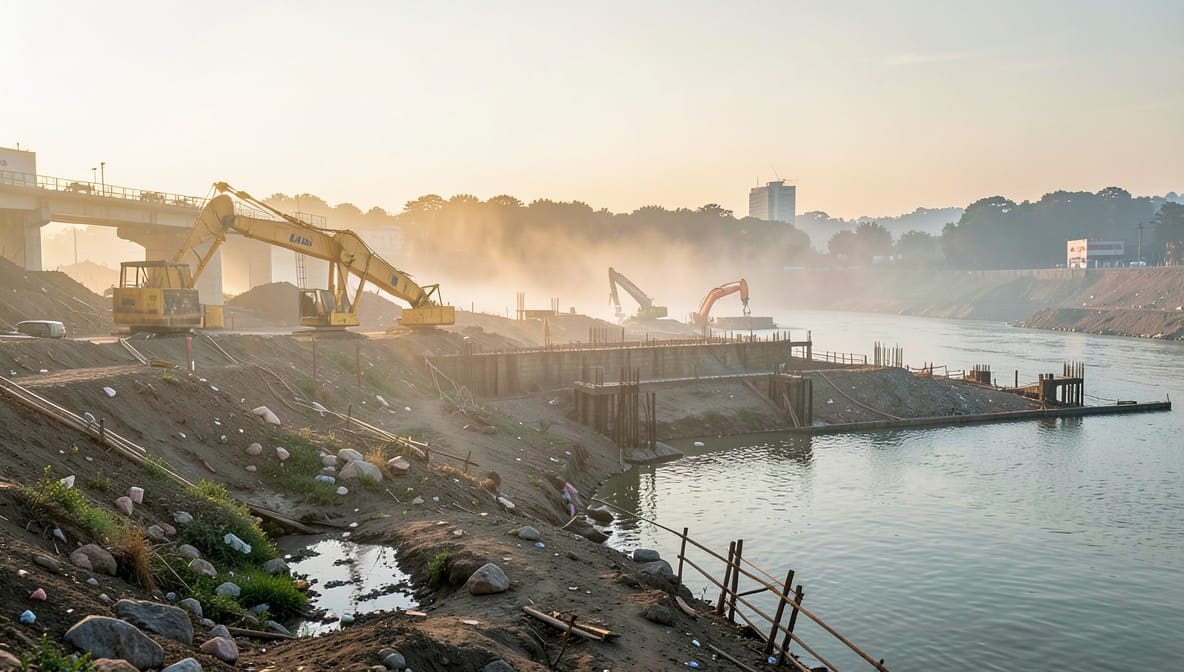
The applicant, Mukesh Goud, challenged unauthorized constructions along the banks of a river in Madhya Pradesh, alleging that buildings were erected within 33 meters of the high flood level, in direct contravention of the Madhya Pradesh Bhoomi Vikas Niyam, 2012, and the Madhya Pradesh Land Development Rules, 2012. The joint committee appointed by the Tribunal found 37 encroachments, all situated far beyond the legally mandated 15-meter buffer from the highest waterline of a watercourse.
Procedural History
- Original Application No. 99/2025(CZ) filed before the Central Zone Bench of the National Green Tribunal seeking enforcement of environmental norms.
- I.A. No. 38/2026 moved by respondents 7, 8, and 9 seeking to justify the 33-meter measurement as compliant with local norms.
- Tribunal examined the joint committee’s report and found no legal basis for the 33-meter standard.
- Respondents failed to produce any Master Plan or statutory provision authorizing the deviation.
Relief Sought
The applicant sought immediate cessation of construction activities within the 15-meter buffer zone, demolition of illegal structures, and direction to the State to enforce compliance with the Land Development Rules, 2012.
The Legal Issue
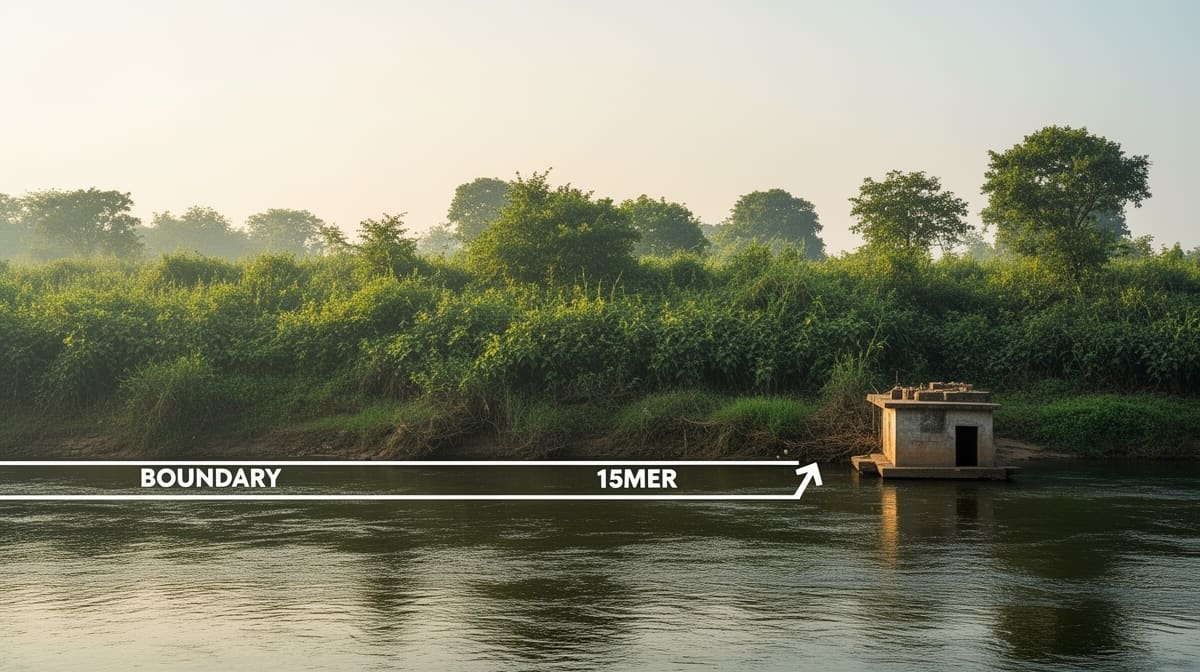
The central question was whether construction within 33 meters of a river’s high flood level complies with Rule 50(b) of the Madhya Pradesh Land Development Rules, 2012, which mandates a 15-meter buffer from the highest waterline of a watercourse.
Arguments Presented
For the Appellant/Petitioner
The applicant’s counsel argued that Rule 50(b) explicitly prohibits construction within 15 meters of a river’s high flood level, and that any deviation from this norm - whether by local practice, administrative convenience, or unofficial interpretation - violates statutory environmental safeguards. Reliance was placed on the principle of precautionary environmental governance under Section 3 of the Environment (Protection) Act, 1986, and the doctrine of sustainable development recognized in M.C. Mehta v. Union of India.
For the Respondent/State
The respondents contended that the 33-meter measurement was based on historical land use patterns and local development plans, and that the 15-meter norm was not uniformly enforced across the State. They argued that the joint committee’s report reflected a reasonable interpretation of local conditions and that strict enforcement would cause undue hardship to residents. However, they failed to produce any official Master Plan or amendment to Rule 50(b) justifying the deviation.
The Court's Analysis
The Tribunal conducted a strict textual interpretation of Rule 50(b), which states: "No building shall be constructed on any plot of land if the site is within 9 meters (15 meters in the case of a river) from the highest waterline of a reservoir/watercourse." The Court emphasized that the rule is unambiguous and leaves no room for discretionary deviation. The respondents’ reliance on a 33-meter standard was not supported by any statutory instrument, Master Plan, or amendment.
"The statutory mandate of 15 meters is not a recommendation but a mandatory environmental safeguard. Any construction within this zone is ipso facto illegal, irrespective of local practice or administrative acquiescence."
The Tribunal rejected the argument that historical usage could override statutory norms, citing T.N. Godavarman Thirumulpad v. Union of India, which held that environmental laws must be interpreted in a manner that prioritizes ecological integrity over convenience. The Court further noted that the State’s failure to produce any documentation justifying the 33-meter standard amounted to a violation of procedural due process under Article 21 of the Constitution, as interpreted in environmental jurisprudence.
The Tribunal also observed that the respondents’ request for additional time to clarify their position was not an admission of legality but an acknowledgment of non-compliance, which could not be condoned.
The Verdict
The applicant succeeded. The Tribunal held that construction within 15 meters of a river’s high flood level is strictly prohibited under Rule 50(b), and any deviation is illegal. The State was directed to identify and remove all encroachments within the 15-meter zone and submit compliance reports within stipulated timelines.
What This Means For Similar Cases
Buffer Zones Are Non-Negotiable
- Practitioners must now treat 15-meter river buffers as absolute legal boundaries under MP Land Development Rules, 2012.
- Any claim of "historical usage" or "local practice" as justification for encroachment is legally untenable.
- Environmental NGOs and petitioners can invoke this ruling to challenge similar violations in other States with analogous rules.
Procedural Compliance Is Mandatory
- Authorities must produce official Master Plans or statutory amendments to justify deviations from environmental norms.
- Failure to do so renders any approval or clearance void ab initio.
- In litigation, the burden shifts to the State to prove legal authorization - not to the petitioner to disprove it.
Enforcement Must Be Proactive
- State agencies like MPPCB and urban development departments must conduct regular surveys of riverbanks and initiate demolition proceedings without waiting for complaints.
- Delay in enforcement constitutes constructive negligence under environmental law principles.
- Future applications under the NGT Act should cite this order to demand immediate interim relief against ongoing construction in buffer zones.