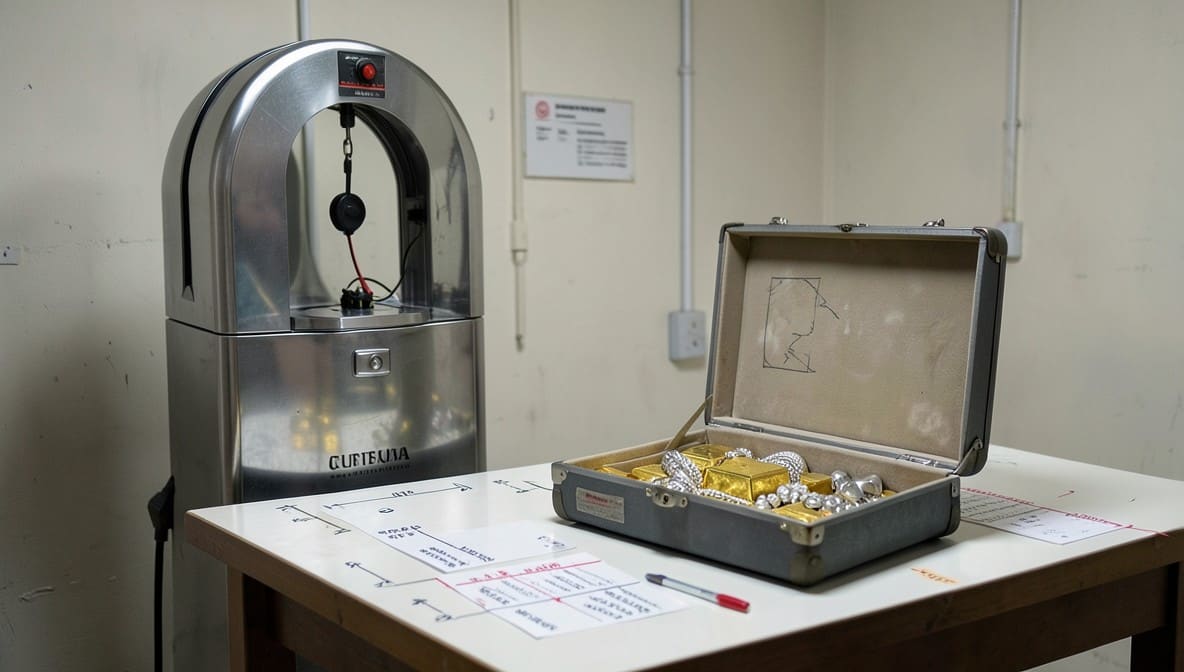
The Customs Appellate Tribunal has affirmed that the clandestine concealment of gold within the human body, coupled with failure to produce lawful documentation, constitutes conclusive evidence of smuggling intent under the Customs Act, 1962. This ruling reinforces the legal principle that circumstantial evidence, particularly modus operandi, can establish guilt in customs violations where direct admission is absent.
Background & Facts
The Dispute
The appellant, Uday Shankar Rai, was intercepted at Netaji Subhash Chandra Bose International Airport, Kolkata, on 18.01.2016 upon arrival from Guwahati on Indigo Flight No. 6E 208. Customs officials, acting on specific intelligence, suspected him of smuggling gold concealed within his body. A search led to the recovery of three bundles wrapped in blue carbon paper and sealed with adhesive tape and rubber sheets, which were voluntarily ejected by the appellant during interrogation.
Key Facts
- The three bundles contained six rectangular bars of yellow metallic substance, later confirmed by a government-approved valuer to be 24 Karat gold of foreign origin
- Total weight: 996.600 grams
- Total value: Rs. 26,40,990
- No bill of lading, invoice, customs declaration, or any document evidencing lawful import or possession was produced by the appellant
- The appellant was not carrying any other personal effects beyond a single handbag
- The gold was found to be in a melted, non-commercial form, inconsistent with personal jewelry or legitimate trade
- The appellant’s voluntary statements dated 18.01.2016 and 19.01.2016 disclosed he earned Rs. 5,000 per month and claimed to have purchased the gold in Guwahati to sell at a profit in Kolkata
- No corroborative evidence supported his claim of purchase or intended sale
Procedural History
- 18.01.2016: Appellant intercepted at Kolkata Airport; gold recovered from body cavity
- 08.07.2016: Show Cause Notice issued under Sections 111(d), 111(i), 111(l), and 112(a)(b) of the Customs Act, 1962
- 07.03.2019: Adjudicating Authority passed Order No. 23/2019 ADC, ordering absolute confiscation of gold and imposing penalty of Rs. 12,00,000
- 24.08.2020: Commissioner of Customs (Appeals) upheld the adjudication order
- 22.05.2026: Hearing before CESTAT Eastern Zonal Bench, Kolkata
- 11.06.2026: Final order passed dismissing the appeal
Relief Sought
The appellant sought setting aside of the confiscation order and penalty, arguing lack of natural justice, absence of proof of foreign origin, and absence of mens rea. He requested return of the seized gold and cancellation of the penalty.
The Legal Issue
The central question was whether the concealment of gold within the body cavity, combined with failure to produce lawful documentation, is sufficient to establish smuggling intent under Section 111(d), 111(i), and 111(l) of the Customs Act, 1962, and whether imposition of penalty under Section 112(a) and 112(b) is legally justified in the absence of direct admission.
Arguments Presented
For the Appellant
The appellant’s counsel contended that:
- Mere concealment does not automatically prove foreign origin or smuggling intent
- The lower authorities relied solely on the appellant’s statements without independent corroboration
- No forensic or laboratory evidence conclusively established the gold’s origin as foreign
- The appellant was denied adequate opportunity for personal hearing, violating principles of natural justice
- The penalty under Section 112 was disproportionate and unsupported by evidence of dishonesty
For the Respondent
The Revenue’s authorized representative argued that:
- The modus operandi of concealing gold in the rectum is a classic hallmark of smuggling, not accidental or innocent transport
- Gold is a notified item under Section 123 of the Customs Act, placing the burden of proving lawful possession on the person in possession
- The appellant’s financial capacity (earning Rs. 5,000/month) made the purchase of Rs. 26.4 lakh gold implausible
- The absence of any documentation, combined with the method of concealment, creates an irrebuttable presumption of illegal import
- The penalty under Section 112 is mandatory where goods are liable to confiscation under Section 111
The Court's Analysis
The Tribunal emphasized that smuggling under the Customs Act is not dependent on direct confession but may be inferred from conduct, circumstances, and the nature of concealment. The Court noted:
"If the appellant had brought the gold through legal means, then there was no need for him to conceal the same in his rectum."
The Tribunal held that the ingenious method of concealment - deep within a body cavity, wrapped in multiple layers, and deliberately hidden from detection - was not consistent with personal use, gift, or accidental transport. Such conduct, the Court observed, is exclusively associated with attempts to evade customs duties.
The Court further relied on Section 123 of the Customs Act, 1962, which places the burden of proving lawful acquisition or possession on the person from whose custody the goods are seized. The appellant failed to discharge this burden. The valuer’s report confirmed the gold was 24 Karat, a purity standard rarely found in domestic Indian gold, further supporting its foreign origin.
The Tribunal rejected the appellant’s claim that he purchased the gold in Guwahati for resale, noting the complete absence of purchase receipts, transport records, or buyer contacts. His financial profile rendered the claim implausible.
Regarding natural justice, the Court found that three opportunities for personal hearing were granted, and the appellant had ample opportunity to submit documents or evidence. No procedural flaw was established.
The Tribunal concluded that Section 111(d) applies to goods imported or exported in contravention of any provision of the Act, Section 111(i) applies to goods concealed with intent to evade duty, and Section 111(l) applies to goods imported without declaration. All three were satisfied.
For penalty, the Court held that Section 112(a) applies to attempts to commit acts rendering goods liable to confiscation, and Section 112(b) applies to any person concerned in concealing goods liable to confiscation. The appellant’s actions squarely fell within both provisions.
The Verdict
The appeal was dismissed. The Tribunal upheld the absolute confiscation of 996.600 grams of 24 Karat gold valued at Rs. 26,40,990 under Section 111(d), 111(i), and 111(l) of the Customs Act, 1962. The penalty of Rs. 12,00,000 imposed under Section 112(a) and 112(b) was also confirmed. No relief was granted to the appellant.
What This Means For Similar Cases
Body Concealment Is Conclusive of Smuggling Intent
- Practitioners must now treat any instance of goods concealed within the human body as prima facie evidence of smuggling intent under the Customs Act
- Defense arguments based on lack of direct admission or absence of documentary proof will be insufficient if concealment is proven
- The burden shifts decisively to the accused to prove lawful origin
Section 123 Burden of Proof Is Critical
- In all notified goods cases (gold, silver, diamonds, etc.), the onus to prove lawful possession lies entirely on the person in custody
- Failure to produce invoices, bills of lading, or customs declarations will result in automatic presumption of illegal import
- Legal advice must now include immediate documentation gathering upon seizure
Penalty Under Section 112 Is Mandatory, Not Discretionary
- Where goods are liable to confiscation under Section 111, penalty under Section 112(a) or (b) is not optional
- Authorities may impose penalty even without proving financial gain or commercial intent
- Appeals against penalty on grounds of proportionality are unlikely to succeed if the underlying smuggling is established