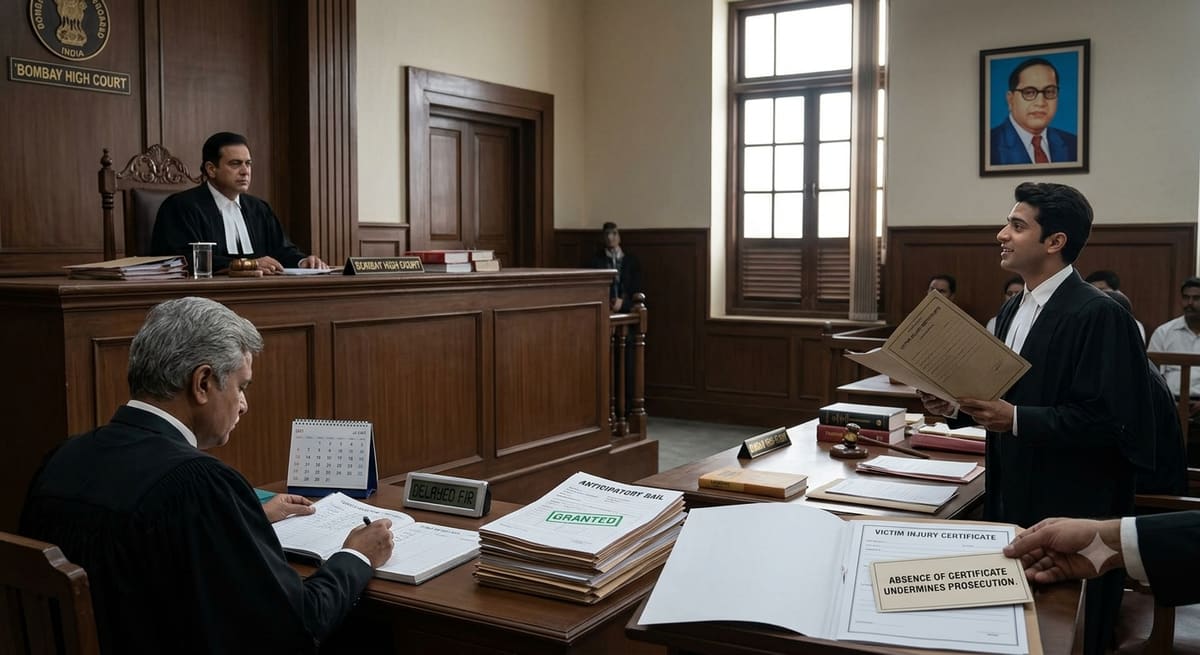
The Bombay High Court has clarified that anticipatory bail cannot be denied merely because an offence under the Bharatiya Nyaya Sanhita, 2023 is serious, especially when the prosecution's case rests entirely on the uncorroborated statement of a co-accused and lacks any direct evidence linking the applicant to the alleged crime. This ruling reinforces the principle that personal liberty must be protected unless there is concrete, independent material indicating flight risk or tampering.
Background & Facts
The Dispute
The applicant, Tejas Dyaneshwar Abhyankar, is apprehending arrest in Crime No. 95/2026 registered at Anjangaon Police Station, District Amravati Gramin, for alleged offences under Sections 316(5), 318(3), 318(4), and 61(2)(a) of the Bharatiya Nyaya Sanhita, 2023, and Sections 5, 7, and 8 of the Maharashtra Prevention of Malpractices at University, Board and Other Specified Examinations Act, 1982. The allegations stem from an inspection of Examination Centre DC-28 at Anjangaon Surji on 27th February 2026, during which certain answer sheets were reported missing.
Key Facts
- The informant, Ku. Rajani Narayan Shirbhate, Deputy Education Officer, conducted the inspection on 27.02.2026 at 4:40 p.m. upon receiving information about missing answer sheets.
- The sole basis for implicating the applicant is a statement made by a co-accused, alleging that the applicant was in contact with Sushil Abhyankar and had assured parents of students that he would ensure their clearance in the examinations.
- The applicant is not employed by the Education Department.
- There is no evidence placing the applicant at the examination centre on the date of the incident.
- No documentary, electronic, or eyewitness evidence directly connects the applicant to the alleged malpractice.
- The applicant voluntarily approached the court seeking anticipatory bail.
Procedural History
- 27.02.2026: Alleged incident of missing answer sheets at Examination Centre DC-28, Anjangaon Surji.
- Early March 2026: Crime No. 95/2026 registered at Anjangaon Police Station.
- Before 02.06.2026: Applicant approached the High Court seeking anticipatory bail.
- 02.06.2026: Court granted interim protection, directing applicant to cooperate with investigation and attend police station.
- 02.07.2026: Applicant appeared before the Investigating Officer; his statement was recorded; mobile phone seized.
- 02.07.2026: Present application for anticipatory bail heard and decided.
The Parties' Positions
For the Applicant
The applicant’s counsel contended that the applicant has no connection to the Education Department or the examination centre. The entire case against him is based on the uncorroborated statement of a co-accused. There is no independent evidence, surveillance footage, communication records, or physical proof linking him to the alleged offence. The applicant has consistently offered full cooperation, appeared before the court, submitted to questioning, and allowed seizure of his mobile phone.
For the Respondent/State
The State, through the Additional Public Prosecutor, did not contest the applicant’s claim of non-involvement but relied on the seriousness of the offences under the Bharatiya Nyaya Sanhita and the Maharashtra Malpractices Act. No counter-evidence or independent material was presented to refute the applicant’s assertion of non-involvement.
Relief Sought
The applicant sought anticipatory bail in the event of arrest in Crime No. 95/2026, with conditions ensuring cooperation with investigation and preservation of evidence.
The Legal Issue
The central question was whether anticipatory bail can be denied solely on the basis of serious allegations under the Bharatiya Nyaya Sanhita, 2023, when the prosecution’s case rests entirely on the uncorroborated statement of a co-accused and there is no direct evidence linking the applicant to the alleged offence.
Arguments Presented
For the Appellant/Petitioner
The applicant’s counsel relied on Arnesh Kumar v. State of Bihar and Sushil Sharma v. State of Rajasthan to argue that arrest is not automatic even for non-bailable offences, and that the court must examine the necessity of custodial interrogation. It was submitted that the applicant’s voluntary cooperation, absence of criminal antecedents, and lack of direct evidence make custodial detention unnecessary. The applicant had already complied with the court’s interim direction by appearing before the Investigating Officer and surrendering his mobile phone.
For the Respondent/State
The State did not present any material to dispute the applicant’s claims. The Additional Public Prosecutor acknowledged the absence of direct evidence but emphasized the gravity of the offences under Sections 316, 318, and 61 of the Bharatiya Nyaya Sanhita, 2023, and the need to deter exam malpractices. No argument was made that the applicant posed a flight risk or would tamper with evidence.
The Court's Analysis
The Court examined the nature of the allegations and the evidentiary basis for the case. It noted that the prosecution’s case against the applicant is entirely dependent on the statement of a co-accused, which is inherently unreliable without corroboration. The Court emphasized that the applicant has no connection to the Education Department, was not present at the examination centre, and has demonstrated willingness to cooperate fully with the investigation.
"The applicant has already appeared before the Investigating Officer, his statement has been recorded, and his mobile phone has been seized. In these circumstances, there is no justification for custodial interrogation."
The Court further observed that the offences alleged, while serious, do not automatically negate the right to anticipatory bail. The court must balance the right to personal liberty under Article 21 with the needs of investigation. Where the allegations are speculative and lack independent corroboration, the court must be cautious before permitting arrest.
The Court also noted that the applicant had complied with the interim protection order issued on 2nd June 2026, thereby establishing his credibility and commitment to the process. The absence of any indication of flight risk, tampering, or intimidation further supported the grant of anticipatory bail.
The Verdict
The applicant succeeded. The Court granted anticipatory bail in the event of arrest in Crime No. 95/2026. The applicant shall be released on executing a personal bond of Rs. 50,000 with one solvent surety of like amount. He must attend the police station upon one day’s prior notice, furnish his current address and mobile number to the Investigating Officer and the Court, and shall not change them until final disposal. He shall not influence witnesses, obstruct the investigation, or tamper with evidence. In case of breach, the trial court may cancel bail after hearing both sides.
What This Means For Similar Cases
Anticipatory Bail Is Not Denied Solely on Gravity of Offence
- Practitioners must argue that seriousness of the offence under the Bharatiya Nyaya Sanhita does not override the necessity of examining the evidentiary foundation for arrest.
- Courts must apply the triple test for anticipatory bail: likelihood of flight, tampering with evidence, and threat to witnesses.
- Absence of direct evidence and reliance on co-accused testimony alone cannot justify denial of bail.
Cooperation with Investigation Is a Strong Factor in Favor of Bail
- Voluntary appearance before court, compliance with interim directions, and surrender of electronic devices are material factors.
- Courts should treat cooperation as evidence of good faith and reduced risk of obstruction.
- Failure to cooperate, not the nature of the charge, should be the trigger for denying bail.
Corroboration Is Essential for Arrest in Cases Based on Co-Accused Statements
- In exam malpractice, corruption, or conspiracy cases, courts must demand independent corroboration before permitting custodial interrogation.
- A co-accused’s statement, especially if self-serving or inconsistent, cannot be the sole basis for arrest.
- Practitioners should file applications under Section 438 CrPC early, especially when the accused has no connection to the crime scene or official role.