The Bombay High Court has clarified that anticipatory bail cannot be denied solely on the basis of serious allegations where the accused’s role is peripheral, custodial interrogation is unnecessary, and no direct involvement in violence is established. This ruling reinforces the principle that liberty must be preserved unless there is a demonstrable risk of evidence tampering or witness intimidation.
Background & Facts
The Dispute
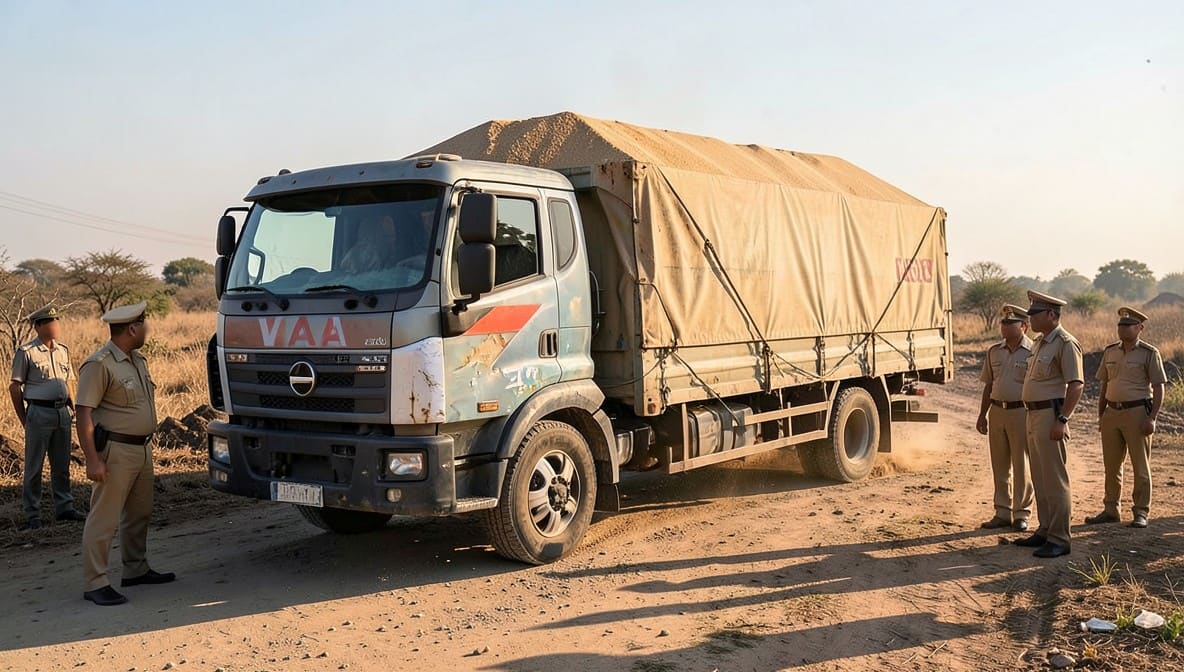
The applicant, Yogesh Namdeo Dhande, apprehends arrest in connection with Crime Report No. 67/2025 registered at Police Station Ambad, District Jalna, for offences under Sections 109, 132, 121(2), 303(2), 189, 190, 191, 352, and 351(2) of the Bharatiya Nyaya Sanhita, 2023, and Sections 3 and 4 of the Mines and Minerals (Regulation and Development) Act. The prosecution alleges that on 06.02.2026, a Circle Officer and revenue officials were conducting an operation against illegal sand transportation when they encountered a hyva vehicle loaded with sand near village Paithan. The driver and occupants lacked valid licenses. The officials were allegedly obstructed, and one co-accused, Dnyaneshwar, assaulted the informant with an iron rod and attempted to kill him. The applicant is accused of being present and aiding in the removal of the vehicle and its cargo.
Key Facts
- The alleged offence occurred on 06.02.2026
- The hyva vehicle loaded with sand was seized by authorities on the same day
- The co-accused accused of assault with an iron rod has been arrested and is currently on regular bail
- The applicant has a prior criminal record involving three cases, but has been acquitted in two of them
- No allegation in the FIR directly links the applicant to the use of a weapon or physical assault on the informant
- The investigation is complete and the charge-sheet has been filed
Procedural History
- 06.02.2026: Alleged offence occurs; C.R. No. 67/2025 registered
- Before 15.04.2025: Investigation concludes; charge-sheet filed
- 16.04.2025: Applicant granted interim protection from arrest
- 15.04.2025: Anticipatory bail application filed before the Bombay High Court (A.B.A. No. 441 of 2025)
- 15.06.2026: Hearing concluded; judgment delivered
The Parties' Positions
For the Applicant
The applicant’s counsel argued that:
- The applicant’s role, if any, was limited to presence and alleged assistance in removing the vehicle
- No allegation exists that he used a weapon or caused assault
- The vehicle and sand have been seized, eliminating any risk of evidence destruction
- The investigation is complete and the charge-sheet filed, negating the need for custodial interrogation
- He has been acquitted in two of three prior cases, indicating no pattern of criminal conduct
- He has cooperated fully with the investigation and has not misused his interim protection
For the Respondent/State
The Additional Public Prosecutor contended that:
- The offences are serious, including attempt to murder and illegal mining
- The applicant has a criminal history
- Three offences are registered against him, indicating a pattern of conduct
- The gravity of the offences warrants denial of anticipatory bail
Relief Sought
The applicant seeks anticipatory bail in the event of arrest, with conditions to ensure cooperation with the investigation and protection of witnesses and evidence.
The Legal Issue
The central question was whether anticipatory bail can be denied merely on the basis of serious allegations and a prior criminal record, when the accused’s role is not directly linked to violence, the evidence is secured, and custodial interrogation is unnecessary.
Arguments Presented
For the Appellant/Petitioner
The applicant relied on the principle that anticipatory bail is a safeguard against arbitrary arrest and must be granted where the accused’s involvement is not violent or obstructive. He cited Arnesh Kumar v. State of Bihar to argue that gravity of offence alone cannot override the right to liberty. He emphasized that the vehicle and contraband were seized, the co-accused responsible for assault was already in custody, and the charge-sheet was filed, rendering custodial interrogation redundant. His acquittal in two prior cases undermined the claim of a persistent criminal tendency.
For the Respondent/State
The State contended that offences under the Bharatiya Nyaya Sanhita, particularly Sections 303(2) and 121(2), are grave and attract stringent bail conditions. It argued that the applicant’s prior criminal record and the involvement in multiple offences indicate a risk of influencing the investigation. The State maintained that the nature of the crime - illegal mining coupled with attempted murder - justifies denial of pre-arrest bail.
The Court's Analysis
The Court examined the factual matrix and found no basis to justify custodial interrogation of the applicant. The prosecution’s own case, as per the FIR, did not attribute any act of violence or weapon use to the applicant. The vehicle and sand, the central objects of the alleged crime, were already seized. The co-accused alleged to have committed assault was already arrested and released on regular bail, indicating the investigation had progressed without the applicant’s detention.
"The accused against whom said assault is directed was arrested and is released on regular bail. The vehicle, which was said to have been taken away, is also seized."
The Court noted that the applicant had been under interim protection since 16.04.2025 and had not misused his liberty. There was no allegation of non-cooperation or tampering with evidence. The Court distinguished the applicant’s role from that of the principal offender and held that prior criminal history, particularly where two out of three cases ended in acquittal, cannot be a decisive factor in denying bail. The Court emphasized that anticipatory bail is not a privilege but a constitutional safeguard, and its denial must be grounded in concrete risk, not speculative fear.
The Verdict
The applicant succeeded. The Court granted anticipatory bail in the event of arrest, directing that he be released on furnishing a personal bond of Rs. 15,000 with one surety of like amount. He is prohibited from contacting witnesses directly or indirectly and from interfering with evidence in any manner. The order is effective immediately upon arrest in connection with C.R. No. 67/2025.
What This Means For Similar Cases
Custodial Interrogation Is Not Automatic in Non-Violent Roles
- Practitioners may now argue that where the accused’s role is ancillary and the primary evidence is secured, custodial interrogation cannot be presumed necessary
- The burden shifts to the prosecution to demonstrate a specific risk of evidence tampering or witness influence
- Seizure of contraband or property significantly weakens the State’s case for detention
Prior Criminal Record Must Be Evaluated with Precision
- Acquittals in prior cases must be weighed against convictions; a history of acquittals undermines claims of habitual criminality
- Courts must avoid blanket denial of bail based on the mere existence of prior cases, regardless of outcome
- The Court’s focus on the nature of prior offences (and their outcomes) sets a precedent for nuanced evaluation of criminal history
Seriousness of Offence Alone Cannot Override Liberty
- Even offences under the Bharatiya Nyaya Sanhita involving attempt to murder or illegal mining do not automatically disqualify an accused from anticipatory bail
- The Court reaffirmed that gravity of offence is only one factor among many, and must be balanced against the accused’s conduct, cooperation, and the stage of investigation
- This judgment reinforces Arnesh Kumar and Siddharam Satlingappa Mhetre by anchoring bail jurisprudence in individualized risk assessment, not categorical denial