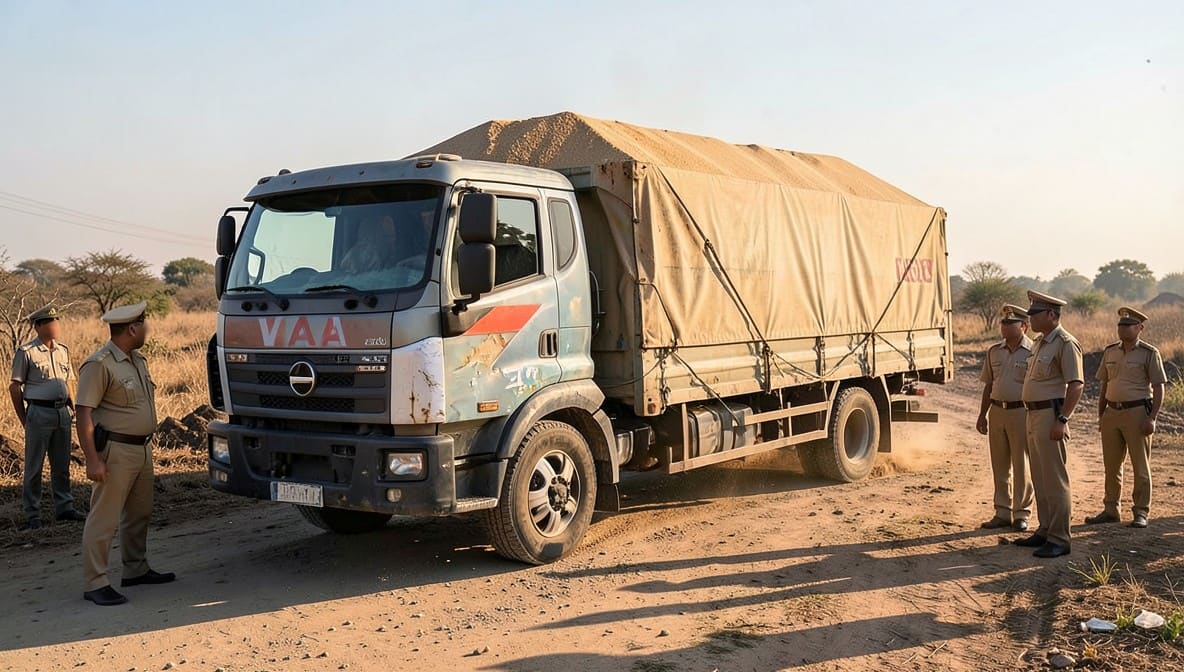
The Bombay High Court at Nagpur has clarified that mere association with accused persons, without any specific role attributed in the First Information Report, cannot justify arrest or denial of anticipatory bail. This ruling reinforces the principle that criminal liability must be grounded in concrete allegations, not circumstantial proximity.
Background & Facts
The Dispute
The applicant, Viraj Vishnu Patil (Dhobale), sought anticipatory bail in connection with Crime No. 183/2026 registered at Police Station, Washim on 03.02.2026 under Sections 115(2), 118(1), 119(2), 189(2), 189(4), 190, 191(2), 191(3), 308(3), 351(2), 351(3), 352 of the Bharatiya Nyaya Sanhita, 2023 and Sections 4 and 25 of the Arms Act, 1959. The complainant, Dr. Pramod Anil Gangawane, a medical practitioner and sarpanch of village Depul, alleged that he was assaulted and extorted of cash and gold ornaments by three named persons and four unknown persons.
Key Facts
- The incident occurred on 03.02.2026 between 11:30 AM and 12:00 PM at Dr. Gangawane’s dental clinic
- The FIR alleges the accused used iron rods, sticks, fighters, and swords to assault the complainant and his attendant, Gopal Thakare
- The complainant claimed the accused demanded ₹6 lakhs as extortion amount and seized cash and gold ornaments
- The applicant was not named as an accused in the FIR
- The applicant was not alleged to have entered the clinic or participated in the assault
- The only connection alleged is that the applicant was present in the same vehicle as the named accused when they arrived at the clinic
- No witness statement or case diary entry attributes any act, omission, or intent to the applicant
Procedural History
- 03.02.2026: FIR registered at Police Station, Washim
- Before 30.04.2026: Applicant apprehended arrest despite no direct allegations against him
- 30.04.2026: Criminal Application (ABA) No. 243 of 2026 filed before the Bombay High Court, Nagpur Bench
Relief Sought
The applicant sought anticipatory bail to prevent arrest in connection with Crime No. 183/2026, arguing that his presence in the vehicle did not constitute participation in the offence.
The Legal Issue
The central question was whether the mere fact of being present in the same vehicle as the accused, without any specific allegation of participation, assistance, or common intention, is sufficient to justify arrest or deny anticipatory bail under the Bharatiya Nyaya Sanhita, 2023.
Arguments Presented
For the Appellant/Petitioner
The applicant’s counsel argued that the FIR contains no allegation linking the applicant to the assault, extortion, or possession of weapons. The applicant was not named in the FIR, was not present inside the clinic, and no evidence suggested he aided, abetted, or conspired with the accused. Reliance was placed on Arnesh Kumar v. State of Bihar to emphasize that arrest cannot be automatic merely due to association. The counsel contended that the prosecution’s case, if any, must be built on specific acts, not suspicion or proximity.
For the Respondent/State
The Additional Public Prosecutor conceded that no specific role was assigned to the applicant in the FIR or case diary. However, the APP argued that the applicant’s presence in the vehicle with the accused raised a prima facie inference of common intention, and that the investigation was still ongoing. The APP did not dispute the absence of direct allegations but urged caution against granting bail at this stage.
The Court's Analysis
The Court conducted a meticulous review of the FIR and case diary. It noted that while the FIR described a violent assault with weapons and extortion, it contained no mention of the applicant’s conduct, words, or actions. The only reference to the applicant was that he arrived in the same vehicle as the named accused. The Court emphasized that presence in a vehicle, without more, cannot substitute for a specific allegation of participation.
"It is not the case that the applicant was present in the clinic where assault took place."
The Court held that the principle of nemo iudex in causa sua and the constitutional guarantee under Article 21 require that arrest be based on credible, specific, and individualized evidence. The Court distinguished this case from those involving common intention under Section 34 BNS, noting that mere association does not equate to criminal liability. The Court further observed that the prosecution’s case, as it stood, lacked any material to connect the applicant to the commission of the offence.
The Court rejected the notion that the applicant’s presence in the vehicle could be treated as a suspicious circumstance warranting arrest, especially where no corroborative evidence existed.
The Verdict
The application was allowed. The Court granted anticipatory bail to Viraj Vishnu Patil (Dhobale) on the following conditions: (i) he shall be released on furnishing a personal bond of ₹55,000 with one solvent surety of like amount; (ii) he shall report to the Washim Police Station on 02.05.2026 and 03.05.2026 between 3:00 PM and 6:00 PM; (iii) he shall not tamper with evidence or influence witnesses; and (iv) he shall not leave India without prior permission of the Court.
What This Means For Similar Cases
Presence in Vehicle Is Not Equivalent to Participation
- Practitioners must challenge arrests based solely on proximity or association where no specific role is alleged in the FIR
- Courts will not infer criminal intent from mere presence in a vehicle or group unless corroborated by independent evidence
- The burden remains on the prosecution to establish a direct link between the accused and the offence
FIR Specificity Is Non-Negotiable for Arrest
- An accused not named in the FIR cannot be arrested unless subsequent investigation reveals concrete, individualized involvement
- Courts will scrutinize whether allegations are particularized or vague
- Blanket inclusion of persons based on association violates the principle of individualized liability under BNS
Procedural Safeguards for Anticipatory Bail
- Courts may impose reporting conditions even while granting anticipatory bail, as seen here with mandatory police reporting on two dates
- Conditions such as non-interference with witnesses and non-departure from India remain standard and enforceable
- The quantum of bond (₹55,000) reflects proportionality to the alleged offence and the applicant’s non-involvement