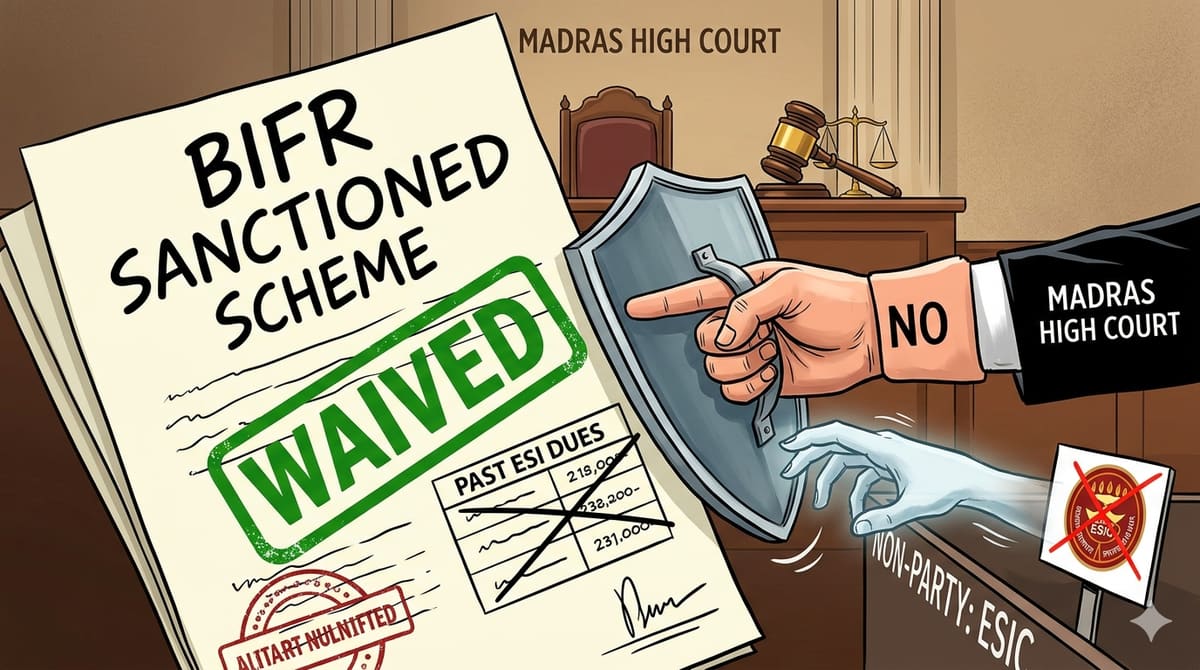
The Madras High Court has clarified that recovery proceedings initiated by the Employees' State Insurance Corporation for interest and damages already waived under a BIFR-sanctioned rehabilitation scheme are legally unsustainable. This judgment reinforces the primacy of statutory revival mechanisms over unilateral debt enforcement, offering critical protection to rehabilitated industrial units.
Background & Facts
The Dispute
The appellant, M/s. Iykot Hi-tech Toolroom Ltd., is a manufacturer of dyes and plastic components that commenced operations in 1994. From 2000 onwards, the company faced severe financial distress and defaulted on its statutory contributions under the Employees’ State Insurance Act, 1948. In response, the Employees’ State Insurance Corporation (ESIC) initiated proceedings under Section 45A of the ESI Act, resulting in orders dated 18.12.2002 and 24.12.2002 determining interest and damages payable.
Due to continued financial deterioration, the company was declared a "Sick Industrial Company" under the Sick Industrial Companies (Special Provisions) Act, 1985, and referred to the Board for Industrial and Financial Reconstruction (BIFR), New Delhi.
Key Facts
The company defaulted on ESI contributions from 2000 to 2006
ESIC claimed total dues (contribution, interest, damages) of Rs. 5,65,097 as of 31.03.2006
BIFR, by order dated 08.01.2007, sanctioned a rehabilitation scheme under which:
Total ESI liability as of 31.03.2006 was fixed at Rs. 2,26,413
Interest and damages amounting to Rs. 3,38,684 were wholly waived
The net amount was to be paid in six monthly instalments
The appellant discharged the Rs. 2,26,413 liability in full by 24.07.2007
BIFR, by order dated 21.04.2008, declared the company no longer sick due to improved financial health
On 08.04.2009, ESIC’s Recovery Officer issued a notice demanding Rs. 7,66,364, including the previously waived interest and damages
The appellant objected, citing the BIFR scheme, but ESIC proceeded with recovery
Procedural History
18.12.2002: ESIC issued order determining interest payable
24.12.2002: ESIC issued order determining damages payable
08.01.2007: BIFR sanctioned rehabilitation scheme waiving interest and damages
21.04.2008: BIFR declared company non-sick
08.04.2009: Recovery notice issued by ESIC for Rs. 7,66,364
2009: Petition filed in EIOP No. 123 of 2009 before Principal Labour Court, Chennai
02.03.2021: Labour Court dismissed petition, holding appellant liable for full dues
27.03.2026: Civil Miscellaneous Appeal reserved
30.04.2026: Judgment pronounced by Madras High Court
Relief Sought
The appellant sought quashing of the recovery notice dated 08.04.2009 and declaration that no liability exists for interest and damages waived under the BIFR scheme. No monetary compensation was claimed beyond cessation of recovery.
The Legal Issue
The central question was whether ESI recovery proceedings for interest and damages, already waived under a BIFR-sanctioned rehabilitation scheme, are legally permissible when the scheme was implemented in good faith and the company has been revived.
Arguments Presented
For the Appellant
The appellant’s counsel argued that the BIFR’s sanctioned scheme dated 08.01.2007 was a binding statutory instrument under the Sick Industrial Companies Act, 1985, and that ESIC, as a creditor, was bound by its terms. The waiver of Rs. 3,38,684 in interest and damages was explicit and unconditional. The appellant had fully complied with the scheme by paying Rs. 2,26,413 within the stipulated period. The subsequent recovery notice violated the principle of res judicata and undermined the statutory objective of industrial revival. Reliance was placed on the Supreme Court’s jurisprudence that rehabilitation schemes must be respected to ensure their efficacy.
For the Respondent
The respondents contended that BIFR proceedings were not adversarial and ESIC was not a party to them, hence the scheme was not binding. They argued that the waiver applied only to the period up to 31.03.2006 and did not extinguish the underlying liability. The recovery notice, they claimed, was for arrears not covered by the scheme or for subsequent defaults. They further asserted that the Labour Court correctly held that the appellant had not challenged earlier notices and had acquiesced to the liability.
The Court's Analysis
The Court undertook a detailed examination of the BIFR’s sanctioned scheme dated 08.01.2007 and found that the waiver of interest and damages was not a mere concession but a core component of the rehabilitation plan. The scheme explicitly stated: "the entire amount of interest and damages claimed by the ESI authorities amounting to Rs. 3,38,684/- ... may be waived and only an amount of Rs. 2,26,413/- be payable in convenient instalments."
"The implementation of the sanctioned scheme has evidently facilitated the revival of the appellant company, as reflected in the order of the BIFR dated 21.04.2008, wherein it has been declared that the appellant company had ceased to be a sick company."
The Court rejected the respondents’ argument that ESIC was not a party to BIFR proceedings and therefore not bound. It held that the BIFR’s authority under the 1985 Act is statutory and its schemes are binding on all creditors, including statutory bodies like ESIC, who are required to participate in the revival process. The Court emphasized that the very purpose of the Act is to prevent liquidation and restore industrial viability, which would be rendered meaningless if creditors could unilaterally revive waived claims.
The Court further noted that the recovery notice dated 08.04.2009 sought to recover amounts explicitly waived under the scheme, including interest and damages for the period ending 31.03.2006. The Labour Court’s failure to appreciate this fundamental point rendered its order legally unsustainable.
The Court concluded that permitting such recovery would create a legal vacuum where statutory rehabilitation mechanisms are rendered ineffective, defeating the legislative intent behind the Sick Industrial Companies Act.
The Verdict
The Madras High Court allowed the appeal and set aside the order dated 02.03.2021 of the Principal Labour Court. The recovery proceedings initiated by the second respondent under the ESI Act on 08.04.2009 are quashed. The appellant is not liable for any interest or damages waived under the BIFR-sanctioned scheme dated 08.01.2007. No costs are awarded.
What This Means For Similar Cases
BIFR Schemes Override Unilateral Recovery
Practitioners representing revived companies must immediately challenge any post-scheme recovery notices for waived dues
ESIC and other statutory bodies cannot revive waived liabilities merely because they were not formal parties to BIFR proceedings
The waiver under a sanctioned scheme is final and extinguishes the underlying claim
Statutory Rehabilitation Trumps Debt Enforcement
Courts must prioritize statutory revival mechanisms over creditor enforcement actions
Any recovery notice that includes amounts covered by a BIFR scheme is void ab initio
Employers undergoing rehabilitation must preserve all BIFR orders and compliance proofs as conclusive evidence of liability discharge
Procedural Compliance Is Non-Negotiable
Creditors must file claims in BIFR proceedings to preserve rights
Failure to participate in BIFR proceedings does not entitle them to later recovery
Post-revival recovery actions based on pre-scheme arrears are legally impermissible