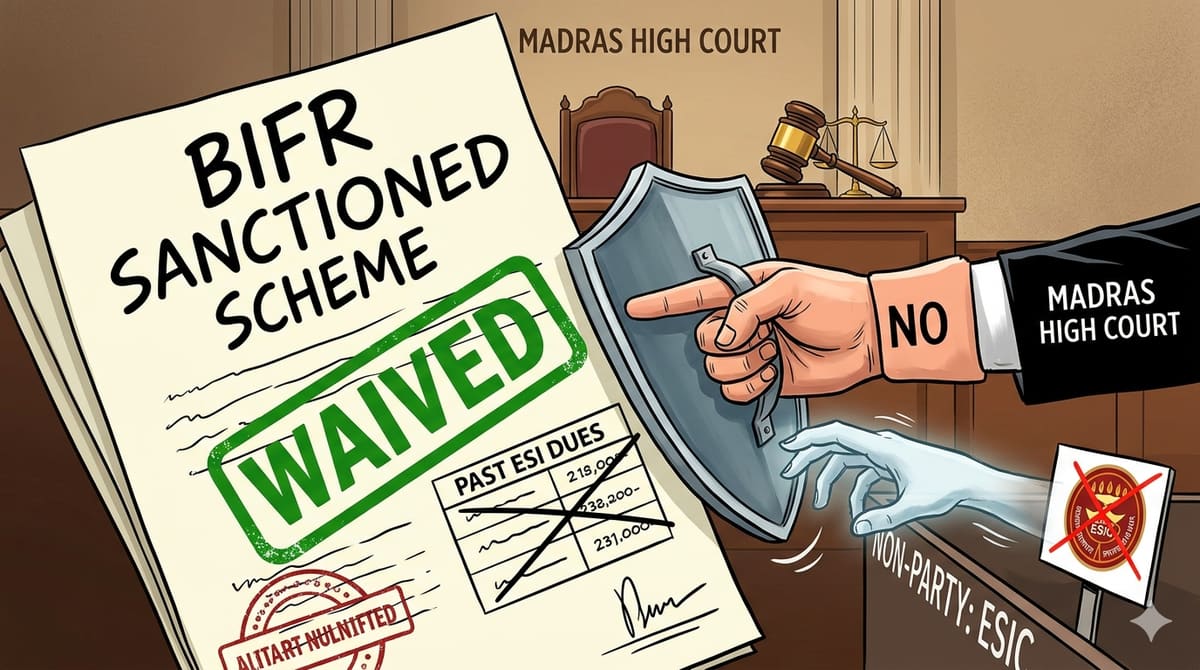
The Bombay High Court has underscored the importance of natural justice in recovery proceedings under Section 45-A of the Employees' State Insurance Act, 1948. In a significant interim order, the Court stayed coercive action against an employer who was never served notice of recovery proceedings, despite the establishment having closed in 2013. The judgment reinforces that recovery certificates cannot be issued arbitrarily without affording the affected party an opportunity to be heard.
Background & Facts
The Dispute
The petitioner, Kalvinder Surender Lipcha, was the proprietor of Navdurga Enterprises, a private limited company. The Employees' State Insurance Corporation (ESIC) issued a recovery certificate under Section 45-A of the ESI Act for unpaid contributions allegedly due for the period 2013 to 2016. The petitioner contended that her establishment had closed down in 2013 and that she was never served notice of the recovery proceedings, rendering the coercive action arbitrary and high-handed.
Key Facts
The petitioner’s establishment, Navdurga Enterprises, held a licence under the Maharashtra Shops & Establishment Act, 2017, which was cancelled on 15.03.2013.
On 01.04.2013, the petitioner informed the ESIC Sub-Divisional Office, Marol, via a letter (Exhibit C at page 22 of the petition) that the establishment had ceased operations, all employees had been discharged, and Nil returns would be filed thereafter.
The petitioner never resumed business after 2013, as averred in the petition.
On 11.06.2019, the ESIC issued a recovery certificate under Section 45-A of the ESI Act for unpaid contributions for the period 2013 - 2016.
The petitioner discovered the recovery proceedings only in 2019 after applying for certified copies of the impugned order dated 21.06.2018.
On 19.09.2019, the petitioner addressed a letter to the Recovery Officer, contesting the recovery proceedings.
A show-cause notice was issued seeking the petitioner’s arrest, which the petitioner challenged as procedurally flawed.
Procedural History
21.06.2018: ESIC passed an impugned order of recovery under Section 45-A without serving notice to the petitioner.
11.06.2019: Recovery certificate issued against the petitioner.
19.09.2019: Petitioner’s letter to the Recovery Officer, contesting the proceedings.
07.02.2026: Order passed in Delay Application No. 2 of 2026, recording that the petitioner was required to prove her case but also noting that she may have been aware of the proceedings (though this was disputed).
2026: Petitioner filed Writ Petition No. 4665 of 2026 before the Bombay High Court, challenging the recovery proceedings.
Relief Sought
The petitioner sought:
Quashing of the recovery certificate dated 11.06.2019.
Stay of coercive proceedings, including arrest warrants, pending adjudication of the writ petition.
A declaration that the recovery proceedings were void ab initio for violation of principles of natural justice.
The Legal Issue
The central question before the Court was whether Section 45-A of the ESI Act permits the issuance of a recovery certificate without serving notice or affording an opportunity of hearing to the employer, particularly when the establishment had ceased operations and no employees were engaged during the alleged period of default.
Arguments Presented
For the Petitioner
Violation of Natural Justice: The petitioner argued that the recovery proceedings were initiated and concluded without her knowledge, depriving her of an opportunity to contest the liability. Reliance was placed on the Supreme Court’s judgment in State of Orissa v. Dr. (Miss) Binapani Dei to emphasize that no order prejudicial to a party can be passed without hearing them.
Closure of Establishment: The petitioner submitted documentary evidence (Exhibit C) proving that the establishment had closed in 2013 and that Nil returns were filed thereafter. It was contended that no contributions were payable for the period 2013 - 2016 as no employees were engaged.
Arbitrary Recovery: The petitioner argued that the recovery certificate was issued arbitrarily, as the ESIC failed to verify the factual position before initiating coercive action.
For the Respondent
Presumption of Awareness: The respondent contended that the petitioner may have been aware of the proceedings, as noted in the order dated 07.02.2026. However, the respondent did not produce concrete evidence to prove that the petitioner was served notice or participated in the proceedings.
Statutory Compliance: The respondent relied on Section 45-A of the ESI Act, which empowers the ESIC to recover unpaid contributions as arrears of land revenue. It was argued that the provision does not explicitly mandate notice before issuing a recovery certificate.
Public Interest: The respondent submitted that recovery of contributions is in the public interest and that delays in payment prejudice the social security benefits of employees.
The Court's Analysis
The Court examined the procedural fairness of the recovery proceedings and the substantive merits of the petitioner’s claim. Key observations included:
Notice and Hearing as Fundamental Requirements:
"One of the principal grievances advanced by Mr. Kini is that the recovery certificate has been issued against the Petitioner on 11.06.2019 under the provisions of Section 45-A of the said Act, the proceedings of which Petitioner was not made aware of or put to notice."
The Court noted that the petitioner was never served with the impugned order dated 21.06.2018, which formed the basis of the recovery certificate. This raised serious concerns about the violation of natural justice, as the petitioner was denied an opportunity to contest the liability.
Documentary Evidence of Closure:The Court placed significant reliance on the documentary evidence submitted by the petitioner, including:
A letter dated 15.03.2013 to the Maharashtra Shops & Establishment Authority regarding cancellation of licence.
A letter dated 01.04.2013 to the ESIC, stating that the establishment had ceased operations and that Nil returns would be filed.
The Court observed that these documents prima facie established that the petitioner’s establishment was not operational during the period 2013 - 2016, and thus, no contributions were payable.
Burden of Proof on the ESIC:The Court noted that the order dated 07.02.2026 recorded that the petitioner was required to prove her case by leading appropriate and cogent evidence. However, the Court emphasized that the onus was on the ESIC to demonstrate that:
The petitioner was served notice of the proceedings.
The petitioner was aware of the recovery proceedings and had an opportunity to contest them.
The liability for contributions was validly determined for the period 2013 - 2016.
The Court held that the ESIC failed to discharge this burden, as there was no evidence to show that the petitioner was served notice or participated in the proceedings.
Interim Relief as a Safeguard:The Court granted ad-interim relief in terms of prayer clause (c) of the petition, staying coercive proceedings against the petitioner. This was based on the prima facie arguable case made out by the petitioner, particularly the lack of notice and the documentary evidence of closure.
The Verdict
The Bombay High Court stayed all coercive proceedings against the petitioner, including the recovery certificate dated 11.06.2019 and any arrest warrants issued pursuant thereto. The Court directed:
The respondent (ESIC) to file an affidavit-in-reply within two weeks, with an advance copy to the petitioner’s advocate.
The petitioner to file a rejoinder, if any, within two weeks thereafter.
The matter to be listed for further hearing on 31.07.2026.
The Court also permitted humdast (service of notice) and directed the petitioner to serve a copy of the petition and order on the respondent by any permissible mode of service, filing proof of service before the next date.
What This Means For Similar Cases
Notice and Opportunity of Hearing Are Non-Negotiable
This judgment reinforces that recovery proceedings under Section 45-A of the ESI Act cannot be initiated arbitrarily. Practitioners must ensure:
Service of Notice: The affected party must be served notice of the proceedings and given an opportunity to contest the liability.
Burden of Proof: The onus lies on the ESIC to prove that notice was served and that the party was afforded a hearing.
Documentary Evidence: Employers who have closed operations must maintain proof of closure (e.g., letters to authorities, Nil returns) to contest recovery proceedings.
Closure of Establishment Must Be Recognized
Nil Returns as Evidence: Filing Nil returns after closure is critical evidence to establish that no contributions are payable.
No Presumption of Continuity: The ESIC cannot presume that an establishment remains operational merely because returns were not filed. It must verify the factual position before initiating recovery.
Coercive Action Without Due Process Is Void
Stay of Recovery: Courts are likely to stay coercive action if the employer demonstrates a prima facie case of procedural irregularity.
Remedy for Employers: Employers who face recovery proceedings without notice can challenge them as void ab initio under Article 226 of the Constitution.
Public Interest vs. Natural Justice: While recovery of contributions serves public interest, it cannot override the principles of natural justice. The ESIC must balance efficiency with fairness in its proceedings.