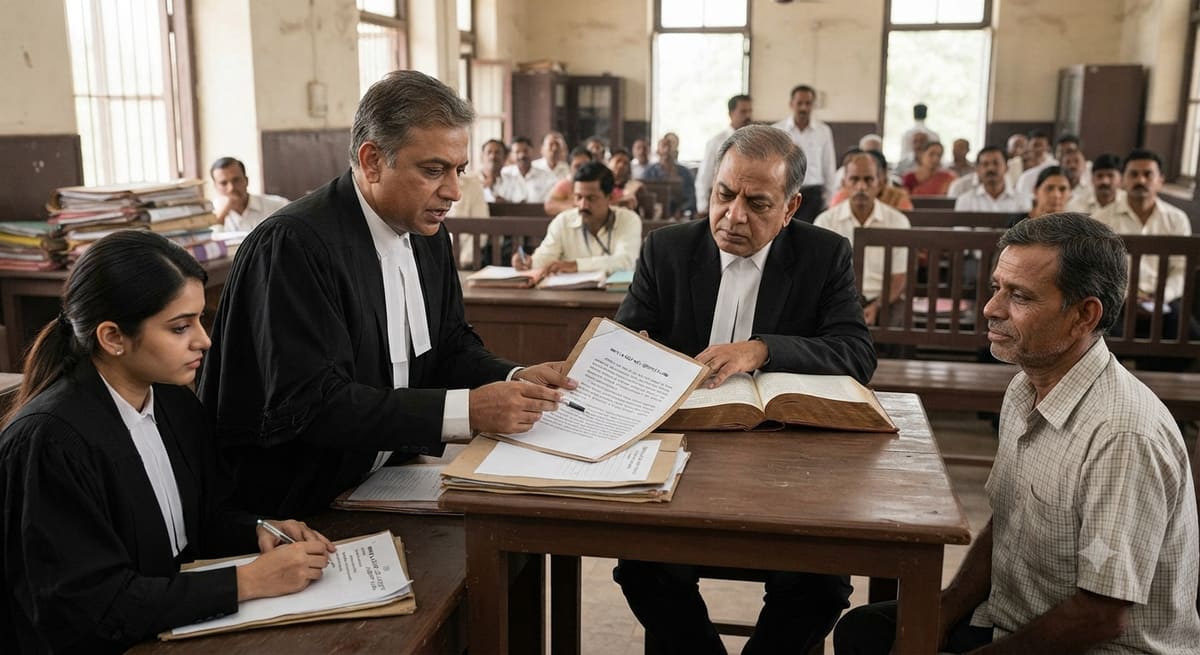
The Bombay High Court has clarified that interim wage relief granted to non-signatory workmen cannot be awarded in isolation from the reciprocal obligations embedded in a private settlement under the Industrial Disputes Act, 1947. This ruling reinforces the contractual nature of settlements and the necessity of balanced adjudication during pendency of industrial references.
Background & Facts
The Dispute
The petitioner, K D Joshi Rubber Industries Pvt. Ltd., is a small-scale manufacturer that entered into a private settlement with 23 out of 43 workmen in 2019, offering a wage increase of Rs.3,700 per month structured over three years. The settlement included enhanced duties, productivity norms, and discipline requirements. The remaining 20 workmen, represented by the respondent Union, refused to sign. The Union later sought interim relief before the Industrial Court, demanding the same wage increase for non-signatories with retrospective effect from 2016.
Procedural History
- July 2016: Respondent Union issued a Charter of Demands; not yet registered under the Maharashtra Recognition of Trade Union Act, 1971.
- July 2016 to March 2017: 17 rounds of negotiations failed to yield a collective settlement.
- March 2019: 23 workmen executed individual settlements under Section 2(p) of the Industrial Disputes Act, 1947.
- November 2018: Industrial dispute referred to the Industrial Court under Section 10(1) of the ID Act.
- March 2020: Respondent Union applied for interim wage relief.
- August 2022: Industrial Court granted interim wage increase of Rs.3,700/month to all 20 non-signatory workmen without addressing reciprocal obligations.
- September 2024: A similar interim order was passed in a connected ULP complaint.
Relief Sought
The petitioner sought quashing of the interim awards, arguing that granting wage benefits to non-signatories without enforcing corresponding obligations violated the integrity of negotiated settlements and undermined collective bargaining.
The Legal Issue
The central question was whether an Industrial Tribunal, while granting interim wage relief under Section 10(4) of the Industrial Disputes Act, 1947, can extend monetary benefits from a private settlement to non-signatory workmen without considering the reciprocal obligations embedded in that settlement, and whether such an order constitutes a proper exercise of interim jurisdiction.
Arguments Presented
For the Petitioner
The petitioner argued that the settlement was a private agreement under Section 18(1), binding only on signatories. Relying on Brooke Bond of India v. Workmen and TELCO Ltd. v. Workmen, it contended that settlements are holistic packages and cannot be fragmented. Granting only the wage component to non-signatories, while ignoring productivity and discipline clauses, distorted the negotiated balance. It further cited Fabril Gasosa v. Labour Commissioner to assert that written terms must be respected and cannot be altered by judicial assumption.
For the Respondent
The respondent Union argued that the employer’s own offer of Rs.3,700 during conciliation demonstrated financial capacity and constituted a de facto standard. It relied on Herbertsons Ltd. v. Workmen to assert that interim relief is permissible upon prima facie case. It contended that the settlement was procured under pressure and designed to divide the workforce, and that non-signatories suffered undue hardship due to inflation and wage stagnation since 2016.
The Court's Analysis
The Court examined the nature of settlements under the Industrial Disputes Act, 1947, distinguishing between private settlements under Section 18(1) and conciliation settlements under Section 18(3). It held that private settlements bind only those who sign them, and cannot be extended to non-signatories without due consideration of their reciprocal obligations.
"The settlement embodied reciprocal obligations, including active work for eight hours per shift, enhancement of production and productivity, maintenance of punctuality and discipline, and compliance with other stipulated service conditions. Grant of monetary benefits in isolation, without corresponding obligations, is contrary to the very concept and sanctity of collective bargaining."
The Court acknowledged the Tribunal’s jurisdiction under Section 10(4) to grant interim relief and accepted that the employer’s offer of Rs.3,700 was a relevant indicator of financial capacity. However, it found the interim order defective for failing to address why the obligations attached to the wage increase were disregarded. The absence of reasoning on this critical legal principle indicated a lack of application of mind.
The Court further clarified that allegations of coercion, unfair procurement of signatures, or union representation were factual disputes requiring evidence and could not be resolved at the interim stage. It emphasized that interim relief must not effectively compel non-signatories to accept a settlement by making its benefits irresistible without its burdens.
The Verdict
The petitioner succeeded in part. The Bombay High Court set aside the interim awards granting Rs.3,700/month to non-signatory workmen, holding that such relief cannot be granted without reasoned consideration of the reciprocal obligations in the settlement. The Industrial Court was directed to reconsider the application afresh, with full attention to the balance of convenience, financial capacity, and the integrity of the negotiated package.
What This Means For Similar Cases
Settlements Are Holistic Packages
- Practitioners must argue that any interim relief extending wage benefits from a private settlement must account for all reciprocal obligations, including productivity norms, attendance, and work discipline.
- Isolating monetary terms without enforcing conditions risks judicial overreach and undermines the contractual foundation of settlements.
Financial Capacity Alone Is Insufficient
- An employer’s prior offer of a wage increase, while relevant to capacity to pay, does not automatically justify extending its terms to non-signatories.
- Tribunals must independently assess whether granting such relief disturbs the equilibrium of rights and duties under the settlement.
Interim Relief Must Not Prejudice Final Adjudication
- Courts must avoid creating de facto outcomes that foreclose final determination.
- Allegations of coercion, unfair bargaining, or union representation remain open for evidence-based adjudication at the final hearing.
- Practitioners should preserve all documentary and oral evidence on these issues for trial, as interim orders cannot resolve them.