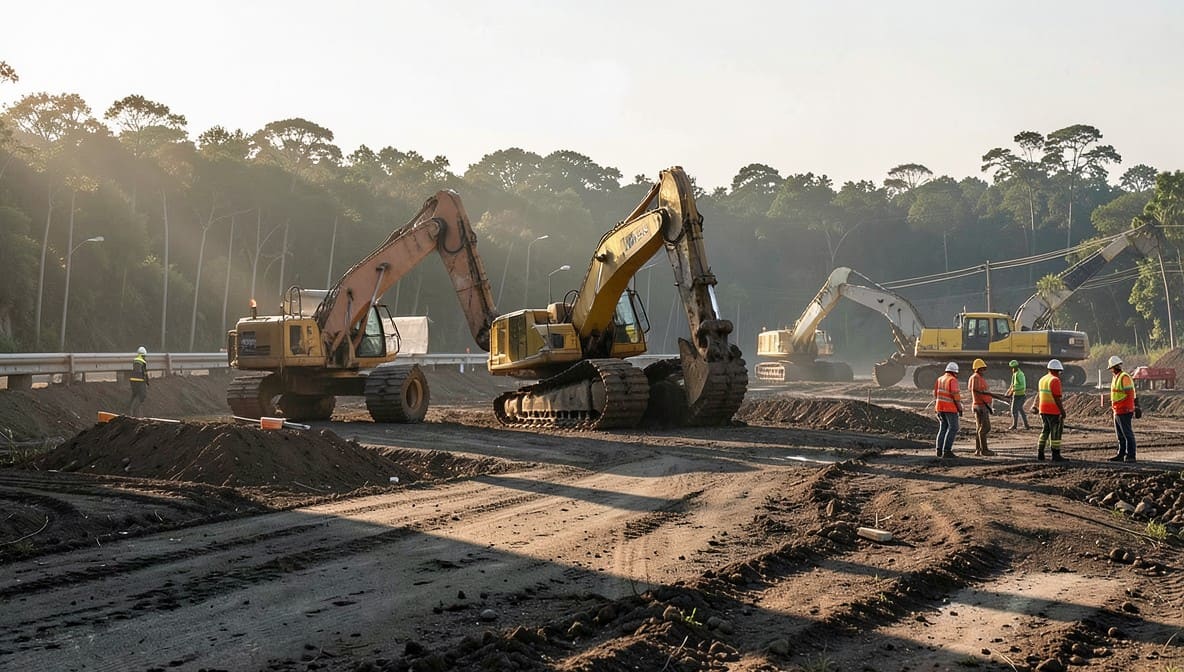
The Gauhati High Court has clarified that while excavated earth reused within the same project site may not attract forest royalty, such exemption is not automatic and must be substantiated by verifiable documentation. The judgment reinforces that statutory compliance in infrastructure projects requires rigorous record-keeping, not just technical assertions.
Background & Facts
The Dispute
The dispute arose from the assessment of forest royalty and related charges by the Assam Forest Department against Simplex Infrastructures Ltd., a contractor executing the "Four Laning of NH-37 from Rangagara to Kaliabor Tiniali" under an EPC contract awarded by the National Highways and Infrastructure Development Corporation Limited (NHIDCL). The Forest Department demanded Rs. 1,45,84,055/- for alleged non-payment of royalty on earth, sand, boulders, and stone aggregates used in the project, including earth excavated from within the project’s Right of Way.
Key Facts
- The EPC contract was awarded on 16.01.2017, and the formal Contract Agreement was executed on 23.01.2017.
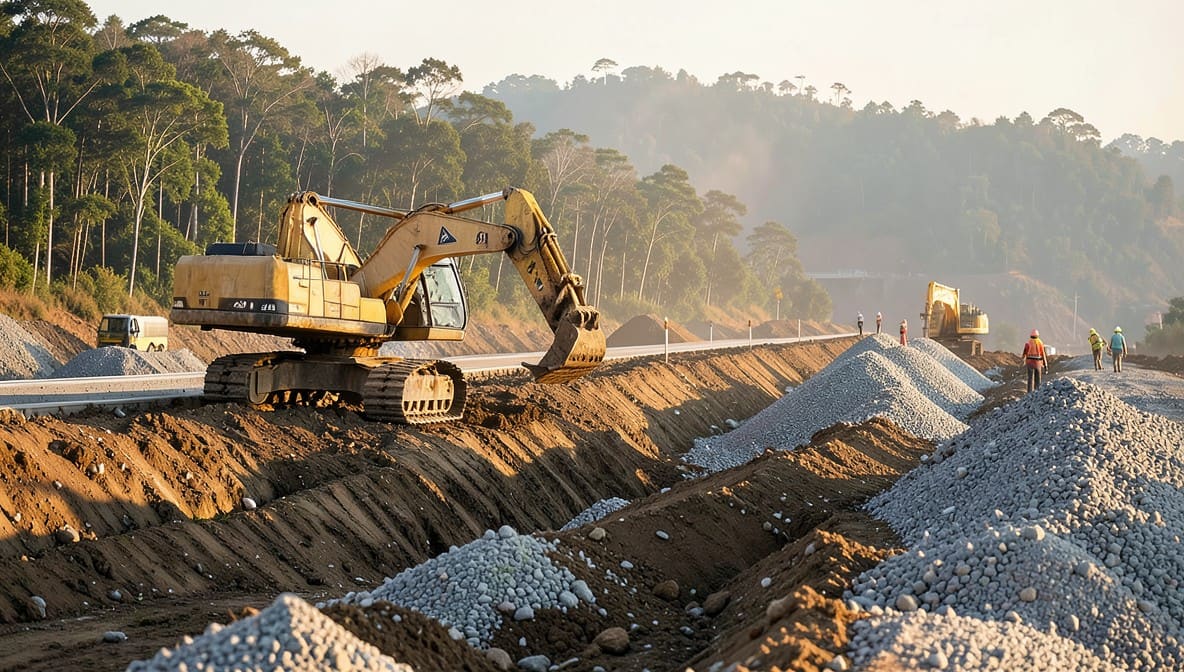
- The project involved extensive earthwork, including cutting of main carriageway, service roads, two minor bridges, and a flyover.
- The petitioner claimed to have used a total of 2,54,749.57 CuM of earth materials:
- 1,46,267.17 CuM procured from external sources, for which royalty was paid and permits obtained.
- 1,08,482.04 CuM excavated internally from the Right of Way and reused within the same alignment.
- The petitioner submitted a detailed reply dated 04.02.2023, furnishing records of external procurement and asserting that internal excavation attracted no royalty.
- On 21.02.2023, the Divisional Forest Officer (DFO), Nagaon, notified a field inspection to be conducted on 27.02.2023. The petitioner was not formally invited but became aware of it only on 01.03.2023.
- Based on the inspection and records from NHIDCL, the DFO assessed only 28,200 CuM of earth as excavated internally, treating the remaining 80,282.04 CuM as unaccounted external procurement.
- The demand of Rs. 1,45,84,055/- included forest royalty, price of earth materials, GST, income tax, and penalty.
- The petitioner submitted objections on 14.03.2023, citing the Supreme Court’s decision in Promoters & Builders Association of Pune v. State of Maharashtra (2015) 12 SCC 736, and provided a calculation sheet based on original survey levels.
- Despite this, the DFO issued reiterated demands on 17.03.2023 and 22.03.2023.
- In May 2023, Forest Guards were deployed at the site, halting construction. The petitioner submitted an undertaking on 17.05.2023 stating it would pay "whatever royalty was legally payable" within one month, seeking resumption of work.
- The DFO permitted work to resume on 19.05.2023 but recorded an adverse observation that the petitioner had "admitted non-payment of royalty."
Procedural History
- 16.01.2017: Letter of Award issued by NHIDCL for NH-37 Four Laning project.
- 23.01.2017: Formal EPC Contract Agreement executed.
- 05.01.2023: DFO, Nagaon, issued notice to NHIDCL seeking details of forest produce used.
- 06.01.2023: NHIDCL forwarded the notice to the petitioner.
- 04.02.2023: Petitioner submitted detailed reply on earth usage and royalty payments.
- 21.02.2023: DFO notified proposed field inspection.
- 27.02.2023: Field inspection conducted by Forest officials.
- 09.03.2023: DFO issued first demand notice of Rs. 1,45,84,055/-.
- 14.03.2023: Petitioner submitted detailed objections.
- 17.03.2023: DFO reiterated demand.
- 22.03.2023: DFO issued final demand notice.
- 05.05.2023: Petitioner sought NHIDCL’s intervention.
- First week of May 2023: Forest Guards deployed, work suspended.
- 17.05.2023: Petitioner submitted undertaking to pay legally due royalty.
- 19.05.2023: DFO permitted resumption of work but recorded adverse observation.
- 09.06.2026: Judgment reserved.
- 01.07.2026: Judgment pronounced.
The Parties' Positions
Petitioner (Simplex Infrastructures Ltd.):
- Argued that earth excavated and reused within the same Right of Way does not attract royalty under the Promoters & Builders Association of Pune precedent.
- Claimed full compliance for externally procured materials with valid permits and royalty payments.
- Contended that the assessment was based on unilateral inspection, without joint verification or scientific measurement.
- Asserted that Rule 64 of the Assam Rules applies only to illegal mining, which was not alleged.
- Stated that the undertaking dated 17.05.2023 was not an admission of liability.
Respondents (State of Assam, Forest Department, NHIDCL):
- Maintained that the petitioner failed to produce valid permits, transit challans, or royalty receipts for substantial quantities of earth.
- Argued that Rule 5 of the Assam Minor Mineral Concession Rules, 2013, imposes statutory liability on contractors for royalty payment.
- Stated that the assessment was based on field inspection, NHIDCL records, and reconciliation of data.
- Contended that Rule 63 and 64 were properly invoked due to lack of documentary proof of lawful extraction.
- Asserted that NHIDCL had no liability under the EPC contract, which placed all statutory obligations on the contractor.
Relief Sought
The petitioner sought:
- Quashing of the impugned communications dated 09.03.2023, 17.03.2023, and 22.03.2023.
- Cessation of all coercive actions, including deployment of Forest Guards.
- Declaration that no royalty is payable on internally excavated and reused earth.
- Direction to NHIDCL to release payments without withholding due to disputed royalty.
The Legal Issue
The central question was whether Rule 5 and Rules 63 - 64 of the Assam Minor Mineral Concession Rules, 2013 permit the imposition of forest royalty on earth excavated and reused within the same Right of Way of a government infrastructure project, and whether such liability can be determined without documentary proof of external procurement, even when the contractor claims internal reuse.
Arguments Presented
For the Petitioner
The petitioner relied on Promoters & Builders Association of Pune v. State of Maharashtra (2015) 12 SCC 736 and TATA Projects Ltd. v. State of Maharashtra (2018) 1 AIR Bom R 238 to argue that royalty cannot be levied on earth excavated and reused within the same project alignment. It contended that Rule 64 applies only to illegal mining, which was not alleged, and that the State cannot impose arbitrary rates of Rs. 45/CuM for royalty and Rs. 80/CuM for price of earth without statutory notification. It further argued that the inspection was unilateral, the undertaking was not an admission, and the stoppage of work was illegal under the statutory scheme.
For the Respondent
The State contended that Rule 5 imposes a statutory obligation on contractors to obtain permits and pay royalty. It argued that the petitioner failed to substantiate its claim of internal reuse with contemporaneous engineering records, transit challans, or royalty receipts. The assessment was based on field verification and NHIDCL data, and Rule 63 - 64 were rightly invoked due to lack of documentation. The State emphasized that the petitioner was given multiple opportunities to respond and that the writ jurisdiction cannot be used to re-appreciate technical evidence.
The Court's Analysis
The Court undertook a detailed examination of the statutory framework under the Mines and Minerals (Development and Regulation) Act, 1957, and the Assam Minor Mineral Concession Rules, 2013. It noted that while Section 14 of the Act excludes the application of Sections 5 - 13 to minor minerals, Section 15 empowers the State to frame rules for regulation, including royalty payment.
"Rule 5 of the Rules of 2013 specifically governs procurement of minor minerals for Government projects and contemplates grant of mining permits to contractors for the quantities specified in the Detailed Project Report, coupled with payment of royalty and other statutory dues."
The Court held that the petitioner’s reliance on Promoters & Builders Association of Pune was misplaced because that case involved undisputed internal reuse with clear documentation. Here, the petitioner’s claim of 1,08,482.04 CuM internal reuse was not corroborated by engineering survey records, measurement logs, or contemporaneous documentation.
"The applicability of the said principle depends upon proper verification of source-wise excavation and utilisation, supported by contemporaneous measurement records and engineering data. In the present case, the respondents have recorded that the claim of internal utilisation is not fully substantiated by documentary evidence in respect of the entire quantity."
The Court further held that Rules 63 and 64 were not misapplied. Rule 63 defines unauthorised mining as extraction without a valid concession, and Rule 64 prescribes consequences. The absence of a formal finding of "illegal mining" does not preclude application of these rules where documentation is lacking.
The Court rejected the petitioner’s argument that the undertaking dated 17.05.2023 amounted to an admission, noting that it was given under duress and explicitly qualified by the phrase "legally payable."
The Court also dismissed the contention that the inspection was unilateral, noting that the petitioner was notified of the inspection and had ample opportunity to participate and submit records. The fact that it chose not to be present did not invalidate the process.
Finally, the Court emphasized that writ jurisdiction under Article 226 is not a forum for re-appreciating technical evidence or substituting the factual findings of a statutory authority. The petitioner’s remedy, if any, lay in a civil or administrative appeal, not in a writ petition.
The Verdict
The writ petition was dismissed. The Court held that the impugned communications dated 09.03.2023, 17.03.2023, and 22.03.2023 do not suffer from illegality, arbitrariness, or lack of jurisdiction. The demand of Rs. 1,45,84,055/- remains enforceable pending adjudication of factual disputes through appropriate legal remedies. The Court clarified that dismissal of the writ petition does not preclude the petitioner from pursuing other available legal remedies to challenge the quantum of liability.
What This Means For Similar Cases
Documentation Is Non-Negotiable for Internal Reuse Claims
- Practitioners must maintain and produce contemporaneous engineering records, survey logs, and measurement sheets to substantiate claims of internal reuse of excavated earth.
- Oral assertions or post-hoc calculations will not suffice; the burden lies on the contractor to prove source and purpose.
Rule 63 - 64 Applies to Lack of Documentation, Not Just Illegal Mining
- Even in the absence of a formal charge of "illegal mining," failure to produce permits or royalty receipts can trigger liability under Rules 63 - 64.
- Contractors must treat every cubic meter of earth as potentially subject to royalty unless fully documented.
Writ Jurisdiction Cannot Substitute Technical Adjudication
- Courts will not re-examine engineering data, cut-and-fill calculations, or volume assessments in writ petitions.
- Challenges to factual determinations must be pursued through departmental appeals or civil suits.
Contractual Obligations Trump State Recovery Attempts
- EPC contracts placing statutory compliance obligations on contractors shield project authorities (like NHIDCL) from liability.
- Contractors cannot shift royalty liability to the awarding authority under the guise of contractual ambiguity.
No Automatic Stay on Work Due to Royalty Disputes
- Deployment of Forest Guards to halt construction without a court order or statutory mandate is unlawful.
- However, the Court did not grant relief on this ground because the petitioner had already submitted an undertaking and work was resumed.