The Income Tax Appellate Tribunal, Mumbai, has reaffirmed that income earned by a non-resident shipping company from cargo transported via feeder vessels under slot arrangements qualifies for tax exemption under Article 8 of the India-Germany Double Taxation Avoidance Agreement. This decision resolves a recurring dispute spanning over 15 assessment years and upholds a consistent judicial and quasi-judicial precedent.
Background & Facts
The Dispute
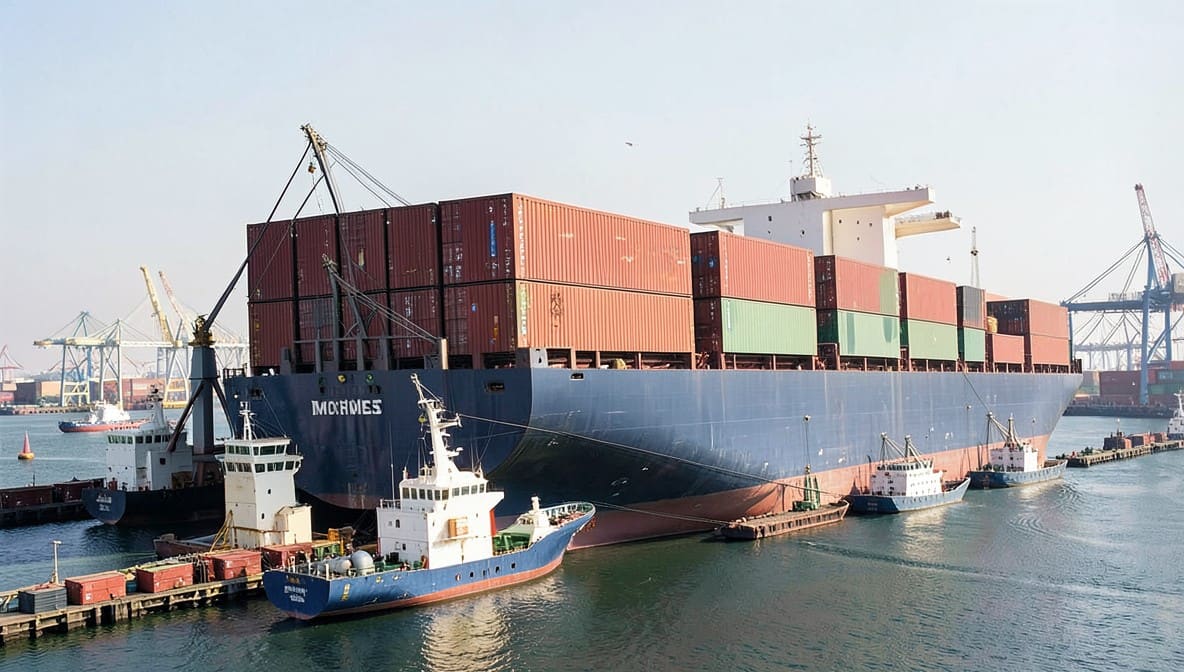
The appellant, Hapag-Lloyd Aktiengesellschaft, a German-based non-resident shipping company, operates international cargo services through vessels owned, chartered, or pooled by it. Due to port depth limitations in certain Indian ports, the company books space on feeder vessels to transport cargo from Indian ports to main vessels located at international hub ports. The dispute centers on whether income generated from these feeder vessel operations is exempt under Article 8 of the India-Germany DTAA or taxable under Section 44B of the Income Tax Act, 1961.
Key Facts
- The appellant is a tax resident of Germany and engages in international shipping operations.
- For Assessment Year 2023-24, the appellant declared gross freight income of Rs. 6,87,99,57,893/-, claiming full exemption under Article 8 of the DTAA.
- The Assessing Officer disallowed exemption for two categories of feeder vessel income:
- Rs. 21,94,99,191/- from feeder-to-feeder transportation
- Rs. 2,12,27,23,559/- from entire journey on feeder vessels
- Total disputed amount: Rs. 23,42,22,22,750/-
- The Assessing Officer treated this income as taxable under Section 44B, arguing that slot arrangements do not constitute "operation of ships" under Article 8.
- The Dispute Resolution Panel (DRP) upheld the Assessing Officer’s view, relying on its earlier order for Assessment Year 2022-23.
- The appellant has consistently claimed this exemption since Assessment Year 2006-07.
Procedural History
- 2007-08: First adjudication by ITAT Mumbai in ITA No. 8854/Mum/2010, order dated 14.08.2013, holding feeder vessel income exempt under Article 8.
- 2006-07 to 2022-23: ITAT consistently followed the 2013 precedent across 10 assessment years.
- 2012: Delhi High Court in Director of Income Tax (Int. Taxation) v. Balaji Shipping upheld the exemption for slot-based feeder vessel income under the India-UK DTAA, with reasoning applied to India-Germany DTAA due to identical provisions.
- 2016 to 2025: Multiple ITAT orders (e.g., ITA No. 1624-1628/Mum/2015, ITA No. 1738/Mum/2025) affirmed the exemption.
- 2023-24: DRP reversed prior precedent, leading to this appeal.
- 15.04.2026: Hearing held before ITAT Mumbai.
- 05.06.2026: Judgment pronounced.
The Parties' Positions
For the Appellant
- Argued that feeder vessel operations are an integral, ancillary part of international shipping business.
- Relied on Balaji Shipping v. DCIT (Delhi HC, 2012), which held that slot arrangements are covered under "operation of ships" as per OECD Model Convention.
- Cited 10 prior ITAT decisions and multiple High Court dismissals of Revenue’s appeals as binding precedent.
- Emphasized that slot arrangements are commercially necessary due to port constraints and do not constitute a separate business.
For the Respondent
- Contended that feeder vessel income arises from slot hire arrangements, which are not "operation of ships" under Article 8.
- Relied on the DRP’s view that the revenue share from feeder vessels (29%) was substantial and thus outside the scope of ancillary activity.
- Argued that Section 44B applies to non-residents earning income from shipping in India, irrespective of contractual structure.
Relief Sought
The appellant sought deletion of the disputed addition of Rs. 23,42,22,22,750/-, restoration of the exemption under Article 8 of the DTAA, and consequential relief on TDS credit of Rs. 2,11,253/-.
The Legal Issue
The central question was whether income earned by a non-resident shipping company from cargo transported via feeder vessels under slot arrangements qualifies as "profit from the operation of ships in international traffic" under Article 8 of the India-Germany DTAA, or whether it is taxable under Section 44B of the Income Tax Act.
Arguments Presented
For the Appellant
The appellant relied on the binding precedent set by the Delhi High Court in Director of Income Tax (Int. Taxation) v. Balaji Shipping (2012), which interpreted "operation of ships" broadly to include slot hire arrangements as ancillary to the core business. The appellant emphasized that the OECD Model Convention, adopted by India, explicitly includes activities directly or indirectly connected with ship operations. It further cited 10 consecutive ITAT rulings in its favor and noted that the Revenue had failed to appeal any of these decisions to the High Court, thereby acquiescing to the legal position. The appellant argued that the 29% revenue share from feeder vessels did not alter the nature of the activity, as the majority of revenue (over 66%) still came from owned/chartered vessels.
For the Respondent
The Departmental Representative conceded the historical precedent but argued that the scale of feeder vessel income in the current year (29%) was materially higher than in earlier years (12% in Balaji Shipping), suggesting a shift from ancillary to primary activity. The DR maintained that Section 44B was the appropriate provision for taxing such income, as slot arrangements were commercial leases, not direct ship operations. However, the DR offered no new legal argument or statutory interpretation to override the established jurisprudence.
The Court's Analysis
The Tribunal conducted a comprehensive review of the legal and factual history of the dispute. It noted that the issue had been litigated for nearly two decades with consistent outcomes in favor of the assessee. The Tribunal emphasized that the Delhi High Court’s reasoning in Balaji Shipping was not confined to the facts of that case but established a principle grounded in the OECD Model Convention and the principle of functional integration.
"The High Court held that availing of slot hire facility had a close nexus with the business operation of ships in the international traffic as an enterprise may not be able to carry on business at all in many situations... Such cases have to be considered as having close nexus with the main business of enterprise of operation of ships. They are ancillary and complement the operation by the enterprise."
The Tribunal rejected the Revenue’s argument that the quantum of income (29%) rendered the activity non-ancillary. It observed that the High Court in Balaji Shipping had explicitly addressed this concern, stating that the ruling did not apply to enterprises operating solely through slot arrangements - a condition not met here, as over two-thirds of the appellant’s revenue came from owned/chartered vessels.
The Tribunal further noted that the DRP’s reliance on its own prior order for AY 2022-23 was legally unsustainable, as it contradicted binding precedent. The Tribunal held that a coordinate bench cannot overrule a prior decision of another coordinate bench unless there is a change in law or a higher court ruling. No such change had occurred.
The Tribunal also affirmed that the OECD Model Convention’s Article 4.1 and 4.2, which define activities "directly connected" or "ancillary" to ship operations, are integral to interpreting DTAA provisions. The use of feeder vessels under slot arrangements was found to be a necessary operational adaptation, not a separate business.
The Verdict
The appeal is partly allowed. The Tribunal set aside the addition of Rs. 23,42,22,22,750/- made under Section 44B and held that the income from feeder vessel operations is exempt under Article 8 of the India-Germany DTAA. The Assessing Officer is directed to delete the disputed addition and recompute the total income accordingly. Regarding TDS credit of Rs. 2,11,253/-, the Assessing Officer is directed to verify the claim with reference to the income offered and TDS records, and decide the issue after providing a reasonable opportunity of hearing.
What This Means For Similar Cases
Ancillary Activities Are Protected Under DTAA
- Practitioners can now confidently assert that any logistical support activity - including slot bookings, port handling, or feeder vessel use - that is functionally necessary for international shipping qualifies for DTAA exemption under Article 8.
- The quantum of income from ancillary activities does not disqualify the exemption, provided the core business remains ship operation.
Precedent Binding Unless Overturned by Higher Authority
- Tax authorities cannot ignore consistent ITAT and High Court rulings merely because the revenue share from ancillary activities increases.
- Revenue must appeal adverse decisions to higher forums; silence or reliance on DRP circulars does not override binding precedent.
Operational Necessity Trumps Formal Structure
- The legal characterization of a transaction (e.g., "slot hire") is secondary to its functional role in the business. If the activity enables international shipping, it falls within Article 8.
- Tax planning for non-resident shipping entities should now explicitly document the operational necessity of feeder vessels and slot arrangements to strengthen exemption claims.