The Himachal Pradesh High Court has reaffirmed that the State, as a welfare entity, cannot deprive a citizen of private property without following due process of law, even when the land has been used for public infrastructure for decades. The judgment underscores that oral consent, unsupported by documentation, cannot override statutory protections under the Constitution and the Specific Relief Act.
Background & Facts
The Dispute
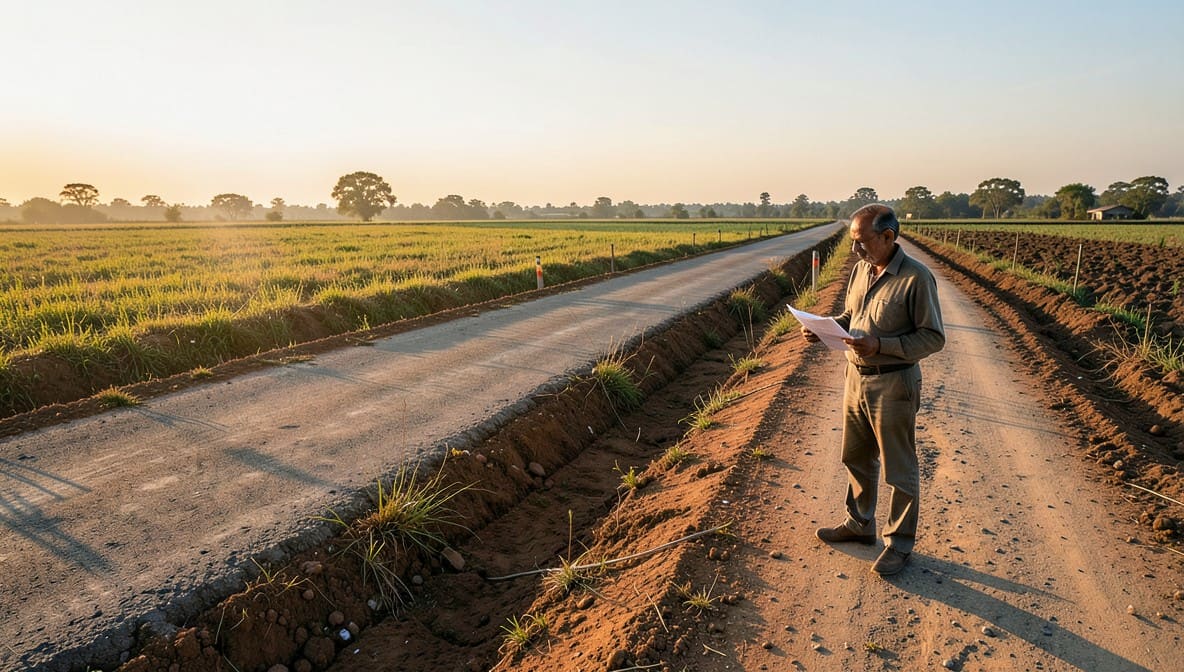
The respondent, Inderjeet, is the recorded owner of two parcels of land in Village Hatli, Tehsil Nadaun, District Hamirpur, H.P., described in revenue records as Khewat No. 242, Khatauni No. 250, Khasra No. 1088 (0-00-22 hectares) and Khewat No. 243, Khatauni No. 251, Khasra No. 1199 (0-07-27 hectares). These lands, classified in revenue records as "Gair Mumkin Sarak" (non-cultivable road land), were utilized by the State of Himachal Pradesh for the construction of the "Dhanet Hamirpur via Kangoo Galore Road". The road was constructed prior to 1980. The respondent was never compensated, nor was any formal acquisition initiated until 2001, when a notification was published in Danik Tribune on 06.03.2001 but subsequently lapsed. Despite assurances from the State that acquisition would be completed, no action followed. The respondent filed a suit for vacant possession under Section 6 of the Specific Relief Act in 2009.
Key Facts
- The respondent is the recorded owner of the suit land as per Missal Hakiyat Bandobast Jadid Sani (Ext. P-1) for 2003-04 and other revenue records.
- The suit land is traversed by the Dhanet-Hamirpur road, constructed before 1980.
- The State claimed oral consent from the respondent and his co-sharers for the road’s construction, but produced no written evidence.
- The respondent examined three witnesses, including himself, and produced documentary evidence including:
- Revenue records (Ext. P-1, P-II, P-3, P-IV to P-VIII)
- Legal notice dated 15.08.2008 (Ext. PX)
- Postal receipts (Ext. PY)
- Notifications for acquisition (Ext. PW3A, PW3/B, PW3/C)
- Notification Ext. PW3/C, issued on 06.03.2001, specifically mentioned Khasra No. 756, which corresponds to the suit land under revised Jamabandi records.
- The State examined two witnesses: DW1 Shiv Kumar and DW2 Joginder Pal, both claiming oral consent and absence of objection from the respondent or his ancestors, including his great-grandmother Udku Devi.
Procedural History
- 2009: Civil Suit No. 184/2009 filed by respondent before Senior Civil Judge, Hamirpur.
- 18.11.2010: Trial court framed eight issues, including maintainability, locus standi, estoppel, and consent.
- 01.09.2017: Trial court decreed the suit, directing the State to complete acquisition and pay compensation within one year; failing which, respondent entitled to vacant possession.
- 16.10.2017: State filed First Appeal No. 133/2017 before District Judge, Hamirpur.
- 06.11.2019: First Appellate Court partly allowed the appeal but upheld the decree for vacant possession, affirming the trial court’s findings.
- 22.02.2024: Regular Second Appeal No. 229/2024 filed before Himachal Pradesh High Court.
- 06.04.2026: Reserved for judgment.
- 17.04.2026: Judgment delivered.
The Parties' Positions
For the Appellants (State of H.P.)
- The road was constructed before 1980 with the oral consent of the respondent and co-sharers.
- The suit is time-barred as the cause of action arose over 30 years ago.
- The respondent is estopped from claiming possession due to acquiescence.
- No formal acquisition was necessary because the land was already designated as "Gair Mumkin Sarak".
- The State cannot be held liable for delay in completing acquisition proceedings.
For the Respondent (Inderjeet)
- The land remains his property despite revenue classification.
- The State’s use of the land without acquisition or compensation violates Article 300A of the Constitution.
- The 2001 notification proves the State recognized the land as privately owned and required formal acquisition.
- Oral consent is insufficient and uncorroborated.
- The State, as a welfare entity, cannot claim adverse possession.
Relief Sought
The respondent sought vacant possession of the suit land and, alternatively, payment of compensation equivalent to his share in the property. The trial court granted the latter as a conditional remedy, with possession as fallback.
The Legal Issue
The central question was whether the State, having used private land for public road construction for over three decades without formal acquisition or compensation, can defeat the owner’s claim for possession on grounds of oral consent and limitation, or whether the owner’s right to due process under Article 300A and the Specific Relief Act prevails.
Arguments Presented
For the Appellant
The Additional Advocate General contended that the suit is barred by limitation, as the cause of action arose when the road was constructed before 1980. He argued that the respondent’s long-standing silence and the absence of any protest for over 30 years amounted to acquiescence and estoppel. He further submitted that the land was classified as "Gair Mumkin Sarak" in revenue records, implying public use, and that the 2001 notification was merely a procedural lapse, not an admission of title. He relied on the principle that courts should not interfere with long-standing public infrastructure unless there is clear evidence of illegal appropriation.
For the Respondent
The respondent’s counsel argued that the State’s use of private property without compensation violates the constitutional mandate under Article 300A. He emphasized that the 2001 notification, which specifically referenced Khasra No. 756 (the suit land), conclusively demonstrated the State’s recognition of the respondent’s title and its obligation to follow acquisition procedures. He cited Maneka Gandhi v. Union of India and State of H.P. v. Krishan Lal to assert that the State cannot claim adverse possession against its citizens. He further argued that oral consent, unsupported by any document, cannot override statutory and constitutional protections.
The Court's Analysis
The Court began by noting that the State admitted to using the respondent’s land for public road construction. It then examined the evidentiary record, particularly the absence of any written document evidencing consent. The Court observed that the State’s reliance on oral testimony from DW1 and DW2 was insufficient to rebut the documentary evidence of ownership and the 2001 acquisition notification.
"In case the plaintiff or any of his co-sharers had ever consented for the construction of the road in question, as is claimed by the defendants/appellants, then what was the necessity to have issued notification, Ext. PW3/C for acquisition of Khasra No.756, which is the suit land. Thus, notification, Ext. PW3/C itself falsifies the unsubstantiated stand qua consent taken by the defendants/appellants for acquisition of the suit land for the construction of the road in question."
The Court held that the issuance of a formal acquisition notification under the Land Acquisition Act, even if lapsed, is a legal act that presupposes the existence of private title. The State cannot simultaneously claim the land was given by consent and then initiate acquisition proceedings. The notification, therefore, acted as an admission of the respondent’s ownership.
The Court further emphasized that the State, as a welfare entity, cannot claim adverse possession against its citizens. It cited State of U.P. v. Mohd. Naim and Union of India v. Tarsem Singh to affirm that the doctrine of adverse possession is inapplicable against the State in its sovereign capacity when it comes to private property rights.
The Court also addressed the scope of second appeal under Section 100 CPC. It held that the First Appellate Court had correctly appreciated both oral and documentary evidence, and its findings were concurrent. The High Court cannot interfere with such findings unless they are perverse, based on inadmissible evidence, or ignore material evidence. None of these conditions were met. The Court relied on Hero Vinoth v. Seshammal and Annamalai v. Vasanthi to reinforce that second appeals are not forums for re-appreciating evidence.
The Court concluded that the respondent’s right to property, protected under Article 300A, cannot be extinguished by mere lapse of time or oral assertions. The State’s failure to complete acquisition proceedings does not absolve it of its obligation to either pay compensation or restore possession.
The Verdict
The appeal was dismissed. The High Court upheld the judgment and decree of the First Appellate Court dated 06.11.2019, directing the State of Himachal Pradesh to complete acquisition proceedings for the suit land and pay compensation equivalent to the respondent’s share within six months from the date of judgment. In default, the respondent shall be entitled to vacant possession of the suit land. Costs of Rs. 15,000 were awarded to the respondent.
What This Means For Similar Cases
State Use of Private Land Requires Formal Process
- Practitioners must argue that any public use of private land, even for decades, triggers constitutional obligations under Article 300A.
- Oral consent without documentation is legally insufficient to extinguish title.
- Acquisition notifications, even if lapsed, constitute admissions of private ownership and revive the obligation to compensate.
Limitation Does Not Bar Claims Against the State
- Claims for possession or compensation against the State for unauthorized use of land are not barred by limitation if the State has not perfected title through adverse possession.
- The doctrine of adverse possession is inapplicable against the State in its sovereign capacity.
- The burden shifts to the State to prove lawful acquisition or consent.
Second Appeals Are Not Fact Re-trials
- High Courts must strictly limit interference in second appeals under Section 100 CPC to substantial questions of law.
- Concurrent findings of fact by trial and first appellate courts are binding unless perverse or based on inadmissible evidence.
- Practitioners should frame second appeals around legal errors, not factual disputes.