The Gauhati High Court has reaffirmed that prolonged state occupation of private land without formal acquisition violates constitutional protections under Article 300A and mandates both immediate payment of assessed rental compensation and initiation of acquisition proceedings under the LARR Act 2013. This judgment clarifies the legal obligations of the Union when military infrastructure occupies private property for decades without lawful transfer of title.
Background & Facts
The Dispute
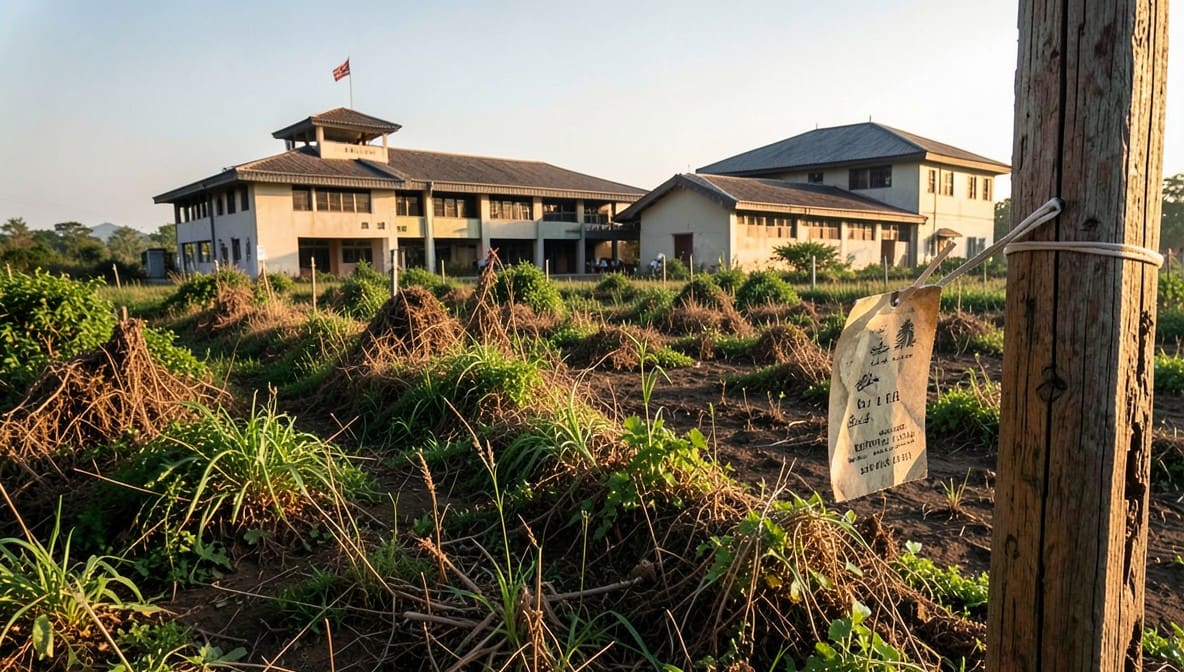
The petitioners, four landowners from Vairengte, Mizoram, sought enforcement of a 2017 High Court order directing payment of rental compensation for their land occupied by the Counter Insurgency Jungle Warfare School (CIJWS). The land was originally acquired under the Land Acquisition Act, 1894, but the Union of India never completed formal acquisition despite occupying the land since 1974. The petitioners’ land passes were among only 21 out of over 100 claims verified as genuine after an anti-corruption investigation.
Key Facts
- The CIJWS was established on land notified under Section 4 and 6 of the Land Acquisition Act, 1894, in the early 1970s.
- The State Government issued acquisition notifications without prior consultation with the Ministry of Defence.
- An investigation by the CID’s Anti-Corruption Branch identified only 21 genuine landowners, including the four petitioners.
- The District Collector, Kolasib, issued Award No. 1 of 2007, but payment was delayed due to disputed ownership.
- The petitioners’ land was found to be physically occupied by the CIJWS during joint verification conducted on 16.05.2017.
- Rental compensation was assessed at Rs. 2,91,60,088/- for the period from May 1974 to July 2020.
- The petitioners submitted a representation on 20.03.2024 seeking payment, but no action was taken.
- The District Collector, Kolasib, formally requested payment of the assessed amount on 10.12.2024.
- The land remains under occupation by the CIJWS as of the date of judgment (30.04.2026).
Procedural History
- 1974: CIJWS began occupying the petitioners’ land without formal acquisition.
- 2007: District Collector, Kolasib, issued Award No. 1 of 2007 for compensation.
- 2010: Original Writ Petition WP(C) No. 48/2010 filed by petitioners seeking payment.
- 2011: Union filed WP(C) No. 19/2011 challenging validity of State’s acquisition.
- 23.02.2017: Coordinate Bench of Gauhati HC directed verification of genuine landowners and payment of compensation.
- 16.05.2017: Joint verification report confirmed petitioners’ land was occupied by CIJWS.
- 07.09.2019: Joint meeting in Chief Secretary’s Office, Mizoram, confirmed compensation payable as per 2017 order.
- 10.12.2024: Defense Estate Office, Guwahati, sent proposal for rental compensation to Ministry of Defence.
- 20.03.2024: Petitioners submitted representation for urgent payment.
- 28.04.2026: Judgment reserved.
- 30.04.2026: Judgment pronounced.
The Parties' Positions
For the Petitioners:
- The Union has occupied their land since 1974 without lawful acquisition.
- Rental compensation of Rs. 2,91,60,088/- assessed by the District Collector must be paid immediately.
- Continued occupation entitles them to compensation under the Right to Fair Compensation and Transparency in Land Acquisition, Rehabilitation and Resettlement Act, 2013 (LARR Act 2013).
- Article 300A of the Constitution protects them from deprivation of property without authority of law.
For the Respondents:
- Only the petitioners’ lands among the 21 verified genuine claims are under occupation.
- The proposal for rental compensation has been sent to the Ministry of Defence on 10.12.2024.
- Acquisition under the Land Acquisition Act, 1894, is no longer applicable since LARR Act 2013 came into force on 01.01.2014.
- The Court’s 2017 directions have been acted upon, and payment is pending only due to internal sanction processes.
Relief Sought
The petitioners sought:
- Immediate payment of assessed rental compensation of Rs. 2,91,60,088/- for the period May 1974 to July 2022.
- Payment of continuing compensation under the LARR Act 2013 for occupation beyond July 2022.
- Initiation of formal land acquisition proceedings under the LARR Act 2013.
- Interest on delayed payments.
The Legal Issue
The central question was whether Article 300A of the Constitution and the LARR Act 2013 require the Union to pay ongoing rental compensation and initiate formal acquisition when private land has been occupied for over four decades without lawful transfer of title, even if the original acquisition was initiated under the 1894 Act.
Arguments Presented
For the Petitioner
The petitioners relied on State of Haryana v. Mukesh Kumar and Union of India v. V. Sreekanth to argue that prolonged occupation without acquisition constitutes a continuing violation of Article 300A. They contended that the 2017 judgment was binding and that the delay in payment since 2017 was unjustified. They further argued that the LARR Act 2013, being a more protective statute, applies to all ongoing occupations after its enforcement date (01.01.2014), and that the Union cannot evade acquisition obligations by relying on the repealed 1894 Act.
For the Respondent
The Union contended that the rental compensation assessment was complete and the delay was administrative, not malicious. They argued that the LARR Act 2013 could not be applied retrospectively to land occupied before 2014 and that the 1894 Act governed the original acquisition. They maintained that the proposal for payment had been submitted and that judicial intervention was premature.
The Court's Analysis
The Court observed that the Union had admitted the factual basis of occupation and the validity of the rental compensation assessment. The Court emphasized that the 2017 judgment was not a mere direction but a binding constitutional mandate under Article 300A, which guarantees protection against arbitrary deprivation of property.
"The State cannot indefinitely hold private property for public use without either paying fair compensation or acquiring it through due process of law. The passage of time does not convert unlawful possession into lawful ownership."
The Court rejected the Union’s argument that the LARR Act 2013 could not apply because the occupation began before 2014. It held that the Act governs the continuing nature of possession and compensation obligations after its enactment. The Court cited K. S. Puttaswamy v. Union of India to affirm that constitutional rights cannot be diluted by procedural delays.
The Court further noted that the proposal for payment had been pending for over seven years since the 2017 order, and the delay in forwarding the proposal to the Ministry of Defence until December 2024 was inexcusable. The Court held that the Union’s internal bureaucratic processes cannot override judicial mandates.
The Court also clarified that the only lawful means to retain the land permanently is through acquisition under the LARR Act 2013, which provides for fair compensation, social impact assessment, and rehabilitation. Merely paying rent is a temporary measure and cannot substitute for acquisition.
The Verdict
The petitioners succeeded. The Court directed the Union to pay the assessed rental compensation of Rs. 2,91,60,088/- within three months from the date of judgment. The Court further directed the Union to initiate formal acquisition proceedings under the Right to Fair Compensation and Transparency in Land Acquisition, Rehabilitation and Resettlement Act, 2013, for the petitioners’ land within three months, and to complete the process in accordance with the timelines prescribed under the Act. The Union shall also pay continuing compensation under the LARR Act 2013 for the period from July 2022 until acquisition is completed.
What This Means For Similar Cases
Rental Compensation Is Not a Substitute for Acquisition
- Practitioners must argue that prolonged occupation (beyond 5 - 7 years) without acquisition triggers mandatory acquisition proceedings under LARR Act 2013, regardless of when possession began.
- Merely paying rent does not cure a constitutional violation under Article 300A.
LARR Act 2013 Applies to Ongoing Occupations
- Even if land was occupied before 01.01.2014, the LARR Act 2013 governs all compensation and acquisition obligations arising after its enforcement.
- The Act’s procedural safeguards apply to all future actions by the State, including continued possession.
Judicial Orders Must Be Implemented Within Reasonable Time
- Delays exceeding five years in implementing court orders on land compensation are prima facie unreasonable.
- Courts will impose strict timelines (e.g., 3 months) for compliance, and non-compliance may attract contempt proceedings.
Documentary Verification Is Binding
- Once a joint verification report confirms land ownership and occupation, the State cannot re-litigate the issue unless new evidence emerges.
- The burden shifts to the State to prove why payment or acquisition should not proceed.
Actionable Takeaways for Practitioners
- File writ petitions under Article 226 if rental compensation remains unpaid beyond 12 months after a court order.
- Always plead for acquisition under LARR Act 2013 in cases of prolonged state occupation, even if the original acquisition was under the 1894 Act.
- Demand interest on delayed compensation under Section 34 of the 1894 Act and Section 30 of the LARR Act 2013.