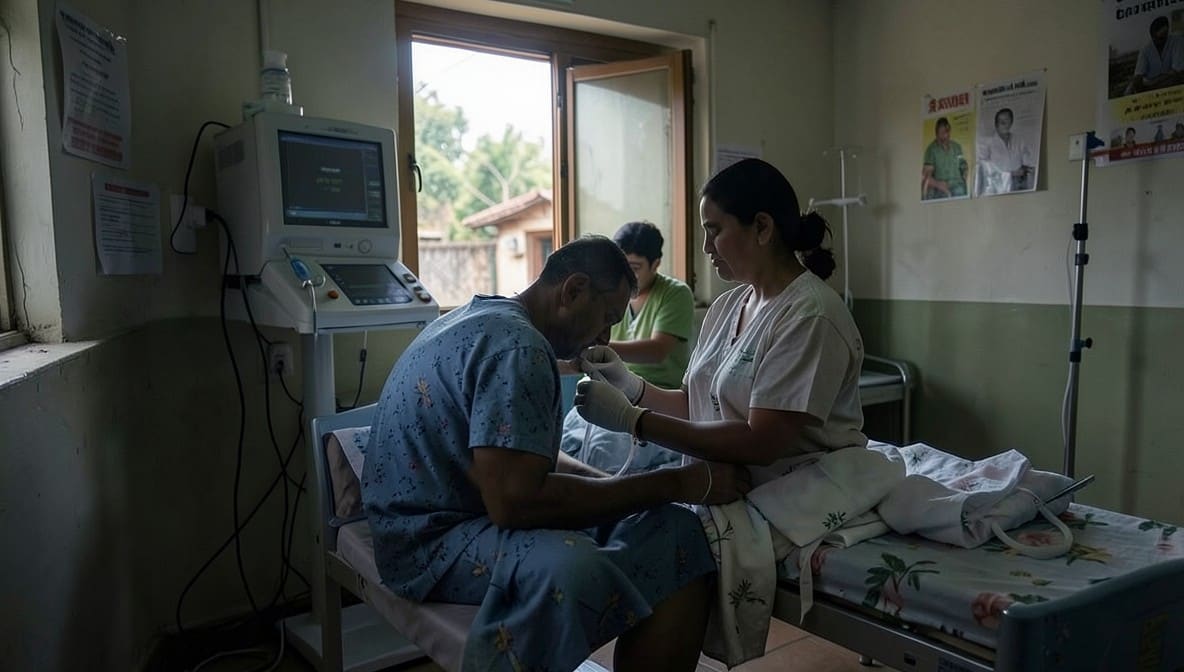
The Himachal Pradesh High Court has delivered a significant ruling on the grant of interim bail, holding that medical emergencies involving close family members can justify the release of an accused even in heinous offences. The Court balanced the right of the accused to attend to his ailing father against the State’s apprehensions of witness intimidation, imposing stringent conditions to mitigate risks while allowing temporary liberty.
Background & Facts
The Dispute
The petitioner, Inderjeet Singh, sought interim bail in connection with FIR No. 243 of 2023, dated 10.08.2023, registered at Police Station Nalagarh, District Solan, Himachal Pradesh. The FIR alleged offences punishable under Sections 302 (murder), 382 (theft after preparation for causing death), and 120B (criminal conspiracy) of the Indian Penal Code (IPC). The prosecution’s case centered on a double murder near Idgah, Nalagarh, where two individuals - Kunal Baba and Varun - were found stabbed and later succumbed to their injuries.
Key Facts
- Incident Date: 10.08.2023, around 6:00 PM, near Idgah, Nalagarh.
- Victims: Kunal Baba (declared dead at the hospital) and Varun (succumbed after first aid).
- Informant’s Statement: Lovkesh Baba, the uncle of the victims, stated that Kunal had received an Instagram call from Gaurav on the day of the incident, during which Gaurav allegedly objected to Kunal posting stories on Instagram. Kunal later informed Lovkesh that Gaurav was visiting Nalagarh.
- Investigation Findings:
- The police arrested the petitioner, Inderjeet Singh, and co-accused Gaurav Gill and Akashdeep Singh.
- A motorcycle (PB-08FB-9802), registered in the petitioner’s name, was used in the crime and later seized at Amritsar.
- Call detail records placed the petitioner and co-accused at Nalagarh on the date of the incident.
- A knife recovered from Gaurav Gill’s disclosure matched the injuries on the victims, with DNA evidence linking it to Varun.
- CCTV footage corroborated the presence of the accused at the crime scene.
- Charge Sheet: Filed on 08.11.2023, with supplementary charge sheets on 03.02.2025 and 26.04.2025. Statements of 18 out of 51 prosecution witnesses have been recorded.
- Trial Schedule: Listed for 10th - 19th September 2026 for recording remaining witness statements.
Procedural History
- 10.08.2023: FIR registered under Sections 302, 382, and 120B IPC.
- Post-10.08.2023: Petitioner arrested and lodged in Model Central Jail, Kanda, District Shimla.
- 08.11.2023: Charge sheet filed before the Trial Court.
- 03.02.2025 and 26.04.2025: Supplementary charge sheets filed.
- 2026: Petitioner filed Cr. MP(M) No. 744 of 2026 seeking interim bail.
The Petitioner’s Position
The petitioner contended that:
- His father, Balbir Singh, was diagnosed with a large cystic mass in the liver, requiring immediate surgery.
- He was the only son and had no other family member to care for his father, as his mother was aged and ill.
- The trial was scheduled for September 2026, and his presence was not required for the proceedings.
- He undertook to abide by all conditions imposed by the Court and surrender after the expiry of interim bail.
Relief Sought
The petitioner prayed for interim bail for 30 days to attend to his father’s medical emergency, subject to furnishing personal and surety bonds and complying with conditions.
The Legal Issue
The central question before the Court was: Whether the medical emergency of a close family member justifies the grant of interim bail to an accused charged with heinous offences under Sections 302, 382, and 120B IPC, and if so, under what conditions can such bail be granted to mitigate risks of witness intimidation or absconding?
Arguments Presented
For the Petitioner
- Medical Emergency: Relied on a prescription slip from PGI Premier Gastroenterology Institute, Jalandhar, confirming the father’s diagnosis and the need for surgery. A certificate from the Sarpanch corroborated the family’s inability to care for the father without the petitioner’s presence.
- No Immediate Role in Trial: Argued that the trial was not scheduled until September 2026, and the petitioner’s presence was not required for the ongoing proceedings.
- Undertaking: Offered to surrender after 30 days and comply with any conditions imposed by the Court.
For the Respondent/State
- Heinous Offence: Contended that the petitioner was involved in a double murder and theft, and his release could intimidate witnesses or lead to absconding.
- Risk of Interference: Emphasized the gravity of the offence and the potential for tampering with evidence if the petitioner were released.
The Court's Analysis
The Court undertook a balancing exercise between the petitioner’s right to attend to his father’s medical emergency and the State’s apprehensions of witness intimidation or flight risk. Key observations included:
-
Medical Evidence: The Court noted the prescription slip and Sarpanch’s certificate as sufficient proof of the father’s medical condition and the family’s dependence on the petitioner. It rejected the State’s argument that the petitioner could engage a paid attendant, holding that:
"Being a son, the petitioner has a right to be present with his father during his difficult times. Therefore, the interim bail cannot be denied on the ground that the petitioner can engage paid attendants."
-
Trial Timeline: The Court observed that the trial was not scheduled until September 2026, and the petitioner’s presence was not immediately required. Thus, granting interim bail would not impede the trial’s progress.
-
Apprehensions of the State: The Court acknowledged the State’s concerns about witness intimidation but held that such risks could be mitigated through stringent conditions. It emphasized that apprehensions alone were insufficient to deny bail, stating:
"These apprehensions can be removed by imposing conditions, and are not sufficient to deny interim bail to the petitioner."
-
Conditions for Bail: The Court imposed strict conditions to address the State’s concerns, including:
- Surrender after 30 days.
- Non-interference with witnesses or evidence.
- Furnishing mobile number and social media details to the police and Court, with an obligation to intimate any changes within five days.
The Verdict
The Court allowed the petition and ordered the petitioner’s release on interim bail for 30 days, subject to the following conditions:
- Furnishing personal and surety bonds of ₹1 lakh each to the satisfaction of the Trial Court.
- Surrendering before the Superintendent of Jail after the expiry of the 30-day period.
- Non-interference with witnesses or evidence during the bail period.
- Furnishing mobile number and social media contact details to the police and Court, with an obligation to intimate any changes within five days.
- Compliance with any additional conditions imposed by the Trial Court.
The Court clarified that its observations were limited to the disposal of the petition and would have no bearing on the merits of the case.
What This Means For Similar Cases
Medical Emergencies Can Justify Interim Bail
- Humanitarian Grounds: Courts may grant interim bail on humanitarian grounds, such as medical emergencies involving close family members, even in cases involving heinous offences.
- Burden of Proof: The accused must provide credible evidence (e.g., medical prescriptions, certificates) to substantiate the emergency. Mere assertions are insufficient.
- Balancing Act: The Court will balance the accused’s right to attend to family against the State’s concerns of witness intimidation or absconding.
Conditions Are Key to Mitigating Risks
- Stringent Conditions: Courts are likely to impose strict conditions to address the State’s apprehensions, such as:
- Surrender obligations after a specified period.
- Non-interference undertakings.
- Monitoring mechanisms (e.g., furnishing contact details, regular intimation of changes).
- Trial Timeline: If the trial is not imminent, courts may be more inclined to grant interim bail, as the accused’s presence is not immediately required.
Apprehensions Alone Are Insufficient to Deny Bail
- Evidence-Based Concerns: The State’s apprehensions of witness intimidation or absconding must be substantiated by evidence. Mere assertions are insufficient to deny bail.
- Judicial Discretion: Courts retain wide discretion in bail matters and may reject blanket objections if conditions can mitigate risks.
Practitioners should note that medical emergencies can be a strong ground for interim bail, but stringent conditions will likely be imposed to address the State’s concerns. The burden of proof lies on the accused to establish the emergency, and the trial timeline plays a crucial role in the Court’s decision-making.