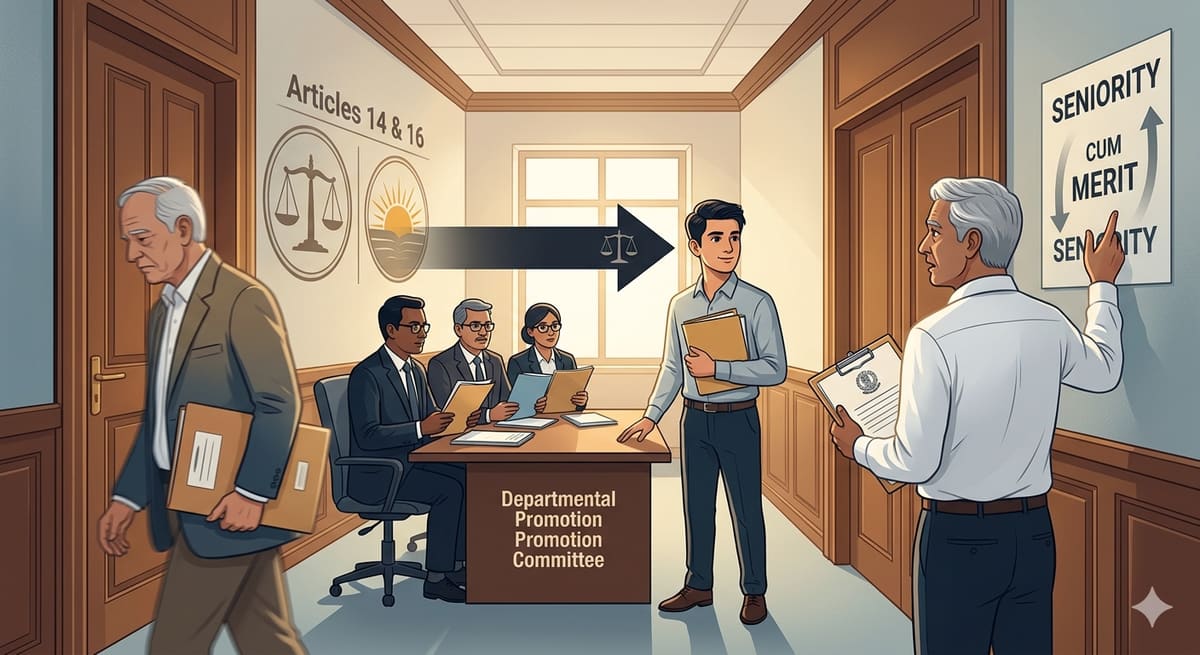
The Supreme Court has reaffirmed that arbitrary denial of promotion to a senior employee, while granting similar benefits to others under identical circumstances, constitutes a violation of the constitutional guarantee of equality. This judgment clarifies that administrative discretion under service rules cannot be exercised in a manner that discriminates against employees with comparable experience and qualifications.
Background & Facts
The Dispute
The appellant, Kamal Prasad Dubey, a long-serving employee of the Primary Agriculture Credit Cooperative Society in Nayagaon, Panna District, sought promotion to the post of Society Manager. Despite 28 years of unblemished service and unanimous recommendations from the Board of Directors and General Body of the Society, his promotion was denied by the Registrar of Cooperative Societies on the ground that he lacked a graduation degree, which was mandated under the 2013 service rules. The denial occurred even though two other employees with the same educational qualification - Higher Secondary pass - were promoted under similar circumstances.
Key Facts
- Appellant appointed as Sahayak Samiti Sevak on 02.09.1987 with Higher Secondary qualification
- Appellant served continuously for 28 years without any disciplinary record
- Old service rules (pre-30.08.2013) permitted promotion to Society Manager with Higher Secondary qualification
- New Rules effective 30.08.2013 required graduation for promotion, but included a proviso allowing relaxation based on experience, competence, or seniority
- Board of Directors passed resolution on 02.07.2015 recommending promotion with relaxation in educational qualification
- General Body ratified the recommendation on 28.09.2015
- Registrar rejected proposal by order dated 07.06.2016 without assigning any reason
- Two similarly situated employees promoted: Sushil Kumar Tripathi on 29.02.2016 and Ram Swaroop Pandey on 12.12.2014, both with only Higher Secondary qualification
- Appellant’s promotion was denied despite identical or superior service record
- Appellant completed M.A. and diploma in computer education by 2020
Procedural History
- 02.07.2015: Board of Directors recommends promotion with relaxation
- 28.09.2015: General Body ratifies recommendation
- 07.06.2016: Registrar rejects proposal cryptically
- 2016: Writ Petition No. 12814 of 2016 filed before High Court of Madhya Pradesh, Jabalpur
- 22.01.2019: Single Judge allows writ petition, directs relaxation and promotion
- 11.11.2019: Division Bench reverses Single Judge’s order, upholds Registrar’s refusal
- 17.12.2019: Review Petition dismissed by Division Bench
- 13.11.2020: Supreme Court grants SLP and stays demotion
- 10.04.2026: Supreme Court delivers judgment
Relief Sought
The appellant sought: (1) setting aside the Division Bench’s order dated 11.11.2019, (2) direction to grant promotion with effect from the date of recommendation (02.07.2015), (3) payment of arrears of salary and allowances from that date, and (4) interest on arrears at 9% per annum.
The Legal Issue
The central question was whether the Registrar’s refusal to grant relaxation in educational qualification, while approving similar relaxations for other employees with identical qualifications and lesser experience, violated Articles 14 and 16 of the Constitution.
Arguments Presented
For the Appellant
The appellant’s counsel argued that the Registrar’s refusal was arbitrary and discriminatory. They relied on the proviso to Rule 19-A of the 2013 Rules, which explicitly permitted relaxation based on seniority and experience. They emphasized that two other employees with the same educational qualification were promoted, establishing a clear case of unequal treatment. The appellant had fulfilled all criteria except formal graduation, which the Rules themselves allowed to be waived. The counsel cited State of Haryana v. Bhagwan Das and Rajesh Kumar v. Union of India to underscore that equality demands equal treatment for equals.
For the Respondent
The State and Registrar contended that the power to grant relaxation rested solely with the Registrar under Rule 19-A, and that the Board of Directors had no authority to override the statutory requirement. They argued that the appellant’s lack of graduation rendered him ineligible, regardless of experience, and that the promotions of the other two employees were either irregular or not properly challenged. They further claimed that the Single Judge erred in substituting administrative discretion with judicial review.
The Court's Analysis
The Court meticulously dissected the procedural and substantive inconsistencies in the Registrar’s decision. It noted that the proviso to Rule 19-A explicitly vested the power to grant relaxation in the Registrar, but did not restrict the Board of Directors from recommending it. The Court held that the Registrar’s role was not to override a valid recommendation but to exercise discretion objectively.
"The Registrar, by rejecting the proposal without assigning any reason, and while approving similar proposals for others, acted in a manner that smothered reasonableness and defied the doctrine of equality."
The Court emphasized that the two promoted employees - Sushil Kumar Tripathi and Ram Swaroop Pandey - were in an identical position to the appellant: both were Higher Secondary pass, had less service tenure, and received relaxation under the same Rule. The Registrar’s failure to explain why the appellant was denied the same benefit, while others were granted it, rendered the decision arbitrary.
The Court rejected the Division Bench’s contradictory reasoning: while acknowledging that the Board of Directors had the authority to recommend relaxation, it then upheld the Registrar’s refusal to grant it. This inconsistency, the Court held, demonstrated a failure to apply legal principles coherently.
The Court further observed that the appellant had since acquired the required qualifications (M.A. and computer diploma), rendering the original ground for denial obsolete. The denial, therefore, was not merely procedurally flawed but substantively unjust.
The Verdict
The appeals were allowed. The Supreme Court set aside the Division Bench’s order dated 11.11.2019 and the Review Petition dismissal dated 17.12.2019. The appellant is directed to be promoted to the post of Society Manager with effect from 02.07.2015, the date of the Board’s recommendation. Arrears of salary and allowances from that date shall be calculated and paid within eight weeks. Interest at 9% per annum shall be paid on arrears from 02.07.2015 until realization. Costs of Rs. 50,000 are awarded to the appellant.
What This Means For Similar Cases
Promotion Decisions Must Be Transparent and Non-Discriminatory
- Practitioners must challenge administrative refusals that lack reasoned justification when similar cases are approved
- Any disparity in treatment among employees with identical or comparable qualifications and experience must be explained
- Silence or cryptic rejection of recommendations by authorities invites judicial intervention under Article 14
Rule-Based Discretion Is Not Absolute
- Provisos granting relaxation (e.g., based on seniority or experience) must be applied uniformly
- Recommending bodies (e.g., Board of Directors) have legitimate authority to initiate relaxation requests
- The final authority (e.g., Registrar) cannot reject recommendations arbitrarily, especially when parity exists
Constitutional Equality Overrides Technical Eligibility
- Merely lacking a formal qualification does not disqualify an employee if the rules permit relaxation
- Experience and seniority, when recognized in the rules, are valid grounds for equitable treatment
- Courts will intervene where administrative discretion is used to perpetuate inequality, even in technical service matters