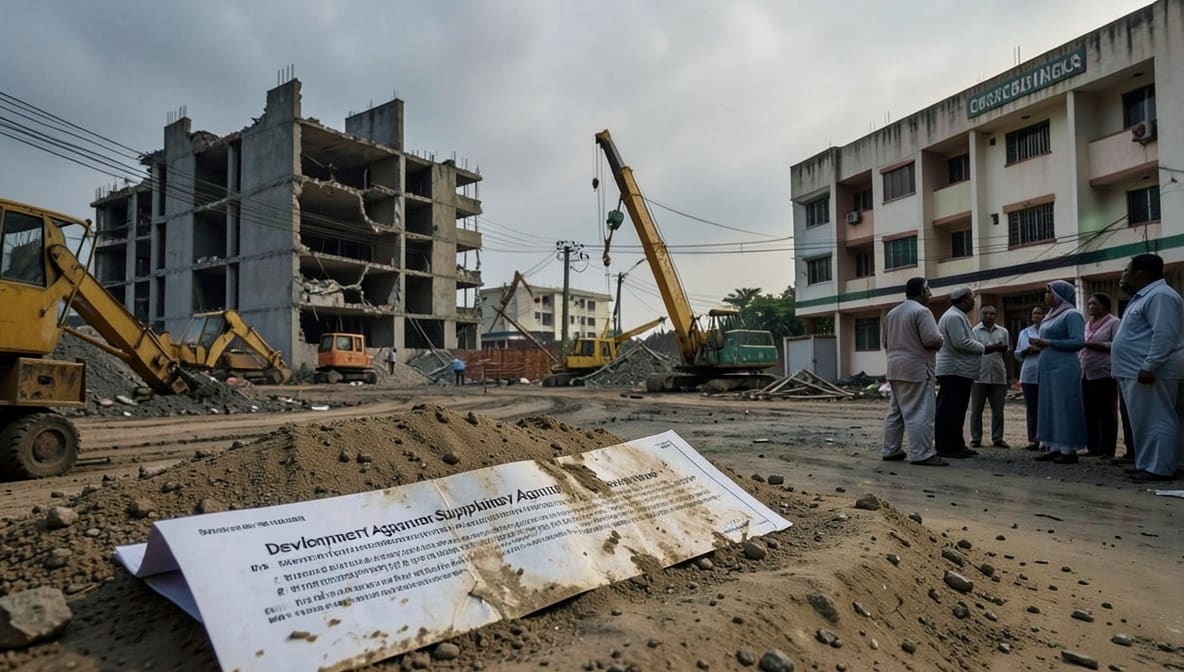
The Bombay High Court has clarified that supplementary agreements modifying redevelopment contracts do not extinguish the original arbitration clause unless the original contract is entirely substituted. This judgment underscores the continuity of arbitration agreements even after execution of consent terms and supplementary agreements, providing crucial guidance for cooperative housing societies and developers embroiled in redevelopment disputes.
Background & Facts
The Dispute
The petitioner, Borivali Sea-View Cooperative Housing Society Limited, entered into a Development Agreement dated 29 October 2020 with respondent No.1 (Town Aaadi Buildjet LLP, formerly M/s. Town KCD Developers LLP) for redevelopment of its property at Village Magathane, Borivali, Mumbai. The agreement included an arbitration clause under Clause 17. The Society’s members vacated their flats by 19 June 2019, and the existing building was demolished. Respondent No.1 obtained the Intimation of Disapproval (IOD) on 28 July 2020 and the Commencement Certificate on 1 November 2021. However, disputes arose between the parties, leading to termination notices and subsequent legal proceedings.
Key Facts
- 29 October 2020: Development Agreement executed and registered; General Power of Attorney granted to respondent No.1’s authorized partner.
- 1 November 2021: Commencement Certificate obtained by respondent No.1.
- 20 September 2024: Society issued notice terminating the Development Agreement, Power of Attorney, and Permanent Alternate Accommodation Agreements (PAAAs).
- 21 September 2024: Society filed Commercial Arbitration Petition (L) No.29125 of 2024 under Section 9 of the Arbitration and Conciliation Act, 1996 seeking interim reliefs.
- 30 November 2024: Respondent No.1 filed Commercial Arbitration Petition (L) No.36225 of 2024 seeking reliefs against the Society.
- 21 May 2025: Both petitions disposed of by a common order appointing a Sole Arbitrator to adjudicate disputes.
Consent Terms and Supplementary Agreement
- 27 October 2025: Society and respondents executed Consent Terms and a Supplementary Development Agreement, modifying the original Development Agreement.
- Society withdrew its termination notice dated 20 September 2024.
- Respondent No.1 agreed to register the Supplementary Development Agreement and a new Power of Attorney within 65 days of the arbitral award.
- Respondent No.1 agreed to pay rental assistance, displacement compensation, brokerage charges, and legal expenses (capped at Rs. 3,00,000).
- Decision-making authority of respondent No.3 (Rajiv Darji) was divested.
- Clause 17 of the original Development Agreement (arbitration clause) was modified to provide for adjudication by a sole arbitrator.
- 28 October 2025: Sole Arbitrator passed a Consent Award in terms of the Consent Terms.
- 14 November 2025: Application submitted to the stamp authority for adjudication of stamp duty on the Supplementary Development Agreement.
Breaches Alleged by the Petitioner
- Failure to Register Documents: Respondents failed to register the Supplementary Development Agreement and new Power of Attorney within 65 days of the Consent Award (by 1 January 2026).
- Non-Commencement of Redevelopment: Project timelines were contingent on registration of the Supplementary Development Agreement, which remained unregistered.
- Non-Payment of Monetary Obligations:
- Arrears of rental assistance, displacement compensation, brokerage charges, and shifting charges (totaling Rs. 6,65,94,180 with 18% compound interest).
- Outstanding property tax of Rs. 2,38,25,560 payable to the Municipal Corporation of Greater Mumbai (MCGM).
- Non-Divestment of Respondent No.3: Respondent No.3 continued to act on behalf of respondent No.1 despite the Consent Terms requiring divestment of his authority.
Procedural History
- 19 January 2026: Society issued a Notice to Cure Breaches under Clause 32 of the Supplementary Development Agreement, calling upon respondents to remedy defaults within 45 days.
- 4 March 2026: Respondents replied, attributing delay in registration to pending stamp duty adjudication.
- 7 March 2026: Special General Body Meeting of the Society passed a resolution terminating the Development Agreement, Supplementary Development Agreement, PAAAs, and Power of Attorney.
- 20 March 2026: Society issued a formal termination notice to respondents.
- Present Petition: Filed seeking interim reliefs under Section 9 of the Arbitration and Conciliation Act, 1996.
Relief Sought
The petitioner sought the following interim reliefs pending arbitral proceedings:
- Appointment of a Court Receiver to take possession of the property and hand it over to the Society.
- Restraining respondents from obstructing appointment of a new developer or redevelopment work.
- Restraining respondents from asserting any rights under the Development Agreement or connected documents.
- Direction to respondents to hand over all original documents relating to the redevelopment project.
- Permission to execute and register a fresh Development Agreement with a new developer.
- Direction to respondents to deposit arrears of Rs. 6,65,94,180 with 18% compound interest.
- Direction to respondents to pay outstanding property tax of Rs. 2,38,25,560 and other statutory dues.
- Direction to respondents to disclose personal wealth and properties of their partners and family members.
The Legal Issue
The central question was whether the arbitration agreement contained in the original Development Agreement survived after execution of the Consent Terms, Supplementary Development Agreement, and Consent Award, or whether the original contract was extinguished by these subsequent documents.
Arguments Presented
For the Petitioner
- Relied on Sections 62 and 63 of the Indian Contract Act, 1872 to argue that the Supplementary Development Agreement merely modified the original contract rather than substituting it.
- Cited judgments of the Bombay High Court in:
- Punjab National Bank Workers' Co-operative Housing Society Limited v. Meeti Developers Private Limited (Arbitration Petition (L) No. 8189 of 2020), where interim relief was granted in favour of a society due to the developer’s default.
- Vishwakiran Co-operative Housing Society Ltd. v. M/s. Super Construction Company (Arbitration Petition No. 156 of 2025), where the Court held that execution of Consent Terms does not affect the enforceability of the original redevelopment agreement.
- Contended that the original arbitration clause continued to govern disputes arising from the Supplementary Development Agreement since both documents were inseparably connected.
- Argued that the failure to register the Supplementary Development Agreement and new Power of Attorney within the stipulated period constituted a breach of contractual obligations.
- Submitted that the Consent Award did not merge all rights of the Society, and independent arbitral proceedings could be initiated for enforcement of rights under the original agreement.
For the Respondents
Respondent No.1 (Town Aaadi Buildjet LLP)
- Contended that the reliefs sought were substantially for enforcement of the Consent Terms and could only be granted till the stage of execution proceedings.
- Argued that the appropriate remedy was to seek execution of the Award rather than interim reliefs under Section 9 beyond that stage.
Respondent No.2 (Akash Tarunkumar Shah)
- Did not oppose the grant of reliefs but denied allegations of default.
- Submitted that respondent No.2 had initiated legal proceedings against the partners and could not be held responsible for the alleged breaches.
Respondent No.3 (Rajiv Darji)
- Argued that the reliefs could only be considered by the Executing Court and not under Section 9 pending execution of the Award.
- Contended that the delay in registration of the Supplementary Development Agreement was due to pending stamp duty adjudication under Section 31 of the Maharashtra Stamp Act, and the delay was beyond respondent No.3’s control.
The Court's Analysis
The Court undertook a detailed examination of the legal effect of the Consent Terms, Supplementary Development Agreement, and Consent Award on the original Development Agreement, focusing on whether the arbitration clause survived these subsequent documents.
"The Consent Terms show that parties did not intend to wipe out the original Development Agreement. On plain reading of the Consent Terms, several clauses merely modify existing obligations, prescribe fresh timelines, substitute certain responsibilities and impose additional obligations upon respondent No.1. At the same time, the parties agreed that except to the extent modified, all other terms and conditions of the original Development Agreement would continue to remain binding."
The Court relied on Sections 62 and 63 of the Indian Contract Act, 1872, which distinguish between substitution of a contract and alteration of contractual obligations. It cited the Supreme Court’s decision in Chrisomar Corporation v. MJR Steels Private Limited and Another, (2018) 16 SCC 117, which held that every alteration does not extinguish the original contract. The original agreement continues to operate except to the extent of inconsistency, unless the alteration goes to the root of the contract and changes its character.
The Court also referred to its own decisions in:
- Mahindra Mangilalji Jain v. M/s. Radha Construction Co. and Others (Commercial Arbitration Application (L) No.12427 of 2025), where it was held that inseparably connected documents cannot be read in isolation, and the arbitration clause in the principal agreement may govern disputes arising from all such documents.
- Vishwakiran Co-operative Housing Society Ltd. v. M/s. Super Construction Company, where it was observed that execution of Consent Terms and a Supplementary Redevelopment Agreement does not extinguish the arbitration clause in the original agreement if both documents continue to operate together.
Applying these principles, the Court held that the Supplementary Development Agreement was not an independent transaction but merely modified certain obligations under the original Development Agreement. The arbitration clause in the original agreement continued to survive unless the parties expressly agreed to its cessation, which they had not.
The Court rejected respondent No.3’s contention that the delay in registration was justified due to pending stamp duty adjudication, holding that:
- Adjudication of stamp duty and registration of documents are independent processes.
- The obligation was to ensure registration within the stipulated period, not merely to seek adjudication.
- Whether the respondents exercised due diligence in complying with this obligation was a disputed question to be examined by the Arbitral Tribunal.
The Court also rejected the argument that the Consent Award extinguished all remedies under Section 9, noting that the petitioner had pleaded that disputes under the original arrangement also survived, and further arbitral proceedings were contemplated.
On the question of interim relief, the Court emphasized the unique nature of redevelopment agreements, which concern residential premises of cooperative housing society members. It observed that delay in redevelopment affects members irreparably, as hardship cannot be compensated merely by damages. The Court relied on its decision in Vishwakiran Co-operative Housing Society Ltd., where it was held that interim protection may be necessary to enable the society to proceed with redevelopment, leaving the developer to pursue claims before the Arbitral Tribunal.
The Verdict
The Court allowed the arbitration petition in part, granting the following interim reliefs pending arbitral proceedings and till execution of the Award:
- Restraint Order: Respondents restrained from obstructing the Society’s appointment of a new developer or carrying out redevelopment work.
- Prohibition on Asserting Rights: Respondents restrained from representing themselves as developers or asserting any rights under the Development Agreement, Supplementary Development Agreement, or connected documents.
- Prohibition on Creating Third-Party Rights: Respondents restrained from selling, transferring, or encumbering the property or redevelopment rights.
- Handover of Documents: Respondents directed to hand over all original documents relating to the redevelopment project (including agreements, plans, approvals, and correspondence) within four weeks.
- Permission to Appoint New Developer: Society permitted to appoint a new developer and execute a fresh Development Agreement, subject to the outcome of arbitral proceedings.
- Cooperation Direction: Respondents directed to extend necessary cooperation for implementation of the order and not obstruct statutory authorities from processing applications by the Society or its new developer.
- Monetary Claims Kept Open: Claims for arrears of rent, displacement compensation, brokerage, and statutory dues kept open for adjudication by the Arbitral Tribunal.
- Clarification: The Court did not express any final opinion on the validity of the termination notice, alleged breaches, or ultimate contractual rights, leaving these issues to be decided by the Arbitral Tribunal.
- No Order as to Costs.
What This Means For Similar Cases
Continuity of Arbitration Clauses in Supplementary Agreements
- Supplementary agreements modifying redevelopment contracts do not automatically extinguish the original arbitration clause unless the original contract is entirely substituted.
- Courts will examine whether the subsequent documents are inseparably connected to the original agreement and whether the arbitration clause was expressly terminated.
- Practitioners must argue that modifications to timelines, obligations, or responsibilities do not alter the foundational contract unless the parties intended substitution.
Interim Relief Under Section 9 Remains Available Despite Consent Awards
- Consent Awards do not preclude interim relief under Section 9 if disputes under the original agreement survive.
- Societies can seek protection of the redevelopment project pending arbitration, even if a Consent Award has been passed, provided they plead independent rights under the original contract.
- Developers cannot rely on the Consent Award to argue that Section 9 reliefs are unavailable beyond execution proceedings.
Redevelopment Disputes Require Urgent Judicial Intervention
- Courts recognize that delay in redevelopment causes irreparable hardship to society members, which cannot be compensated by monetary relief.
- Interim protection may be granted to preserve the redevelopment project and prevent prolonged paralysis, leaving commercial disputes to be adjudicated by the Arbitral Tribunal.
- Balance of convenience will lean in favour of preserving the project rather than allowing uncertainty to continue, especially where confidence between parties has deteriorated.
- Statutory authorities cannot insist on consent or No Objection Certificates from defaulting developers if the Society or its new developer complies with legal requirements.
Stamp Duty Adjudication Does Not Excuse Non-Registration
- Adjudication of stamp duty is not a substitute for registration of documents within agreed timelines.
- Developers cannot avoid contractual obligations by attributing delay to stamp authorities unless they demonstrate due diligence in completing registration.
- Registration timelines in redevelopment agreements are strictly enforceable, and failure to comply may constitute a breach of contract.