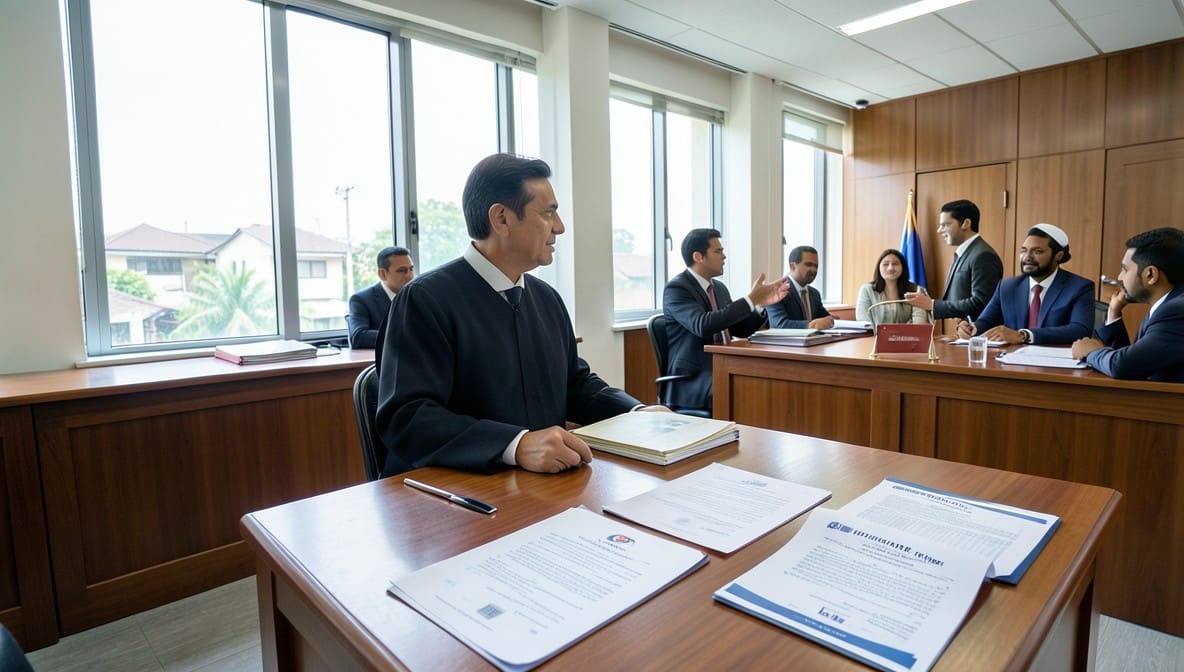
The Bombay High Court has decisively clarified that the jurisdiction under Section 9 of the Arbitration and Conciliation Act, 1996, is strictly provisional and terminates upon the constitution of an arbitral tribunal. This judgment brings finality to a decade-long procedural morass involving over 30 interim applications and Rs. 11 crores in court deposits, reinforcing that Section 9 is not a standalone equitable remedy but a statutory tool limited to preserving the subject matter of the arbitration agreement.
Background & Facts
The Dispute
The dispute arose from a Development Agreement (DA) dated May 2, 2013, between the petitioner, Mulund Raviraj Co-operative Housing Society Ltd. (the Society), and the respondent, M/s Rupji Constructions (the Developer), a partnership firm comprising Madhukar Rupji and his son Tejal Rupji. The DA governed the redevelopment of the Society’s property in Mulund, Mumbai. The Society alleged that the Developer defaulted on its obligations, including failure to provide bank guarantees, pay statutory dues, and complete construction beyond the plinth level, despite having collected funds from flat purchasers and demolished residential units.
Key Facts
- The Development Agreement contained an arbitration clause, triggering jurisdiction under Sections 9, 17, and 37 of the Arbitration and Conciliation Act, 1996.
- The Society filed the Section 9 Petition on October 6, 2017, seeking injunctions against creation of third-party rights, asset disclosure, deposit of Rs. 7 crores, and restraint on alienation of properties.
- On December 14, 2017, the Court passed the December 2017 Order, which:
- Attached three cars, 193 wristwatches, properties in Shivaji Park and Hindu Colony, Dadar
- Directed disclosure of all assets, bank accounts, shareholdings, and development projects of Madhukar and Tejal for the preceding ten years
- Imposed a blanket restraint on sale, alienation, or encumbrance of all immovable and movable properties of the Developer and its partners
- Madhukar Rupji passed away in 2022; Tejal Rupji remains a partner and is currently in judicial custody.
- The Mahul Property, leased to Grauer and Weil since April 1, 2016, was claimed jointly by Madhukar and his uncle Kamalakar Rupji (deceased), with his adopted son Chetan asserting succession.
- The Society received statutory Intimation of Disapproval for self-development on September 15, 2025.
- The Statement of Claim (SOC) was filed on January 17, 2025, seeking damages of Rs. 18.65 crores and permanent restraint on the Developer’s claims over the Society’s property.
Procedural History
- 06.10.2017: Section 9 Petition filed before Bombay High Court
- 14.12.2017: December 2017 Order passed, imposing wide-ranging asset restraints and disclosure directions
- 2018 - 2024: Over 31 interim applications filed by third parties including decree-holders, flat allottees, tenants, family members, and MCGM
- 02.09.2024: Sole arbitrator appointed under Section 11 of the Act
- 23.08.2025: Section 17 Application filed by the Society
- 04.02.2026: Section 17 Order passed by the Arbitral Tribunal
- 29.04.2026: Judgment delivered by Justice Somasekhar Sundaresan disposing of the Section 9 Petition and all pending interim applications
The Parties' Positions
- Society: Argued that Section 9 relief was necessary to preserve the subject matter of the DA and prevent dissipation of assets. Contended that the December 2017 Order was justified given the Developer’s history of defaults in multiple projects.
- Developer: Argued that the Section 9 jurisdiction had become redundant after the constitution of the Arbitral Tribunal in 2024. Sought recall of the December 2017 Order and release of assets to enable continuation of other projects.
- Third Parties (Decree-holders, Allottees, Tenants): Sought access to the Rs. 11+ crores deposited in court to satisfy decrees or claims arising from unrelated projects (e.g., Rupji Akansha, Rupji Dream, Rupji Arena).
- MCGM: Sought release of property tax dues from the court deposits.
- Tejal’s Family (Priyanka, Advait, Ishika): Sought access to court deposits as part of family disputes and maintenance claims.
Relief Sought
- Society sought continuation of asset restraints and deposit of proceeds from Mahul Property sale.
- Developer sought recall of the December 2017 Order and release of funds for legal fees and project development.
- Third parties sought release of deposited amounts to satisfy their decrees or refund claims.
- MCGM sought recovery of property tax dues.
- Tejal’s family sought a share of deposited amounts.
The Legal Issue
The central question was whether the jurisdiction under Section 9 of the Arbitration and Conciliation Act, 1996, continues to subsist after the constitution of an Arbitral Tribunal under Section 11, and whether non-signatory third parties with no privity to the arbitration agreement may intervene in Section 9 proceedings to claim benefits from court-deposited funds.
Arguments Presented
For the Petitioner
The Society relied on the purpose of Section 9 as a safeguard to preserve the subject matter of arbitration pending tribunal constitution. It argued that the December 2017 Order was essential to prevent asset dissipation, given the Developer’s history of fraud in other projects and its failure to comply with contractual obligations. The Society contended that the Arbitral Tribunal, newly constituted, lacked the institutional capacity to manage the complex asset freeze and disclosure regime already in place. It further argued that third parties had exploited the prolonged Section 9 proceedings to file frivolous applications, and that the court’s equitable jurisdiction should not be curtailed prematurely.
For the Respondent
The Developer, through its counsel, argued that Section 9 jurisdiction is inherently temporary and ceases upon the constitution of the Arbitral Tribunal under Section 11, unless the remedy under Section 17 is shown to be inefficacious. It cited Ashok Traders, Cox and Kings, and ASF Buildtech to establish that Section 9 is not a general equity jurisdiction but a statutory mechanism confined to parties to the arbitration agreement. The Developer emphasized that the blanket restraint under the December 2017 Order had crippled its ability to monetize assets in unrelated projects, thereby prejudicing its capacity to fulfill obligations under the DA. It also submitted that Tejal had voluntarily undertaken to pay decree-holders within 12 months of the Order’s vacation, and that such undertakings should be enforced through contempt, not Section 9.
The Court's Analysis
The Court undertook a rigorous analysis of the statutory architecture of the Arbitration and Conciliation Act, 1996. It emphasized that Section 9 is not an independent equitable jurisdiction but a statutory mechanism designed to preserve the subject matter of the arbitration agreement pending the constitution of an arbitral tribunal. The Court held that the very purpose of arbitration is to provide a self-contained dispute resolution mechanism, and that Section 9 is merely a bridge to that mechanism.
"The Section 9 jurisdiction is meant to empower the Court to preserve and protect the subject matter of the arbitration agreement to enable the arbitration proceedings to be meaningful. Access to this jurisdiction is available to a 'party', which is defined as a party to the arbitration agreement."
The Court noted that the Arbitral Tribunal was constituted on September 2, 2024, and that the Section 17 Application had already been filed and decided on February 4, 2026. Under Section 17, the Tribunal possesses the same powers as the Section 9 Court. Therefore, the Court held that continued exercise of Section 9 jurisdiction after tribunal constitution is impermissible unless Section 17 is shown to be inefficacious - a threshold not met here.
The Court further held that privity to the arbitration agreement is the foundational requirement for invoking Section 9. Third parties - including decree-holders from unrelated projects, flat allottees, tenants, and family members - lack standing to intervene. The Court relied on Cox and Kings, ASF Buildtech, and Advaya to affirm that non-signatories must demonstrate express or implied consent, commonality of subject matter, or de facto control to qualify as veritable parties - none of which existed here.
Regarding the December 2017 Order, the Court held that its continued operation would be an overreach. The restraint on all assets of the Developer and its partners, including properties unrelated to the DA, was disproportionate and no longer justified. The Court directed the Arbitral Tribunal to reassess the necessity of the restraint solely in relation to the Society’s claim under the SOC.
The Court also rejected MCGM’s application for direct release of property tax dues, holding that municipal authorities must pursue recovery through statutory mechanisms, not by piggybacking on arbitration proceedings.
The Court acknowledged the efforts of the Court Commissioner, Mr. Trivedi, and directed his fees of Rs. 2,50,000 to be paid from the deposited funds upon handover.
The Verdict
The Section 9 Petition and all 31 interim applications were finally disposed of. The Court held that:
- The jurisdiction under Section 9 stands terminated as the Arbitral Tribunal has been constituted and has already passed a Section 17 Order.
- All third-party applications - including those by decree-holders, flat allottees, tenants, family members, and MCGM - are dismissed without leave to intervene.
- The Arbitral Tribunal must determine, within three months, the precise amount of the Rs. 11+ crores deposited in court that is necessary to secure the Society’s claim under the DA.
- Any surplus amount beyond that determined by the Tribunal shall be released to the Developer.
- The Arbitral Tribunal shall reassess the continued validity of the December 2017 Order, limiting any restraint strictly to the subject matter of the arbitration agreement.
- Tejal shall comply with his undertaking to pay decree-holders within 12 months of the Tribunal’s determination of surplus funds.
- The Court Commissioner, Mr. Trivedi, shall hand over all documents and assets to the Registry within seven working days, and shall be paid Rs. 2,50,000 upon completion.
What This Means For Similar Cases
Section 9 Jurisdiction Is Time-Bound and Purpose-Limited
- Practitioners must file Section 9 applications promptly and not rely on them as long-term asset preservation tools.
- Once an arbitral tribunal is constituted, Section 9 applications must be withdrawn or abandoned unless a clear case of Section 17 inefficacy is made out.
- Courts will not permit Section 9 proceedings to continue as a de facto execution forum for unrelated claims.
Third Parties Cannot Access Arbitration-Related Deposits
- Decree-holders, allottees, or creditors from unrelated projects have no right to claim from funds deposited under Section 9.
- Such parties must pursue remedies in their respective forums - civil courts, consumer commissions, or execution proceedings.
- Courts will not allow third parties to exploit delays in tribunal constitution to gain access to arbitration-related assets.
Arbitral Tribunals Now Hold Primary Authority Over Asset Restraints
- Any restraint on assets must be justified solely by the needs of the arbitration agreement.
- Courts must not impose blanket restraints on unrelated properties; such orders must be reviewed by the arbitral tribunal.
- Parties seeking modification of interim orders must approach the tribunal, not the Section 9 court, after tribunal constitution.