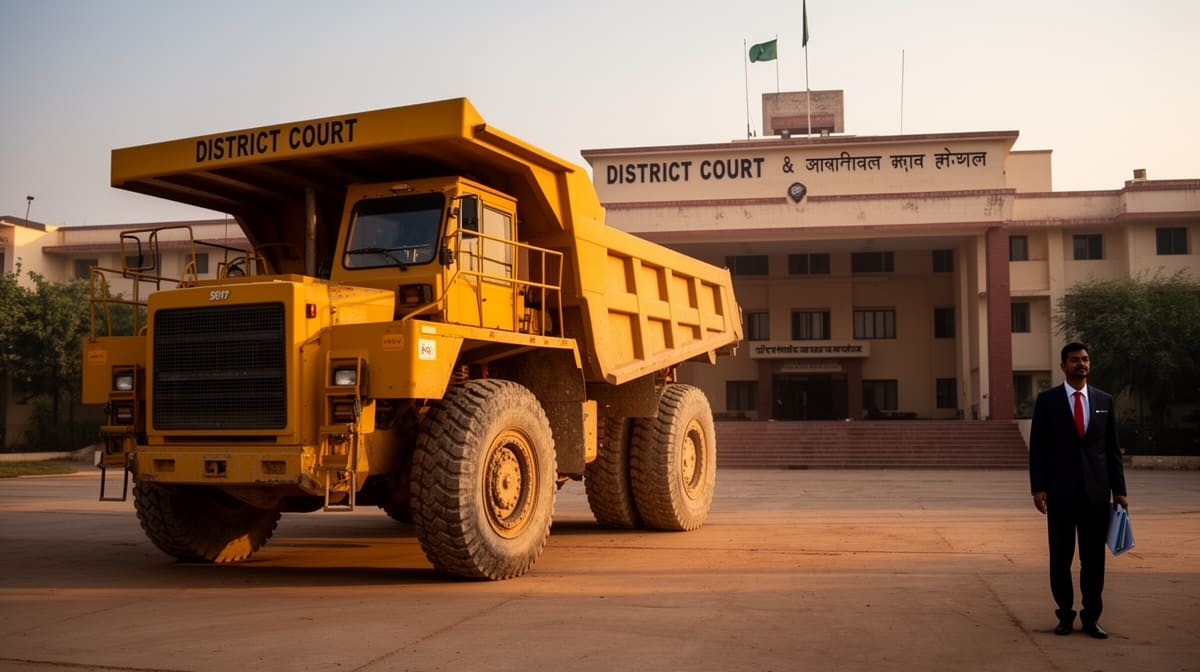
The Andhra Pradesh High Court has clarified that authorities cannot seize commercial vehicles for alleged illegal sand transportation without first imposing a monetary penalty under the prescribed rules. This ruling reinforces the principle that confiscation is not an automatic remedy for regulatory violations and must follow due process.
Background & Facts
The Dispute
The petitioner, Bachanaboina Swamy, owner of a lorry bearing registration number TG30T3366, was engaged in commercial transportation of sand for hire. On 06.04.2026, the 3rd Respondent, the Station House Officer of Chillakallu Police Station, seized the vehicle based on a complaint alleging illegal transportation of sand without valid permits. The seizure was made in connection with FIR No.65 of 2026, and a crime number 68 of 2026 was registered under Section 303(2) of the Bharatiya Nyaya Sanhita, 2023 and Section 27 of the Andhra Pradesh Water, Land and Trees Act, 2002.
Key Facts
- The petitioner’s lorry is used for commercial hire purposes and is registered in Nalgonda District, Telangana.
- The seizure occurred on 06.04.2026 without any prior notice, opportunity to be heard, or issuance of a penalty notice.
- The vehicle was seized under criminal law provisions despite the existence of a specific regulatory framework under the Andhra Pradesh Mineral Mining and Control Rules, 1966, and subsequent Government Orders.
- The petitioner had no prior history of violations and was not given any chance to produce documents or explain the circumstances.
Procedural History
- 06.04.2026: Lorry seized by 3rd Respondent without procedural compliance.
- 07.04.2026: Petitioner filed Writ Petition No.9487/2026 before the Andhra Pradesh High Court.
- 07.04.2026: Interlocutory Application IA No.1/2026 filed under Section 151 CPC seeking interim release of the vehicle.
- 09.04.2026: Hearing conducted before Justice Maheswara Rao Kuncheam; parties consented to disposal at admission stage.
The Parties' Positions
For the Petitioner
- Argued that the seizure was arbitrary, violative of Articles 14, 19(1)(g), and 21 of the Constitution.
- Contended that the APMMC Rules, 1966, and G.O.Ms.No.100 dated 26.06.2025 provide a specific penalty regime that excludes vehicle confiscation as an immediate remedy.
- Relied on Sunderbai Ambalal Desai v. State of Gujarat to argue that mere retention of vehicles serves no public purpose.
- Cited W.P.No.17948/2025 of this Court as binding precedent on the same issue.
For the Respondents
- Did not contest the procedural irregularity but sought time to complete investigation.
- Did not produce any evidence of prior notice, opportunity of hearing, or application of penalty provisions.
- Relied on general police powers under CrPC without addressing the specific regulatory framework.
Relief Sought
The petitioner sought:
- Declaration that the seizure was illegal and violative of constitutional rights.
- Immediate release of the lorry bearing TG30T3366.
- Direction to the authorities to follow due process under G.O.Ms.No.100, 2025.
The Legal Issue
The central question was whether authorities can seize a commercial vehicle for alleged illegal sand transportation without first imposing a penalty under Rule 9-B(19) of G.O.Ms.No.100, 2025, or whether such seizure violates the procedure established by law under Article 21 and the principles of natural justice.
Arguments Presented
For the Petitioner
The petitioner’s counsel argued that Rule 9-B(19) of G.O.Ms.No.100 dated 26.06.2025 explicitly prescribes monetary penalties for violations such as transporting sand without a permit, with no provision for vehicle seizure. The rule categorizes penalties based on vehicle type and repetition of offence, indicating a legislative intent to treat such violations as regulatory, not criminal. The counsel emphasized that the Supreme Court in Sunderbai Ambalal Desai v. State of Gujarat held that retention of vehicles without a penalty framework is arbitrary and serves no legitimate purpose. The petitioner further relied on W.P.No.17948/2025, where this Court had previously held that seizure without penalty imposition is illegal.
For the Respondent
The Government Pleader for Mines and Geology did not dispute the applicability of G.O.Ms.No.100, 2025, nor did they produce any order or record showing that penalty proceedings were initiated. No counter-affidavit was filed to justify the seizure under criminal law. The respondents’ silence on the regulatory framework amounted to an admission that the seizure was not in conformity with the prescribed procedure.
The Court's Analysis
The Court examined the statutory and administrative framework governing mineral transportation in Andhra Pradesh. It noted that G.O.Ms.No.100 dated 26.06.2025 was issued under the Mines and Geology Department to regulate illegal mining and transportation activities. Rule 9-B(19) provides a graduated penalty structure for first and subsequent offences, with no mention of confiscation or seizure. The Court observed that the legislature, by prescribing specific penalties, intended to replace arbitrary police action with a structured administrative remedy.
"The existence of a detailed penalty regime under G.O.Ms.No.100 indicates a legislative intent to channel enforcement through monetary penalties, not confiscation."
The Court distinguished the present case from situations involving theft or smuggling, where seizure may be justified under criminal law. Here, the alleged violation pertains to regulatory non-compliance - a matter governed by administrative rules. The Court further held that the seizure without notice or opportunity of hearing violated natural justice, as the petitioner was not given any chance to produce documents or explain the nature of the transport.
The Court also noted that the Supreme Court in Sunderbai Ambalal Desai had condemned the indiscriminate seizure of vehicles for minor regulatory breaches, stating that such actions cause undue hardship and serve no deterrent purpose without a penalty. The Court concluded that the respondents’ action was not merely irregular but fundamentally contrary to the procedure established by law under Article 21.
The Verdict
The petitioner succeeded. The Court directed the authorities to pass an order under Rule 9-B(19) of G.O.Ms.No.100 dated 26.06.2025 to levy a penalty, if warranted. Upon payment of such penalty and production of valid ownership documents, the 3rd Respondent shall release the seized lorry bearing registration number TG30T3366. All pending interlocutory applications are closed.
What This Means For Similar Cases
Penalty Must Precede Confiscation
- Practitioners must challenge any vehicle seizure under mining or transport regulations if no penalty notice has been issued under the relevant G.O.
- Seizure under CrPC or IPC for regulatory violations without prior penalty imposition is now legally untenable.
Regulatory Framework Overrides Police Discretion
- When a specific administrative rule prescribes penalties (e.g., G.O.Ms.No.100, 2025), police cannot bypass it to invoke criminal law.
- Courts will treat such bypasses as violations of Article 21 and the doctrine of proportionality.
Procedural Compliance Is Non-Negotiable
-
Authorities must issue notice and afford opportunity of hearing before any enforcement action.
-
Failure to follow prescribed penalty procedures renders seizure illegal, regardless of the nature of the alleged violation.
-
Always check for applicable G.O.s or rules before advising on vehicle seizure cases.
-
File writ petitions at the earliest stage - disposal at admission is possible if procedural illegality is clear.
-
Cite Sunderbai Ambalal Desai v. State of Gujarat and relevant G.O. provisions together to strengthen arguments.