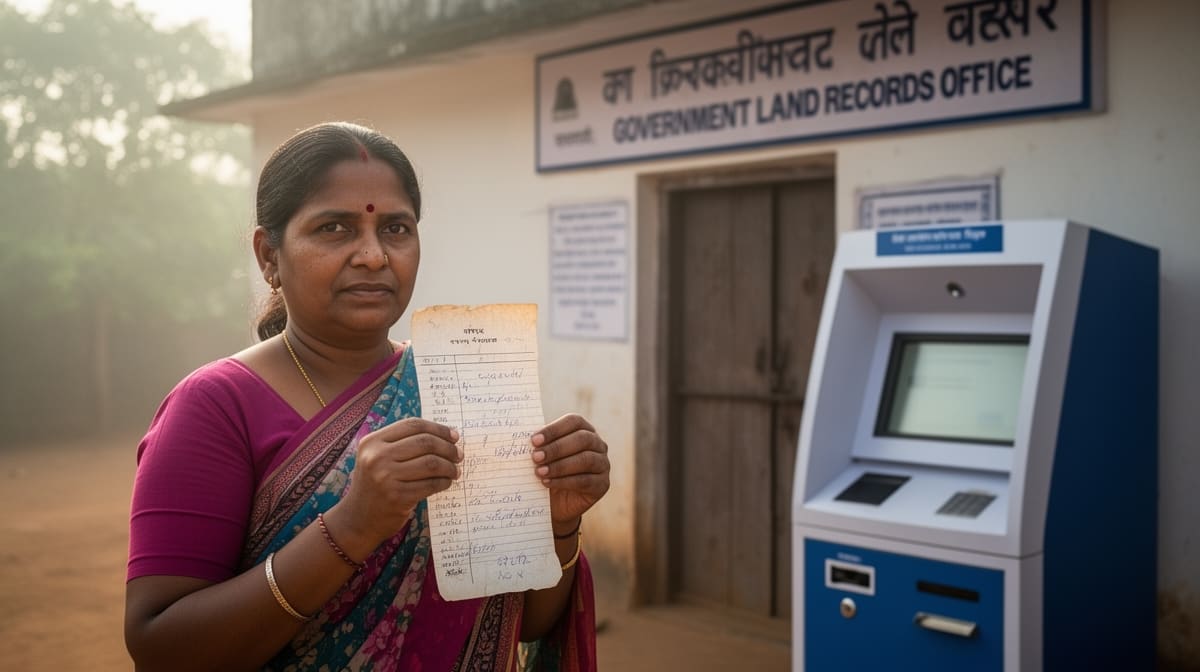
The High Court of Telangana has reaffirmed that prolonged inaction by revenue authorities on digital land record corrections constitutes arbitrary state conduct, violating the constitutional guarantee of equality under Article 14. This order compels administrative bodies to act decisively on citizen-initiated applications for land data accuracy, reinforcing the state’s duty to maintain transparent and accessible land records.
Background & Facts
The Dispute
The petitioner, Marka Rama, is the widow and legal successor of the original purchaser of agricultural land admeasuring 2.25 guntas in Survey No. 1231AA, Adavirangapuram Village, Venkatapuram Mandal, Mulugu District. The land was acquired in 1994 under a registered sale deed. After a subsequent survey, the actual extent was found to be 2.25 guntas, but only 1.05 guntas were reflected in the digital pattadar passbook issued to her. The remaining 1.20 guntas were omitted despite the petitioner’s efforts to correct the error through mutation and succession procedures.
Procedural History
- 1994: Original purchase of land via registered sale deed
- 1996: Death of petitioner’s husband; succession initiated
- Post-1996: Mutation of land in name of son, Marka Ramesh, with petitioner’s consent
- 2025: Petitioner submitted online Application No. 2500140102 dated 15.10.2025 seeking inclusion of the missing 1.20 guntas in her digital pattadar passbook
- No action taken: The 4th Respondent (Tahsildar) failed to process or respond to the application for over four months
- 2026: Writ petition filed under Article 226 of the Constitution
Relief Sought
The petitioner sought a writ of mandamus directing the revenue authorities to consider her application, correct the digital pattadar passbook to reflect the full extent of 2.25 guntas, and declare the inaction as illegal, arbitrary, and violative of Articles 14 and 300-A of the Constitution.
The Legal Issue
The central question was whether administrative inaction on a legitimate application for correction of land records in a digital pattadar passbook, without any lawful justification, amounts to arbitrary state conduct in violation of Article 14 of the Constitution.
Arguments Presented
For the Petitioner
Counsel for the petitioner, Sri Thota Venkatesham, argued that the omission of 1.20 guntas from the digital pattadar passbook was a clerical error that had been substantiated by original sale deeds, mutation records, and survey documents. He contended that the state’s failure to act for over four months, despite a clear statutory duty under the Telangana Land Records Act and the Digital Land Records Mission, amounted to negligence and denial of equal protection. He relied on State of Haryana v. Bhagwan Das to assert that delay in administrative action when rights are at stake, is itself a violation of Article 14.
For the Respondent
The Assistant Government Pleader for Revenue conceded that the application was pending but submitted that appropriate action would be taken in accordance with law. No specific legal justification was offered for the delay, nor was any procedural bar or pending dispute cited to explain the inaction.
The Court's Analysis
The Court observed that the petitioner had established a prima facie case of ownership and succession, supported by documentary evidence. The omission of land extent in the digital pattadar passbook was not contested on merit but remained unaddressed for months. The Court emphasized that digital land records are not mere administrative convenience but a constitutional imperative under Article 300-A, which protects property rights against arbitrary deprivation.
"The State cannot remain silent on a citizen’s legitimate claim for correction of land records, especially when the same is supported by documentary evidence and the digital system is designed to ensure transparency and accountability."
The Court held that prolonged inaction without reason transforms a procedural lapse into an arbitrary exercise of power, which is impermissible under Article 14. The state’s duty to maintain accurate land records is not discretionary but mandatory, and failure to act within a reasonable time undermines public trust in the land administration system. The Court declined to adjudicate the merits of the correction claim, as that was within the domain of the revenue authorities, but made it clear that non-decision is a decision and must be justified.
The Verdict
The petitioner succeeded. The Court held that administrative inaction on a documented land record correction request violates Article 14 and directed the revenue authorities to dispose of the application within four weeks after providing a hearing to the petitioner and all interested parties. No costs were imposed.
What This Means For Similar Cases
Administrative Silence Is Not an Option
- Practitioners must now treat unexplained delays in processing land record applications as actionable violations of Article 14
- A writ of mandamus is maintainable even if the applicant’s claim is not yet proven, provided there is a prima facie case and statutory duty to act
- Revenue officers cannot rely on generic assurances like "action will be taken" - they must demonstrate procedural diligence
Digital Records Are Legally Binding
- Digital pattadar passbooks are now recognized as official instruments of title, not just informational tools
- Any discrepancy between physical records and digital records must be resolved in favor of the citizen if supported by documentary evidence
- Failure to update digital records despite valid mutation or succession orders constitutes constructive deprivation under Article 300-A
Reasonable Timeframes Are Implied by Law
- Courts will now impose strict timelines (e.g., 4 weeks) for disposal of land record applications
- Delay beyond 60 days without justification will invite judicial intervention
- Practitioners should file writ petitions if no action is taken within 30 days of submission, especially where property rights are affected