The Himachal Pradesh High Court has reaffirmed that a registered Will cannot be validated merely on the basis of formal execution if it is shrouded in suspicious circumstances, particularly when the beneficiary actively participates in its creation and the testator’s death predates the alleged execution date. This judgment reinforces the judicial principle that the conscience of the court must be satisfied before accepting a Will as genuine.
Background & Facts
The Dispute
The plaintiff, Kamla Devi, filed a civil suit seeking a declaration that a Will dated 22.04.1991, purportedly executed by her brother Puran Chand, was invalid and non-binding. She claimed ownership of ancestral land based on her status as Puran Chand’s sister and a mutation entry dated 07.05.1991 in her favor. The defendant, Brahma Ram, produced the Will dated 22.04.1991, naming him as the sole beneficiary, and sought to establish his title through it. The central conflict was whether Puran Chand, who allegedly died on 21.04.1991, could have executed a Will on 22.04.1991, and whether the document was genuine or fabricated.
Key Facts
- Puran Chand was admitted to CHC, Ratti, on or before 06.04.1991 with a complaint of cardio-respiratory failure, as per Death Certificate Ex.PW1/A.
- Death Certificate Ex.PW1/A recorded the date of death as 21.04.1991 and the period of illness as 15 days.
- The Panchayat record also recorded Puran Chand’s death on 21.04.1991.
- The Will (Ex.DW3/A) was dated 22.04.1991 and claimed Puran Chand had executed it while on leave from the hospital.
- The hospital record (Ex.DW3/A) was later altered to show death on 23.04.1991, contradicting the official death certificate.
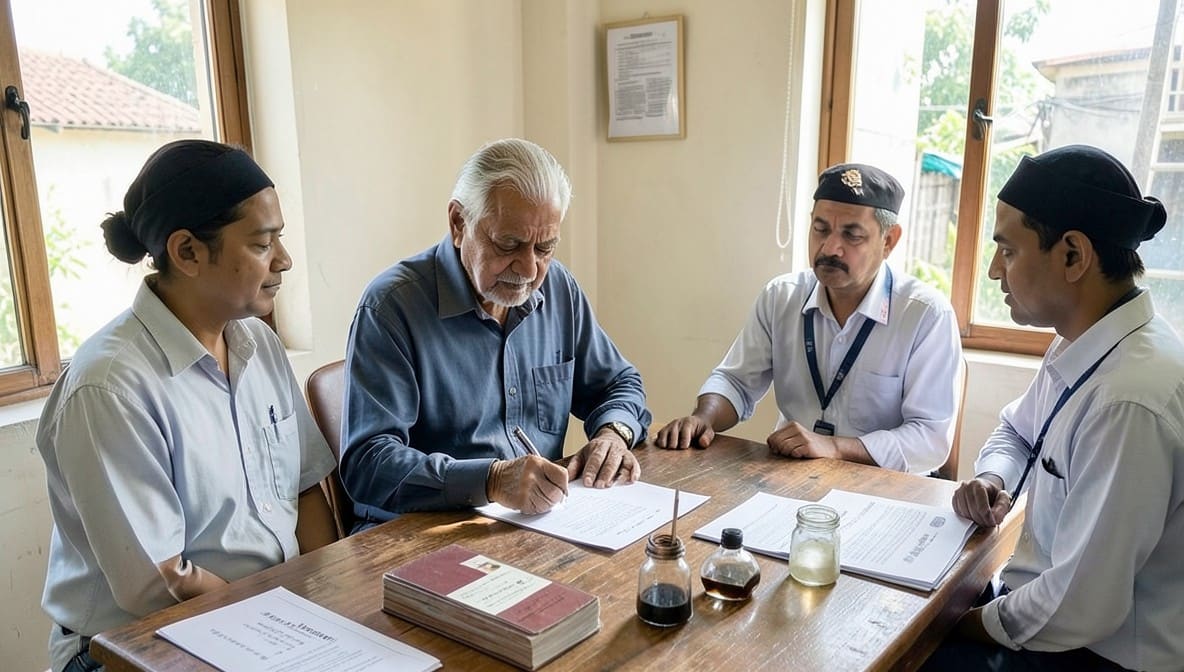
- The scribe of the Will, Pratap Singh (DW3), was an advocate and a visitor to the defendant’s household.
- Ghanshyam (DW5), a witness to the Will, was the real brother-in-law of the defendant Brahma Ram.
- Darshan Singh Kalia (DW7), the registering officer, admitted he did not personally know Puran Chand and relied on Pratap Singh’s identification.
- The Will referred to Puran Chand as "alias Jogi," a name no witness confirmed, raising doubts about identity.
- The Will stated Brahma Ram was "taking care" of Puran Chand, yet witnesses testified Puran Chand cooked for himself and was not dependent.
- Mutation No.144 in favor of the plaintiff was attested on 07.05.1991.
- Mutation No.135 in favor of the defendant was attested clandestinely.
Procedural History
- 18.04.1997: Trial Court (Sub Judge, Sarkaghat) decreed the suit in favor of the plaintiff, holding the Will was forged and executed under suspicious circumstances.
- 19.05.2008: Appellate Court (Additional District Judge, Mandi) dismissed the appeal, affirming the Trial Court’s findings.
- 13.08.2008: High Court admitted the second appeal on five substantial questions of law.
- 12.05.2026: Judgment delivered by the High Court dismissing the appeal.
The Parties' Positions
For the Appellant (Brahma Ram): Argued that the Will was duly executed and registered, Puran Chand died on 23.04.1991, and the Trial Court erred in rejecting the testimony of the defendant’s witnesses. He contended that the scribe and identifier could be the same person, and that the plaintiff’s non-appearance warranted an adverse inference.
For the Respondent (Kamla Devi): Maintained that the Will was a fabrication, as Puran Chand was critically ill and died on 21.04.1991, making execution on 22.04.1991 impossible. The beneficiary’s active role in the Will’s preparation, the conflicting death records, and the implausible scenario of a hospitalized man traveling to Mandi to execute a Will were cited as irrefutable suspicious circumstances.
Relief Sought
The appellant sought to set aside the judgments of the courts below, declare the Will valid, and dismiss the plaintiff’s suit. The respondent sought confirmation of the Trial Court’s decree, declaration of the Will as invalid, and restoration of her title to the ancestral property.
The Legal Issue
The central question was whether a Will, despite being registered and bearing the testator’s signature, can be accepted as genuine when it is surrounded by multiple suspicious circumstances - including a death date preceding execution, beneficiary involvement in drafting, identity discrepancies, and conflicting medical records - and whether the High Court may interfere with concurrent findings of fact in a second appeal under Section 100 of the CPC.
Arguments Presented
For the Appellant
The appellant’s counsel argued that the Will was properly executed under Section 63 of the Indian Succession Act and attested by two witnesses under Section 68 of the Indian Evidence Act. He contended that the scribe (Pratap Singh) could also act as the identifier, as no law prohibits it. He further argued that the plaintiff’s failure to appear as a witness warranted an adverse inference under Iswar Bhai C. Patel v. Harihar Behera. He claimed the Trial Court erred in clubbing issues and that the High Court was entitled to reappreciate evidence to correct a manifest error.
For the Respondent
The respondent’s counsel emphasized that the Will was executed on a date after the testator’s death, as confirmed by the official death certificate and Panchayat record. He highlighted that the beneficiary’s brother-in-law and advocate were the scribe and witness, creating a clear conflict of interest. He cited Meena Pradhan v. Kamla Pradhan and H. Venkatachala Iyengar v. B.N. Thimmajamma to argue that the burden on the propounder to dispel suspicious circumstances was not discharged. He further contended that the plaintiff’s relationship with the testator was not denied and thus no adverse inference could be drawn, and that the High Court had no jurisdiction to reappreciate evidence in a second appeal.
The Court's Analysis
The Court undertook a meticulous review of the evidence and the legal framework governing the proof of Wills. It began by reaffirming the principles laid down in Meena Pradhan v. Kamla Pradhan and Gurdial Singh v. Jagir Kaur, emphasizing that the execution of a Will must satisfy the judicial conscience, particularly when suspicious circumstances exist. The Court noted that the mere registration of a Will or the presence of attesting witnesses does not validate it if the circumstances surrounding its execution raise legitimate doubt.
"The presence of suspicious circumstances makes the initial onus heavier and, therefore, in cases where the circumstances attendant upon the execution of the will excite the suspicion of the court, the propounder must remove all legitimate suspicions before the document can be accepted as the last will of the testator."
The Court found that the suspicious circumstances in this case were real, germane, and valid: the testator was admitted with cardio-respiratory failure 15 days prior to the alleged execution date; the death certificate issued by the hospital authority recorded death on 21.04.1991; the scribe was a known associate of the beneficiary; the Will contained an unexplained alias; and the beneficiary’s own witnesses contradicted the narrative of the testator’s health and mobility.
The Court further held that the Trial Court and Appellate Court had correctly appreciated the evidence and that their concurrent findings could not be disturbed in a second appeal under Section 100 of the CPC. It cited Kashibai v. Parwatibai, Rur Singh v. Bachan Kaur, and C. Doddanarayana Reddy v. C. Jayarama Reddy to underscore that the High Court’s jurisdiction in second appeals is strictly limited to substantial questions of law, and reappreciation of evidence without perversity is impermissible.
Regarding the scribe-identifier issue, the Court held that while it is unusual, no statutory provision prohibits a scribe from identifying the testator, and the absence of a legal bar cannot validate a suspicious document.
On the issue of clubbing of issues, the Court relied on Hiru v. Mansa Ram and Jagat Singh v. Shanti Swaroop, holding that when issues are interlinked - such as ownership and validity of title through a Will - clubbing them for discussion does not vitiate the judgment.
On the non-appearance of the plaintiff, the Court held that since the defendant did not specifically deny the plaintiff’s relationship as sister, the fact was deemed admitted under Order 8 Rule 5 of the CPC, and no adverse inference could be drawn under Rattan Dev v. Pasam Devi.
Finally, the Court held that the death certificate (Ex.PW1/A) was admissible under Section 35 of the Indian Evidence Act as a public record made in the discharge of official duty.
The Verdict
The appeal was dismissed. The High Court upheld the concurrent findings of the Trial Court and Appellate Court that the Will dated 22.04.1991 was forged and executed under suspicious circumstances. The plaintiff’s title to the ancestral property was confirmed, and the defendant’s claim based on the Will was rejected. The Court ordered the records of the lower courts to be sent down forthwith. All pending applications were disposed of.
What This Means For Similar Cases
Suspicious Circumstances Override Registration
- A registered Will is not immune from challenge; registration alone does not validate a document if suspicious circumstances exist.
- Practitioners must scrutinize the timing of execution relative to the testator’s health and death, and the beneficiary’s involvement in drafting.
- Medical records, death certificates, and Panchayat entries carry greater weight than oral testimony when they contradict the propounder’s version.
Second Appeals Cannot Be Used to Reappreciate Evidence
- High Courts must resist the temptation to act as fact-finding courts in second appeals under Section 100 CPC.
- Concurrent findings of fact by two lower courts are binding unless shown to be perverse or based on no evidence.
- Lawyers must frame substantial questions of law with precision - mere disagreement with factual findings is insufficient for admission of a second appeal.
Adverse Inference Requires Specific Denial
- Failure to specifically deny a pleaded relationship (e.g., sibling) amounts to an admission under Order 8 Rule 5 CPC.
- Non-appearance of a plaintiff cannot be used to draw an adverse inference if the claim is supported by documentary evidence and the relationship is not contested.
- Courts must distinguish between cases where the plaintiff’s testimony is essential and those where documentary proof suffices.
Scribe and Identifier: No Legal Bar, But High Scrutiny
- While no law prohibits a scribe from identifying the testator, such a role creates a red flag.
- Courts must demand a cogent explanation for why a beneficiary’s associate was chosen as scribe and identifier.
- The absence of independent verification of the testator’s identity renders the Will vulnerable to challenge.