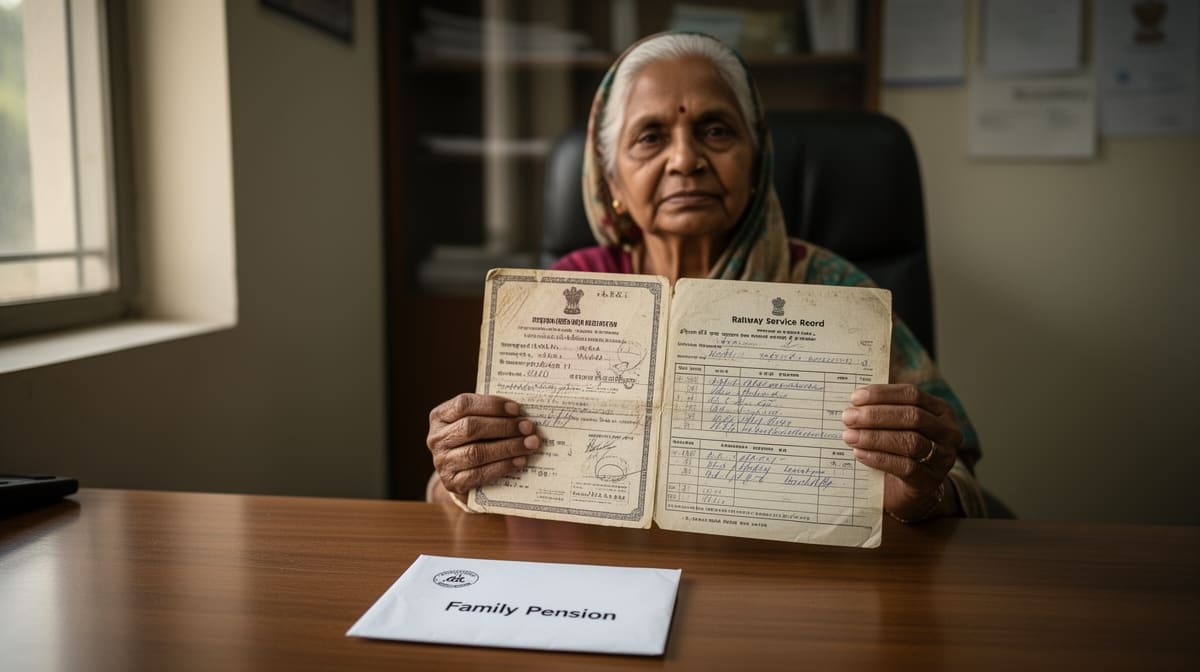
The Gauhati High Court has clarified that a second wife married during the subsistence of a valid first marriage cannot claim family pension under Railway Pension Rules if the second marriage is void under the Hindu Marriage Act, 1955. The judgment reinforces the primacy of statutory marriage validity over administrative benefit entitlements, even where the second wife is unaware of the prior marriage.
Background & Facts
The Dispute
The petitioners, Smti. Bharati Saikia and her minor son Mousam Saikia, sought a share in the family pension, death gratuity, leave encashment, group insurance, and provident fund benefits of Late Amal Saikia, a former Railway Jamadar Peon who died in service. They claimed entitlement as dependants under the Railway Services (Pension) Rules, 1993. Their claim was rejected by the Central Administrative Tribunal, Guwahati Bench, which awarded all benefits to Smti. Malati Saikia, the deceased’s first wife.
Key Facts
- Late Amal Saikia was employed by the North Frontier Railway since 30.04.1990.
- He married Smti. Malati Saikia in 1987, with whom he had one son, Jitumoni Saikia (born circa 1998 - 1999).
- The couple separated in 2001, after which Amal Saikia allegedly ceased cohabitation with Malati Saikia.
- In 2010, Amal Saikia married Smti. Bharati Saikia, who was unaware of his prior marriage.
- The petitioners resided together in Railway Quarter No. T/22(A), Lumding, until Amal Saikia’s death.
- Amal Saikia never disclosed his second marriage or son to the Railway authorities during his service.
- Malati Saikia was officially recorded as the spouse in all service records, including family declarations and pension nomination forms.
- Malati Saikia claimed to have been driven out in 2001 and had no knowledge of the second marriage until after her husband’s death.
Procedural History
- 22.03.2023: Central Administrative Tribunal, Guwahati Bench, dismissed Original Application No. 040/00264/2020, holding that only the first wife was entitled to benefits.
- 05.05.2026: Hearing before the Gauhati High Court Division Bench.
- 06.05.2026: Judgment delivered.
The Parties' Positions
For the Petitioners:
- Argued that Rule 70 and Rule 75(7)(i)(a) of the Railway Services (Pension) Rules, 1993, use the plural terms "wives" and "widows," entitling both wives to equal shares.
- Claimed ignorance of the first marriage and asserted that the minor son, as a child of the deceased, was entitled to benefits irrespective of marital validity.
- Relied on the humanitarian intent of pension rules to protect dependants.
For the Respondents (Railway & First Wife):
- Contended that the second marriage was void under Section 11 of the Hindu Marriage Act, 1955, as the deceased was already married and had not obtained divorce.
- Highlighted that the deceased had never declared the second marriage in service records, violating Rule 21 of the Railway Services (Conduct) Rules, 1966.
- Asserted that the first wife, despite separation, remained the legally wedded spouse and was entitled to all benefits.
Relief Sought
The petitioners sought:
- Equal share of family pension under Rule 75(7)(i)(a) and (b)
- Proportionate share of death gratuity under Rule 70
- Inclusion of the minor son as a beneficiary for all retiral benefits
- Reversal of the Tribunal’s order denying them benefits
The Legal Issue
The central question was whether a woman who entered into a second marriage during the subsistence of a valid first marriage, and who was unaware of the prior marriage, is entitled to family pension under the Railway Services (Pension) Rules, 1993, when the second marriage is void under the Hindu Marriage Act, 1955.
Arguments Presented
For the Petitioner
The petitioner’s counsel argued that the language of Rule 75(7)(i)(a) and Rule 70 uses inclusive terms like "wives" and "sons," which should be interpreted broadly to include all surviving spouses and children, regardless of the legality of the marriage. He emphasized that the second wife was a victim of deception and that the minor son, as a biological child, must not be penalized for his father’s actions. He cited humanitarian principles and the objective of pension rules to protect dependants.
For the Respondent
The Central Government Counsel and Amicus Curiae contended that the Pension Rules must be read in harmony with personal law. Under Section 5(i) of the Hindu Marriage Act, 1955, a marriage is void if either party has a living spouse at the time of solemnization. Section 11 renders such marriages null and void ab initio. Rule 21 of the Railway Services (Conduct) Rules, 1966, explicitly prohibits Railway servants from contracting a second marriage without prior permission and proof of legal permissibility. The first wife, though separated, remained the legally recognized spouse in official records and was entitled to all benefits.
The Court's Analysis
The Court examined the interplay between the Railway Services (Pension) Rules, 1993, and the Hindu Marriage Act, 1955. It held that while the Rules use plural terms such as "wives," these must be interpreted in light of the legal status of the marriage under personal law. The Court emphasized that the Rules do not override statutory prohibitions on polygamy.
"The provisions of the Pension Rules of 1993 would refer to only such claims of employees or their dependants, where second marriage during the subsistence of the first marriage, is permissible and not otherwise."
The Court relied on the Full Bench decision of the Bombay High Court in Kamalbai v. State of Maharashtra & Ors. (2019) 3 Mh. L.J (FB) 921, which held that a second wife cannot claim family pension if her marriage is void under the Hindu Marriage Act. The Court noted that even if the second wife was unaware of the first marriage, the legal invalidity of the union cannot be cured by ignorance or good faith.
The Court further observed that Rule 21 of the Railway Services (Conduct) Rules, 1966, imposes a mandatory obligation on Railway employees to disclose marital status and obtain permission before contracting a second marriage. The deceased’s failure to do so rendered the second marriage not only void but also a breach of service conduct norms.
However, the Court recognized the distinct position of the minor son, petitioner No. 2. Rule 70 explicitly includes "sons" as beneficiaries of death gratuity, and Rule 75(7)(i)(b) provides that upon the death of a widow, her share of family pension becomes payable to her eligible child. The Court held that the minor son’s entitlement arises from his status as a biological child of the deceased, independent of his mother’s marital status.
The Verdict
The writ petition was partially allowed. The order of the Central Administrative Tribunal dated 22.03.2023 was modified to grant the minor son, Mousam Saikia, a proportionate share in the family pension as per Rule 75(7)(i)(b) of the Railway Services (Pension) Rules, 1993. The share shall be calculated as one-half of the total family pension, payable from the date of the deceased’s death. All other benefits, including death gratuity, leave encashment, group insurance, and provident fund, were awarded exclusively to the first wife, Smti. Malati Saikia. The petitioners’ claims for family pension were otherwise dismissed.
What This Means For Similar Cases
Second Marriages Are Not Automatically Entitling
- Practitioners must establish the legal validity of a marriage before claiming pensionary benefits under service rules.
- Ignorance of a prior marriage does not validate a void marriage under personal law.
- Claims by second wives in Hindu marriages will be rejected if the first marriage was subsisting and unannulled.
Children’s Rights Are Independent of Parental Marital Status
- Biological children of deceased employees are entitled to benefits under pension rules regardless of whether their mother’s marriage was valid.
- Rule 70 and Rule 75(7)(i)(b) protect children’s interests separately from parental marital status.
- Advocates should file separate claims for minor children even when the mother’s claim is barred.
Conduct Rules Bind Service Beneficiaries
- Railway and other public sector employees must comply with conduct rules regarding marriage disclosures.
- Failure to disclose a prior marriage may disqualify dependants from benefits, even if the employee is deceased.
- Employers may rely on official records (e.g., family declarations, nomination forms) to determine beneficiaries.