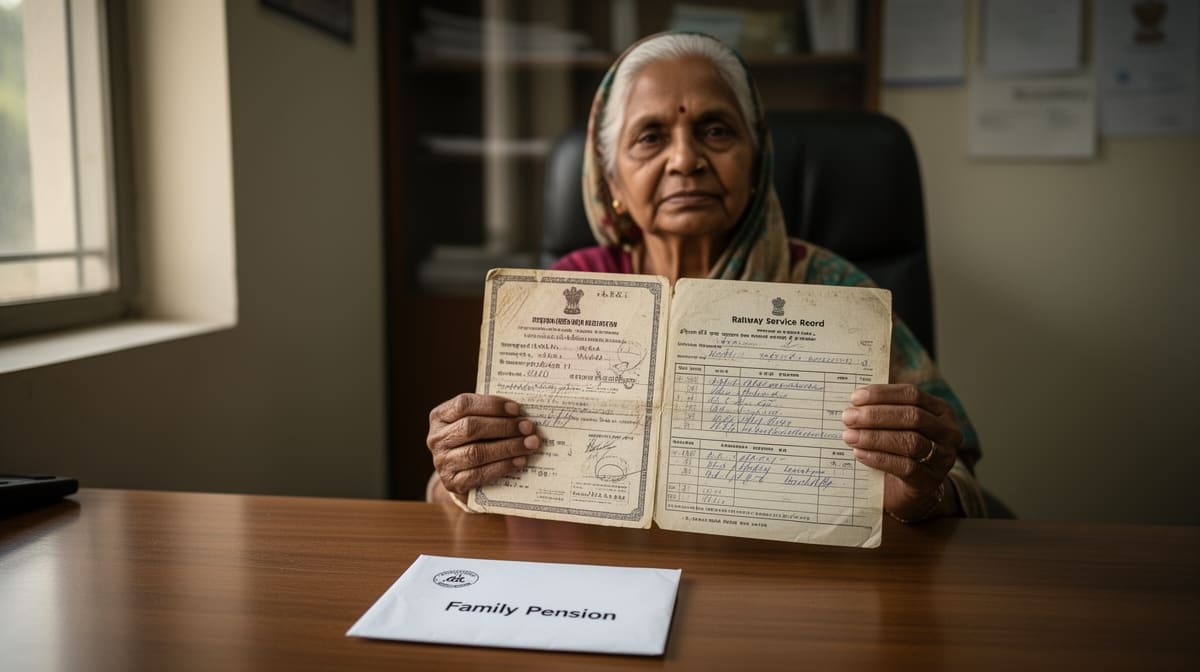
The Central Administrative Tribunal has clarified that family pension under government service rules is exclusively available to the first legally wedded wife when a government servant contracts a second marriage without obtaining mandatory prior permission. This judgment reinforces statutory compliance over equitable claims and sets a binding precedent for pension authorities across Jammu and Kashmir.
Background & Facts
The Dispute
The applicant, Smt. Sharifa Begum, is the first legally wedded wife of Late Mohd. Shafi, a government school teacher who served for over 37 years until his death on 11.02.2023. He was survived by two wives: the applicant and respondent No.5, Smt. Naseem Akhter, whom he married during the subsistence of his first marriage. A legal heir certificate issued on 11.03.2023 recognized both women and the applicant’s son as heirs. The applicant, who was wholly dependent on her husband, applied for family pension and gratuity. Respondent No.5, a regular government employee with her own salary, also staked a claim.
Procedural History
- 2023: Death of Late Mohd. Shafi; pension application initiated by applicant
- 2024: Office of Principal Accountant General (A&E), Jammu, flagged second marriage during scrutiny
- 08.07.2024: Official communication issued seeking confirmation on whether prior permission under Rule 22(1) was obtained
- 31.08.2024: Headmaster confirmed no such permission was ever granted
- 2025: Applicant filed Original Application No. 549/2025 before the Central Administrative Tribunal, Jammu Bench, seeking direction to release benefits
Relief Sought
The applicant sought: (a) immediate sanction of family pension, gratuity, and other retiral benefits; and (b) any alternate relief deemed just in the circumstances. She contended that the delay was arbitrary and that respondent No.5, being financially independent, had no claim under the rules.
The Legal Issue
The central question was whether a second wife, who married a government servant without obtaining prior permission under Rule 22(1) of the Jammu and Kashmir Employees (Conduct) Rules, 1971, is eligible for family pension under the Jammu and Kashmir Family Pension-cum-Gratuity Rules, 1964, when the first legally wedded wife is alive and dependent.
Arguments Presented
For the Petitioner
The applicant’s counsel argued that: (1) she is the first legally wedded wife and sole dependent; (2) the second marriage was void under service conduct rules due to lack of prior permission; (3) the legal heir certificate does not override statutory pension eligibility criteria; and (4) denying pension to her while granting it to a financially independent second wife would violate principles of equity and statutory intent. Reliance was placed on the principle that pension is a statutory right, not a discretionary bounty.
For the Respondent
The respondents contended that: (1) the matter involves disputed questions of fact regarding marital status and dependency; (2) the Accountant General’s role is limited to authorization, not determination of beneficiary; and (3) the application was procedurally defective under the Administrative Tribunals Act. They asserted that no statutory right was violated and that the delay was procedural, not arbitrary.
The Court's Analysis
The Tribunal examined the statutory framework under Rule 22(1) of the Jammu and Kashmir Employees (Conduct) Rules, 1971, which explicitly prohibits government servants from contracting a second marriage during the subsistence of the first without prior government permission. The Tribunal emphasized that this rule is not merely disciplinary but has direct pensionary consequences.
"Family pension is not a bounty but a statutory right intended to provide immediate succour to the dependent family members of a deceased employee."
The Court noted that Schedule XV of the Jammu and Kashmir Civil Services Regulations, Volume II, and the Family Pension-cum-Gratuity Rules, 1964, explicitly bar eligibility for family pension to a second wife if the marriage was contracted after 05.02.1971 without prior permission. These provisions were not ambiguous and left no room for discretion.
The Tribunal rejected the respondents’ argument that the matter involved disputed facts. The absence of permission was admitted by the Drawing and Disbursing Officer and unchallenged by respondent No.5. Once this fact was established, the legal consequence followed automatically. The Court further held that equity must align with statutory intent: denying pension to the dependent first wife while granting it to a salaried second wife would defeat the very purpose of pension as social security.
The Tribunal also underscored that administrative authorities must act with promptitude in pension matters, which are vital for post-retiral survival. Prolonged inaction on the pretext of resolving inter se claims, when statutory guidelines are clear, constitutes arbitrariness.
The Verdict
The applicant won. The Tribunal held that the first legally wedded wife is the sole eligible beneficiary for family pension when a second marriage is contracted without prior permission under Rule 22(1). Respondent No.5, having no legal entitlement under the rules, was excluded from benefit. The respondents were directed to sanction all pensionary benefits within 12 weeks.
What This Means For Similar Cases
First Wife’s Entitlement Is Absolute
- Practitioners must assert that eligibility for family pension is determined by statutory rules, not equitable claims or legal heir certificates
- Where a second marriage lacks prior permission, the second wife’s claim is statutorily invalid, regardless of her financial status or relationship with the deceased
- Legal heirs certificates are irrelevant to pension eligibility under service rules
Administrative Delay Is Not Permissible
- Pension authorities cannot withhold benefits indefinitely pending resolution of competing claims when statutory eligibility is clear
- Delays beyond 12 weeks without justification may attract contempt proceedings or writ remedies under Article 226
- Authorities must act proactively to verify compliance with conduct rules at the earliest stage of pension processing
Conduct Rules Override Personal Relationships
- Service conduct rules are not merely disciplinary - they have direct civil consequences
- Violation of Rule 22(1) renders a second marriage ineligible for pension benefits, even if valid under personal law
- This principle applies uniformly across all government services in Jammu and Kashmir and may be persuasive in other states with similar rules