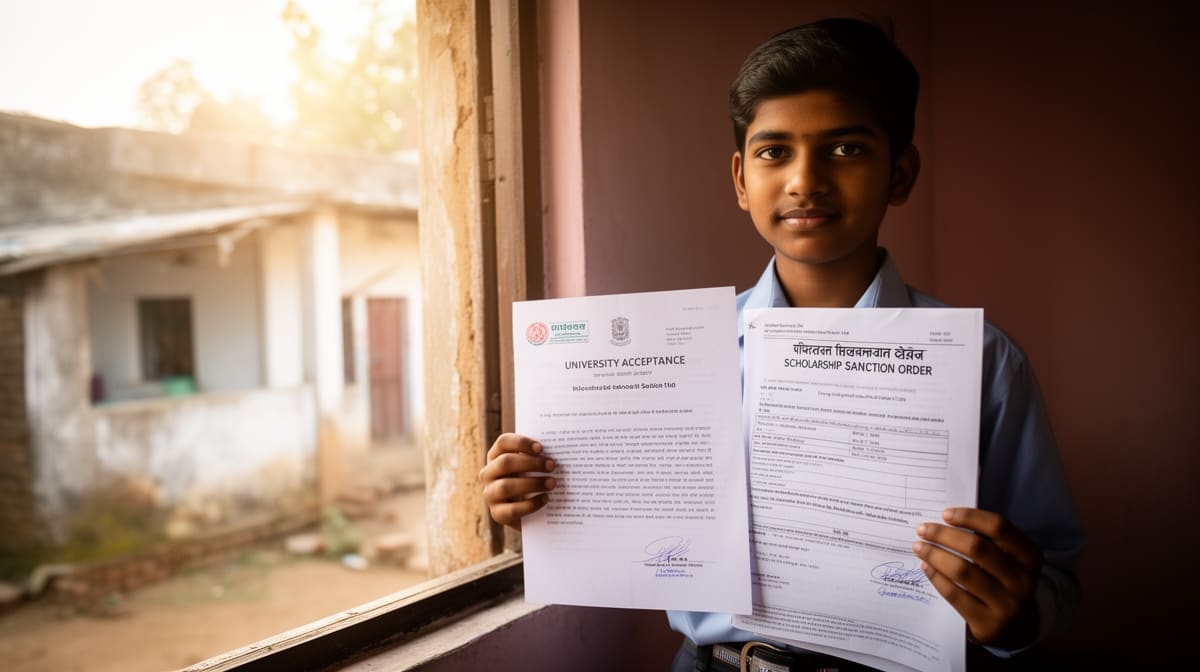
The Andhra Pradesh High Court has reinforced the state’s constitutional obligation to disburse public funds without undue delay when verified data is available, setting a clear timeline for reimbursement under the Reimbursement of Tuition Fee (RTF) scheme. This ruling establishes that administrative inertia cannot override statutory and policy-based entitlements, particularly when digital platforms provide transparent, auditable records.
Background & Facts
The Dispute
The petitioner, KKR and KSR Institute of Technology and Sciences, is a private unaided college that admitted students under the State’s Reimbursement of Tuition Fee (RTF) and Maintenance Fee (MTF) schemes for the academic years 2018-19, 2019-20, and 2020-21. These schemes, administered by the Social Welfare Department, entitle eligible institutions to reimbursement of tuition fees paid on behalf of economically disadvantaged students. Despite the college fulfilling all eligibility criteria and the students being duly enrolled, the state withheld payment of Rs. 66,96,700, citing procedural delays and lack of formal admission.
Procedural History
- The petitioner submitted claims through the Jnanabhumi portal, the state’s centralized digital platform for scholarship processing.
- The portal displayed verified student enrollment data and calculated reimbursement amounts for all three academic years.
- Despite repeated representations, the state departments - Social Welfare, Finance, and Higher Education - failed to release funds.
- The petitioner filed a writ petition under Article 226, alleging violation of Articles 14, 19, and 21, and sought immediate release of dues with 24% interest.
Relief Sought
The petitioner sought a writ of mandamus directing the state to release the admitted dues of Rs. 66,96,700 with interest at 24% per annum, and to prevent further delay in processing future claims.
The Legal Issue
The central question was whether the state can withhold statutorily mandated reimbursements merely on the ground that the amount has not been formally "admitted" in a bureaucratic sense, when the underlying data is verifiable through a government-mandated digital platform.
Arguments Presented
For the Petitioner
The petitioner argued that the Jnanabhumi portal, established under G.O. Ms. No. 45 of 2017 and modified by G.O. Ms. No. 81 of 2019, is the sole authoritative source for determining eligibility and quantum of reimbursement. Counsel cited State of Haryana v. Bhagwan Das to assert that when a public authority creates a transparent, automated system for entitlements, it cannot later deny benefits by invoking procedural technicalities. The delay, they contended, violated Article 14 by treating similarly situated institutions unequally and Article 21 by depriving the college of its right to livelihood.
For the Respondent
The state countered that the claimed amount was not "admitted" but merely "claimed," and that final verification required physical documentation and internal audit clearance. The Government Pleader argued that the portal was only an application interface and not a conclusive record, and that financial sanctions required sequential approvals from Finance and Social Welfare Departments, which had not yet been completed.
The Court's Analysis
The Court rejected the state’s argument that the portal data was merely preliminary. It emphasized that the Jnanabhumi portal was not an optional tool but a statutory mechanism created to eliminate discretion, reduce corruption, and ensure timely disbursement. The Court noted that the portal’s design - integrating student enrollment, fee structure, and institutional eligibility - rendered it the definitive source for calculation.
"The Jnanabhumi portal is not a mere application platform; it is the operational backbone of the RTF scheme, and its data, once populated and verified, constitutes the prima facie basis for reimbursement. To insist on additional documentation after portal verification is to defeat the very purpose of digitization."
The Court further held that the state’s failure to act for over three years, despite having access to complete data, amounted to arbitrary administrative inaction under Article 14. It distinguished K.S. Puttaswamy v. Union of India to affirm that the right to timely public benefit is an essential facet of dignity under Article 21. The Court also rejected the claim that financial approvals were pending, noting that the Finance Department’s role is to release funds once entitlement is established - not to re-examine eligibility.
The Verdict
The petitioner succeeded. The Court held that verified data on the Jnanabhumi portal constitutes conclusive proof of entitlement under the RTF scheme. The state was directed to verify the claim within eight weeks and release the amount within three months thereafter, with no order on costs.
What This Means For Similar Cases
Portal Data Is Conclusive for Reimbursement
- Practitioners must now treat verified entries on state-mandated digital portals (e.g., Jnanabhumi, e-Scholarship, NCS) as binding for reimbursement claims.
- Any demand for additional physical documents after portal verification is legally untenable unless the portal itself flags discrepancies.
Delay in Public Disbursement Violates Article 14 and 21
- Institutions and beneficiaries can invoke Article 14 to challenge arbitrary delays in releasing statutorily mandated funds.
- Courts will treat prolonged non-payment of educational reimbursements as a deprivation of livelihood under Article 21, especially for private institutions dependent on such funds.
Administrative Processes Must Align with Digital Systems
- Government departments cannot use internal clearance chains as an excuse to delay payments already calculated and verified on digital platforms.
- The burden shifts to the state to prove that portal data is erroneous - not to the claimant to prove its correctness.