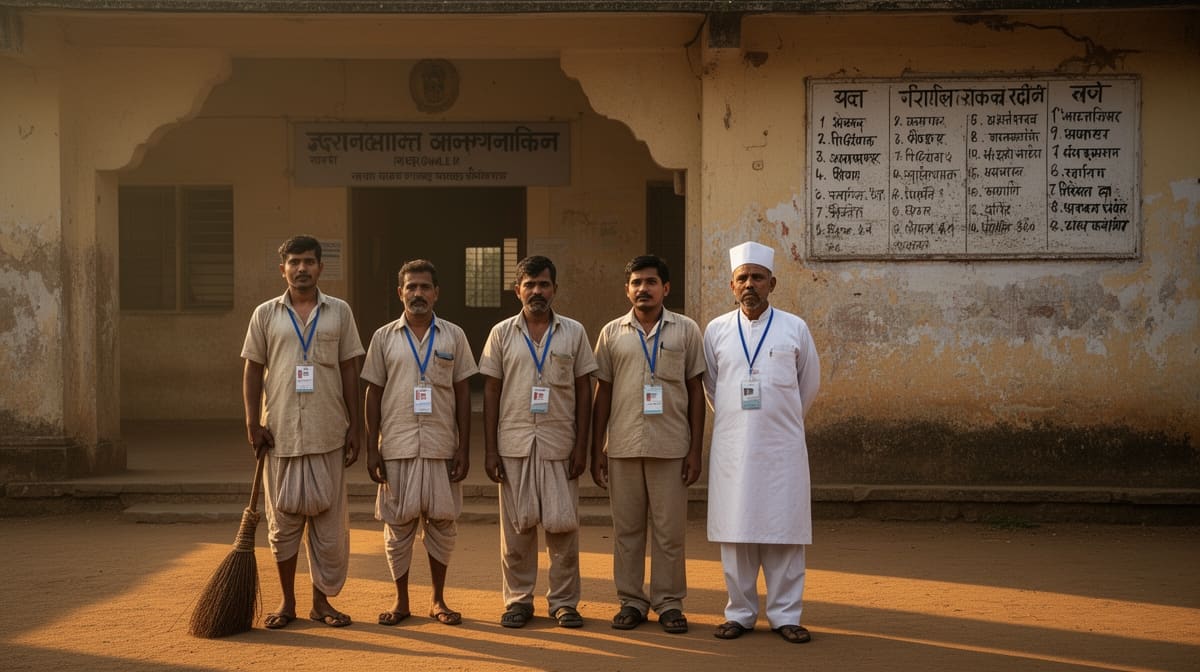
A landmark ruling by the Karnataka High Court has reaffirmed that prolonged, uninterrupted service by daily wage employees in sanctioned posts creates a legitimate claim for regularization, irrespective of procedural irregularities in initial appointment. The judgment decisively rejects the State’s attempt to deny relief based on technicalities after nearly three decades of service.
Background & Facts
The Dispute
The respondent, Smt. Lakshmi Devi, was appointed as an Attender-cum-Sweeper at a Government Sports High School in Bengaluru North on 06.07.1995 on a consolidated pay basis. She has rendered continuous service for over 30 years without interruption. Despite repeated representations and recommendations from departmental authorities, including a 2015 recommendation under the Karnataka Daily Wages Employees' Welfare Act, 2012, the State failed to act on her request for regularization.
Procedural History
- 1999: Respondent joined a group petition (Application Nos.1366-1371/1999) seeking regularization; Tribunal directed individual representations.
- 2007: Tribunal disposed of group petition, directing authorities to consider individual cases.
- 2011: Consolidated pay enhanced by departmental order.
- 2014-2015: Department sought and forwarded respondent’s details for consideration under the 2012 Act; no action taken.
- 2016: Similar case of Rajanna (Assistant Teacher) was regularized following a High Court direction.
- 2024: Respondent filed fresh representation on 03.01.2024; no response.
- 2025: Karnataka State Administrative Tribunal (KSAT) allowed her application for regularization with effect from completion of 10 years of service.
- 2025: State filed Writ Petition under Articles 226 and 227 challenging the Tribunal’s order.
Relief Sought
The respondent sought regularization of her service with effect from 06.07.2005 (completion of 10 years), along with consequential benefits including pay parity, seniority, and pension entitlements.
The Legal Issue
The central question was whether an employee who has served continuously for over 30 years in a sanctioned post, without illegal appointment or lack of qualifications, can be denied regularization solely on the ground of procedural irregularity in initial hiring, particularly in light of the UMADEVI (3) exception and subsequent Apex Court rulings.
Arguments Presented
For the Petitioner
The State contended that the respondent’s appointment was illegal because:
- She was not appointed against a formally sanctioned post.
- She lacked prescribed qualifications for the post.
- Her appointment violated Article 14 and Article 16 of the Constitution.
- She did not meet the strict conditions laid down in Umadevi (3), which, according to the State, barred regularization of illegally appointed persons.
- Reliance was placed on Umadevi (3) and Upendra Singh to argue that backdoor appointments cannot be regularized.
For the Respondent
The respondent argued that:
- The post of Attender-cum-Sweeper was a sanctioned, essential post with no prescribed qualifications at the time of her appointment.
- She fulfilled the UMADEVI (3) exception: continuous service exceeding 10 years in a duly sanctioned post, without any illegality.
- Her service was not sporadic but integral to the functioning of the institution.
- Reliance was placed on Jaggo v. Union of India and Dharam Singh v. State of U.P., which clarified that long-term, perennial work cannot be disguised as temporary.
- The State’s delay and inaction estop it from now challenging the legality of an appointment it accepted for three decades.
The Court's Analysis
The Court undertook a comprehensive review of the UMADEVI (3) jurisprudence and its subsequent evolution in State of Karnataka v. M.L. Kesari, Jaggo, and Dharam Singh. It emphasized that UMADEVI (3) did not categorically bar regularization but drew a critical distinction between illegal and irregular appointments.
"The true effect of the direction is that all persons who have worked for more than ten years as on 10-4-2006... in vacant posts, possessing the requisite qualification, are entitled to be considered for regularisation."
The Court found that the respondent’s appointment was not illegal. There was no evidence that the post was unsanctioned or that she lacked qualifications at the time of appointment. The State itself had accepted her services for over 30 years, enhanced her pay, and even recommended her case under the 2012 Act. The Court held that the State cannot now invoke procedural irregularities to deny relief after reaping the benefits of her labor.
The Court further relied on Jaggo, where the Supreme Court observed that labeling employees as "contractual" or "part-time" does not negate the reality of their continuous, indispensable service. The State’s reliance on Upendra Singh was rejected as inapplicable, since that case involved a different factual matrix where qualifications were lacking.
The Court also invoked constitutional principles under Article 21 (right to livelihood) and Article 14 (equality), holding that prolonged insecurity and arbitrary denial of regularization after three decades of service violates constitutional discipline. The State, as a constitutional employer, cannot balance budgets on the backs of those performing essential public functions.
The Verdict
The respondent won. The Karnataka High Court upheld the Tribunal’s order, holding that continuous service of over 30 years in a sanctioned post, without illegality, entitles an employee to regularization as a one-time measure under the UMADEVI (3) exception. The writ petition was dismissed.
What This Means For Similar Cases
Regularization Is Not Dependent on Formal Recruitment
- Practitioners must now argue that procedural irregularity ≠ illegality when the employee served in a sanctioned post with no disqualifying conditions.
- Where the State accepted service for over 10 years, the burden shifts to the State to prove illegality - not the employee to prove regularity.
- Merely lacking a competitive selection process does not render an appointment illegal if qualifications were met and the post was sanctioned.
Long Service Creates a Legitimate Expectation
- Employees with 20+ years of service have a constitutionally protected expectation of regularization under Article 21.
- Courts will now scrutinize whether the State’s refusal is arbitrary, especially when similar cases (e.g., Rajanna) were regularized.
- Delay in acting on representations, followed by sudden denial, amounts to estoppel and violates principles of natural justice.
State Must Maintain Transparent Establishment Records
- Departments must maintain accurate muster rolls and sanctioned post registers.
- If outsourcing replaces long-serving employees, courts will infer that the work was perennial and the original engagement was effectively permanent.
- Failure to explain differential treatment of similarly placed employees invites judicial intervention under Article 14.