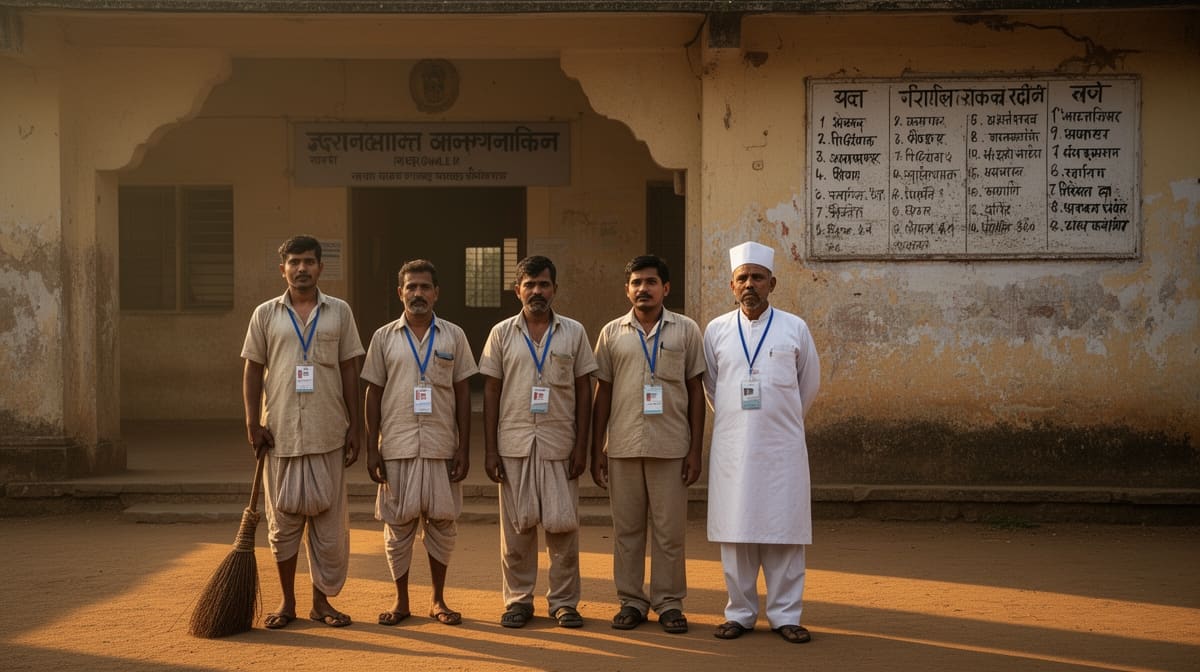
The Andhra Pradesh High Court has reaffirmed the primacy of the Supreme Court's Umadevi principles in regularization cases, dismissing an appeal by Dr Y.S.R. Horticultural University that sought to deny regularization to an employee with 33 years of continuous service. The Court held that procedural state rules cannot override substantive rights accrued through prolonged, unblemished service, particularly when the employee meets the Umadevi criteria of 10+ years in a sanctioned post.
Background & Facts
The Dispute
The respondent, Nelli Stayanarayana, joined Dr Y.S.R. Horticultural University as a Casual Labour in 1992. After 16 years in this capacity, he transitioned to a Time Scale Worker in 2008. During his tenure, he acquired a Bachelor of Arts degree, passed English Type Writing (Lower Grade), and obtained a Post Graduate Diploma in Computer Applications (PGDCA). On 20.09.2013, he submitted a representation to the University seeking regularization as a Junior Assistant-cum-Typist. The University rejected his request via proceedings dated 18.03.2014, prompting him to file W.P.No.12879 of 2014.
Key Facts
- Employment History:
- Joined as Casual Labour: 1992
- Transitioned to Time Scale Worker: 2008
- Total service at disposal of writ petition: 33 years
- Qualifications Acquired During Service:
- Bachelor of Arts (B.A.)
- English Type Writing (Lower Grade)
- Post Graduate Diploma in Computer Applications (PGDCA)
- Representation and Rejection:
- Representation for regularization: 20.09.2013
- Rejection Proceedings: 18.03.2014
- No Counter-Affidavit: The University did not file a counter-affidavit in the writ proceedings.
Procedural History
- 20.09.2013: Respondent submits representation for regularization.
- 18.03.2014: University rejects representation.
- W.P.No.12879 of 2014: Respondent files writ petition before the High Court.
- 09.01.2025: Learned Single Judge directs regularization of respondent’s services in the cadre of Junior Assistant or equivalent post, denying back wages but granting notional seniority from the date of time scale extension.
- Appeal Delay: University files Writ Appeal No. 591 of 2025 with a 55-day delay, which is condoned.
The Parties' Positions
For the Appellant (University)
The University contended that the respondent did not meet the five-year continuous service requirement as on 25.11.1993, the cut-off date under G.O.Ms.No.212 dated 22.04.1994. It argued that the respondent’s age (45 years as on 01.07.2010) exceeded the prescribed limit of 39 years (relaxable to 44 years for SC/ST/BC candidates) for the post of Junior Assistant-cum-Typist under a Direct Recruitment Notification. The University also pointed out that a junior employee, Mr. K. Naga Malleswara Rao, was appointed through a selection process, not regularization.
For the Respondent
The respondent relied on the Supreme Court’s decisions in Jaggo v. Union of India and Pawan Kumar v. Union of India, arguing that his 33 years of continuous service in a sanctioned post justified regularization under the Umadevi principles. He highlighted that the then Registrar had sought government permission on 31.12.2009 to appoint him and others to vacant Junior Assistant-cum-Typist posts under ICAR schemes, citing the University’s need for manpower.
Relief Sought
The respondent sought regularization of his services as Junior Assistant-cum-Typist, with notional seniority from the date of his time scale extension and denial of back wages.
The Legal Issue
The central question was whether G.O.Ms.No.212 dated 22.04.1994, which mandates five years of continuous service as on 25.11.1993 for regularization, can override the Supreme Court’s Umadevi principles, which permit regularization of employees with 10+ years of continuous service in sanctioned posts, even if their appointments were irregular.
Arguments Presented
For the Appellant (University)
- Non-Compliance with G.O.Ms.No.212: The respondent did not complete five years of service as on 25.11.1993, disqualifying him for regularization under state rules.
- Age Bar: The respondent’s age exceeded the prescribed limit for the post under the Direct Recruitment Notification.
- Precedent: A junior employee was appointed through selection, not regularization, indicating the University’s adherence to procedural norms.
For the Respondent
- Supreme Court Precedents: Relied on Umadevi, Jaggo, and Pawan Kumar to argue that prolonged, unblemished service in a sanctioned post justifies regularization as a one-time measure.
- University’s Need: The Registrar’s communication dated 31.12.2009 acknowledged the University’s requirement for manpower, supporting the respondent’s claim.
- No Illegality: The respondent’s initial appointment was not illegal, and he possessed the requisite qualifications for the post.
The Court's Analysis
The Court conducted a detailed examination of the Umadevi principles and their application to the respondent’s case. Key observations included:
-
Admitted Facts: The respondent had 33 years of continuous service, joining as a Casual Labour in 1992 and transitioning to a Time Scale Worker in 2008. His appointment was not illegal, and he possessed the necessary qualifications for the post of Junior Assistant-cum-Typist. No material was presented to suggest unsatisfactory performance or major disciplinary actions.
-
Rejection Grounds: The University’s rejection of the respondent’s representation was based solely on non-compliance with G.O.Ms.No.212, not on age or merit. The Court noted that the rejection did not address the respondent’s prolonged service or the University’s need for manpower.
-
Supreme Court’s Umadevi Principles: The Court emphasized that Umadevi permits regularization of employees with 10+ years of continuous service in sanctioned posts, even if their appointments were irregular. The judgment aims to prevent backdoor entries but does not penalize employees who have rendered long, unblemished service in necessary roles.
"It is well established that the decision in Umadevi (supra) does not intend to penalize employees who have rendered long years of service fulfilling ongoing and necessary functions of the State or its instrumentalities. The said judgment sought to prevent backdoor entries and illegal appointments that circumvent constitutional requirements. However, where appointments were not illegal but possibly 'irregular,' and where employees had served continuously against the backdrop of sanctioned functions for a considerable period, the need for a fair and humane resolution becomes paramount."
-
State Rules vs. Constitutional Principles: The Court reiterated that state rules or executive orders cannot whittle down the scope of Supreme Court judgments. In U.V.S.R.Prasad & Others v. State of Andhra Pradesh, a Division Bench of the erstwhile High Court held that G.O.Ms.No.212 and Act 2 of 1994 do not override the Umadevi principles. The Supreme Court dismissed the Special Leave Petition against this decision, reinforcing the binding nature of Umadevi.
-
Misapplication of Umadevi: The Court criticized the selective application of Umadevi by government departments to deny regularization to long-serving employees, noting that such practices distort the judgment’s intent.
"Government departments often cite the judgment in Umadevi (supra) to argue that no vested right to regularization exists for temporary employees, overlooking the judgment's explicit acknowledgment of cases where regularization is appropriate. This selective application distorts the judgment's spirit and purpose, effectively weaponizing it against employees who have rendered indispensable services over decades."
-
Precedents Supporting Regularization: The Court relied on Vinod Kumar v. Union of India, which held that procedural formalities cannot perpetually deny substantive rights accrued through continuous service. It also cited Jaggo, where the Supreme Court set aside a Delhi High Court order denying regularization to employees with prolonged service in sanctioned posts.
The Verdict
The Court dismissed the appeal, upholding the Single Judge’s order dated 09.01.2025 directing the University to regularize the respondent’s services in the cadre of Junior Assistant or an equivalent post. The Court clarified that:
- The respondent is not entitled to back wages.
- The regularization and actual service benefits shall take effect from the date of the regularization order.
- The respondent’s services shall be considered for notional seniority purposes from the date of his time scale extension.
No costs were awarded.
What This Means For Similar Cases
Umadevi Principles Trump State Rules
- Binding Nature of Supreme Court Judgments: State governments and instrumentalities cannot rely on local rules or executive orders to deny regularization to employees who meet the Umadevi criteria of 10+ years of continuous service in sanctioned posts. Practitioners should argue that such rules are subservient to constitutional principles under Article 141.
- One-Time Measure: Regularization under Umadevi is a one-time measure to address prolonged, irregular service. It does not create a vested right for future cases but provides relief to employees who have already rendered substantial service.
Procedural Formalities Cannot Deny Substantive Rights
- Continuous Service Matters: Courts are likely to favor employees with unblemished, prolonged service in sanctioned posts, even if their initial appointments were irregular. Practitioners should emphasize the duration and quality of service in regularization pleas.
- No Back Wages: While regularization may be granted, back wages are typically denied unless there is a specific direction for the same. The focus remains on future service benefits.
Age and Merit Considerations Are Secondary
- Age Bar Not Absolute: The Court did not uphold the University’s argument regarding the respondent’s age exceeding the prescribed limit. Where an employee has rendered decades of service, age-related disqualifications may be overlooked.
- Qualifications Suffice: The respondent’s acquisition of B.A., typewriting, and PGDCA qualifications during service strengthened his case. Employees should be encouraged to upskill during their tenure to bolster regularization claims.
Strategic Litigation for Regularization
- Exhaustive Factual Narrative: Pleadings should include a detailed timeline of service, qualifications acquired, and any communications from the employer acknowledging the need for manpower (e.g., the Registrar’s letter dated 31.12.2009).
- Precedent-Based Arguments: Rely on Umadevi, Jaggo, Pawan Kumar, and Vinod Kumar to argue that procedural lapses cannot defeat substantive rights accrued through continuous service.
- Challenge State Rules: If state rules impose arbitrary cut-offs (e.g., five years by 1993), argue that they cannot override Supreme Court judgments under Article 141 of the Constitution.