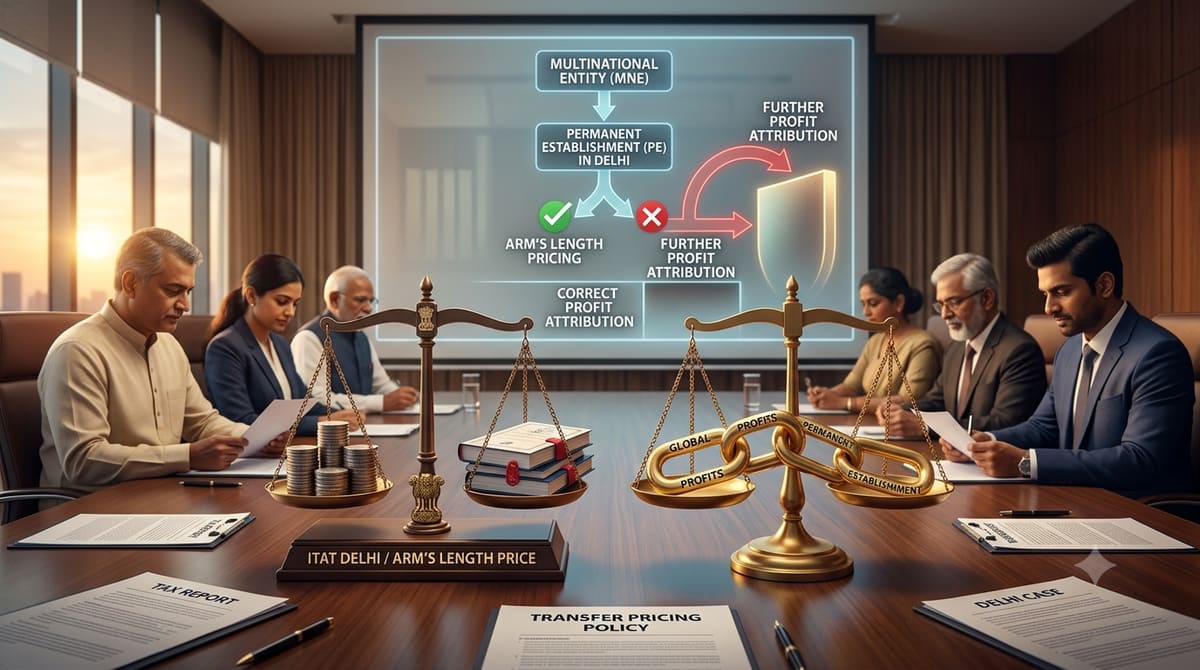
The Income Tax Appellate Tribunal (ITAT), Delhi, delivered a significant ruling on transfer pricing adjustments, clarifying that foreign exchange gains must be treated as operating income and that common expenses should be allocated based on gross profit margins rather than turnover. The judgment also reinstated comparables rejected by the Transfer Pricing Officer (TPO), setting aside a Rs. 3.66 crore adjustment and directing a fresh determination of the Arm's Length Price (ALP).
Background & Facts
The Dispute
The appellant, Sara Sae Pvt Ltd, challenged the assessment order dated 28.06.2017 passed by the Assessing Officer (AO) under Section 143(3) read with Section 144C of the Income Tax Act, 1961. The order was passed in consonance with the Dispute Resolution Panel (DRP) order dated 18.05.2017 and the TPO order dated 28.10.2016 under Section 92CA(3) of the Act. The dispute pertained to transfer pricing adjustments relating to the international transaction of sale of finished goods by the assessee’s Commodity Division to its Associated Enterprise (AE) in the USA, amounting to ₹51.68 crores.
Key Facts
- The assessee operates in two segments: Capital Goods (specialized equipment for oil and gas industry) and Commodity Products (fast-moving items like valves, flanges, and castings).
- The assessee entered into international transactions with its AE, benchmarked using the Transactional Net Margin Method (TNMM) with the assessee as the tested party and Operating Profit/Operating Cost (OP/OC) as the Profit Level Indicator (PLI).
- The assessee’s PLI was 6.61%, while the working capital adjusted mean of comparables was 1.55%. The assessee claimed the transaction was at Arm’s Length Price (ALP).
- The assessee included foreign exchange gain of Rs. 2,38,83,566 as part of operating profit in its Transfer Pricing (TP) study.
- The TPO excluded the foreign exchange gain, reallocated common expenses between the Delhi and Dehradun offices based on turnover instead of net profit ratio, and rejected four of the five comparables chosen by the assessee.
- The TPO computed the assessee’s PLI at (-)1.39% and benchmarked it against Hilton Metal Forgings (PLI: 5.59%), resulting in a transfer pricing adjustment of Rs. 3,65,84,151.
Procedural History
- 13.01.2016: Assessee filed audited accounts of the Commodity segment before the TPO.
- 28.10.2016: TPO passed order under Section 92CA(3), excluding foreign exchange gains and reallocating expenses.
- 18.05.2017: DRP upheld the TPO’s order under Section 144C(5).
- 28.06.2017: AO passed assessment order under Section 143(3) read with Section 144C.
- ITA No. 5484/Del/2017: Assessee filed appeal before ITAT, Delhi.
- 01.04.2026: Hearing conducted.
- 29.06.2026: ITAT pronounced the present order.
Relief Sought
The assessee sought:
- Setting aside the transfer pricing adjustment of Rs. 3,65,84,151.
- Inclusion of foreign exchange gain of Rs. 2,38,83,566 as operating income.
- Allocation of common expenses based on gross profit margins instead of turnover.
- Reinstatement of the four comparables rejected by the TPO.
- Allowance of interest expenditure of Rs. 51,95,632 under Section 57(iii) of the Act.
The Legal Issue
The appeal raised three key legal questions:
- Whether foreign exchange gains should be treated as operating income for the purpose of determining the PLI under TNMM.
- Whether the allocation of common expenses between divisions should be based on gross profit margins or turnover.
- Whether the rejection of comparables by the TPO on grounds of functional dissimilarity or persistent losses was justified.
Arguments Presented
For the Appellant
- Foreign Exchange Gains: Relied on the coordinate bench decisions in D. E. Shaw India Advisory Services Pvt Ltd v. DCIT (87 taxmann.com 15), Global E Business Operations Private Ltd v. ACIT (124 taxmann.com 244), and Rampgreen Solutions Pvt Ltd v. DCIT (154 taxmann.com 541), which held that foreign exchange gains/losses emanate from regular business activities and should be treated as operating income.
- Expense Allocation: Argued that the assessee’s consistent practice of allocating common expenses based on net profit ratio was accepted by the TPO in Assessment Years (AYs) 2010-11 and 2011-12. Cited the decision in Fujitsu India Ltd v. DCIT (78 taxmann.com 279), which held that allocation based on gross profit margins is more logical than turnover.
- Comparables: Submitted that the TPO had accepted Carnation Industries, Surindra Engineering, and Gontermann Pieper as comparables in AY 2011-12 and AY 2012-13 on grounds of functional similarity. Argued that there was no change in the Functions, Assets, and Risks (FAR) analysis for the year under consideration.
- Interest Disallowance: Contended that the disallowance of Rs. 51,95,632 under Section 57(iii) was unjustified, relying on the Supreme Court decision in CIT v. Rajendra Prasad Moody (115 ITR 519), which allows deduction of interest expenditure against interest income from loans advanced to subsidiaries.
For the Respondent
- Foreign Exchange Gains: Argued that foreign exchange gains should be excluded as they are non-operating in nature.
- Expense Allocation: Contended that allocation based on turnover was more appropriate than profit margins.
- Comparables: Justified the rejection of comparables on grounds of functional dissimilarity and persistent losses.
- Interest Disallowance: Supported the AO’s disallowance of proportionate interest on funds utilized for equity investment in the subsidiary, as no dividend income was earned.
The Court's Analysis
Foreign Exchange Gains as Operating Income
The ITAT relied on the coordinate bench decisions in D. E. Shaw India Advisory Services Pvt Ltd, Global E Business Operations Private Ltd, and Rampgreen Solutions Pvt Ltd, which consistently held that foreign exchange gains or losses arising from regular business activities must be treated as operating income for the purpose of determining the PLI under TNMM. The Tribunal quoted the operative portion of D. E. Shaw India Advisory Services Pvt Ltd:
"The only effective ground remaining to be adjudicated is on the plea of the assessee to treat foreign exchange gain/loss as operating in nature. This issue is squarely covered in favour of the assessee by the order of ITAT Delhi Bench in the case of Ericsson India (P.) Ltd. (supra) wherein the ITAT Delhi Bench in Para 17 of the said order, while ruling in favour of the assessee, directed the TPO to treat the foreign exchange gain/loss as operating in nature in calculating the operating margin of the assessee as well as final comparable companies. Respectfully following the same, we set aside this issue to the file of TPO/AO to treat the foreign exchange gain/loss as operating in nature in calculating the operating margin of the assessee as well as final comparable companies."
The Tribunal directed the TPO to include the foreign exchange gain of Rs. 2,38,83,566 as part of the assessee’s operating income.
Allocation of Common Expenses
The Tribunal examined the assessee’s method of allocating common expenses between the Delhi and Dehradun offices based on net profit ratio, which was its consistent practice. The TPO had sought to reallocate these expenses based on turnover, which the Tribunal found unsustainable. The Tribunal relied on the decision in Fujitsu India Ltd v. DCIT, which held that allocation based on gross profit margins is more logical than turnover or headcount. The Tribunal quoted the relevant observation:
"There can be no rationale in apportioning the costs on the basis of number of persons working in the three segments... At the same time, we are also not agreeable with the apportionment of unallocated costs in the ratio of sales price or, say, gross revenue... In our considered opinion, a more logical way of apportioning 'Unallocable costs' is to divide them in the ratio of gross profit margins (not gross profit rate) earned by the assessee from the three segments. This will present a more realistic way of apportioning the unallocable costs."
The Tribunal directed the TPO to accept the assessee’s contention and re-compute the PLI based on gross profit margins.
Rejection of Comparables
The assessee had selected five comparables to benchmark the international transaction, with the following PLIs:
| Name of the Comparable | PLI (OP/OC) |
|---|---|
| Hilton Metal Forgings | 5.59% |
| Carnation Industries | 7.32% |
| Sanghvi Forgings and Engineering | 11.90% |
| Gontermann Pieper | (-)13.34% |
| Surindra Engineering | (-)2.17% |
The TPO accepted only Hilton Metal Forgings and rejected the remaining four comparables on grounds of functional dissimilarity or persistent losses. The Tribunal noted that:
- The TPO had accepted Carnation Industries and Surindra Engineering as comparables in AY 2011-12 and Gontermann Pieper and Surindra Engineering in AY 2012-13 on grounds of functional similarity.
- There was no change in the FAR analysis for the year under consideration.
- The rejection of Gontermann Pieper on grounds of persistent losses was unjustified, as the comparable had not incurred losses in three consecutive financial years (PLIs: 12.28%, 8.21%, (-)7.94%, (-)13.34%).
The Tribunal directed the TPO to reinstate all four comparables and re-benchmark the assessee’s PLI against the mean of the five comparables.
Disallowance of Interest Expenditure
The assessee had availed an External Commercial Borrowing (ECB) of USD 7 million from Standard Chartered Bank, London, in FY 2011-12. Out of this, USD 1.5 million was invested in the equity of its wholly owned subsidiary, STS Products Inc. USA, and USD 5.5 million was advanced as a loan bearing 6.6% interest. During the year, the assessee received Rs. 2,00,21,236 as interest income from the subsidiary and claimed deduction of Rs. 2,42,46,284 as interest expenditure under Section 57(iii). The AO disallowed a proportionate interest of Rs. 51,95,632 on the ground that no dividend income was earned on the equity investment.
The Tribunal relied on the Supreme Court decision in CIT v. Rajendra Prasad Moody, which held that interest expenditure incurred on borrowed funds is allowable as a deduction under Section 57(iii), even if the investment does not yield immediate income. The Tribunal directed the AO to allow the deduction of Rs. 51,95,632.
The Verdict
The ITAT partly allowed the assessee’s appeal for statistical purposes and directed the TPO/AO to:
- Include foreign exchange gain of Rs. 2,38,83,566 as part of the assessee’s operating income.
- Reallocate common expenses between the Delhi and Dehradun offices based on gross profit margins instead of turnover.
- Reinstate the four comparables (Carnation Industries, Sanghvi Forgings and Engineering, Gontermann Pieper, and Surindra Engineering) and re-benchmark the assessee’s PLI against the mean of the five comparables.
- Allow the deduction of Rs. 51,95,632 under Section 57(iii) of the Act.
- Recompute the transfer pricing adjustment in light of the above directions.
The Tribunal dismissed Ground No. 5 (challenging the initiation of penalty proceedings under Section 271(1)(c)) as premature.
What This Means For Similar Cases
Foreign Exchange Gains Are Operating Income
- Binding Precedent: The ITAT’s reliance on coordinate bench decisions establishes that foreign exchange gains/losses arising from regular business activities must be treated as operating income for transfer pricing purposes. This principle is now binding on TPOs and AOs in similar cases.
- Practical Implication: Assessees must ensure that foreign exchange gains are included in the operating profit while computing the PLI under TNMM. Exclusion of such gains could lead to unjustified transfer pricing adjustments.
Expense Allocation Must Be Based on Gross Profit Margins
- Logical Allocation: The Tribunal’s endorsement of gross profit margins as the basis for allocating common expenses provides clarity on the most appropriate method for such allocations. Turnover-based allocation is no longer sustainable.
- Consistency Requirement: Assessees must maintain consistency in their expense allocation methods across assessment years. Any deviation could invite scrutiny and adjustments.
Persistent Losses Require Three-Year Threshold
- Definition Clarified: The Tribunal clarified that persistent losses must be understood as losses incurred in three consecutive financial years, including the year under consideration and the two preceding years. This definition is now authoritative for rejecting comparables on grounds of persistent losses.
- Functional Comparability Overrides Product Similarity: Under TNMM, broader functional comparability takes precedence over product similarity. Assessees can rely on this principle to defend the inclusion of comparables that may not be product-identical but are functionally similar.
Interest Expenditure Allowable Even Without Immediate Income
- Supreme Court Precedent: The Tribunal’s reliance on CIT v. Rajendra Prasad Moody reaffirms that interest expenditure on borrowed funds is allowable under Section 57(iii), even if the investment (e.g., equity shares) does not yield immediate income (e.g., dividends).
- Proportionate Disallowance Invalid: AOs cannot disallow interest expenditure proportionately based on the absence of immediate income from investments. The entire interest expenditure is allowable if the borrowed funds are used for income-generating purposes.