Topic

Representation of the People Act

The Representation of the People Act, 1950 and 1951 governs electoral processes in India, including voter registration, candidate eligibility, election petitions, and disqualifications.

13 articlesLatest 0 month ago
Section 31 RP Act | BLA Undertaking for Enumeration Forms Struck Down; Verification Liability Limited to Photograph Match in SIR : Delhi HC
Case Law Analysis
|Delhi High Court

Section 31 RP Act | BLA Undertaking for Enumeration Forms Struck Down; Verification Liability Limited to Photograph Match in SIR : Delhi HC

The Delhi High Court quashed the ECI's mandate requiring Booth Level Agents to undertake verification of enumeration forms in Special Intensive Revision, holding that Section 31 RP Act confines BLA liability to photograph matching. The court deemed the blanket undertaking requirement arbitrary as the statutory duty to verify electoral rolls rests with Booth Level Officers, not party-appointed agents.

Article 329(b) bars post-election asset-disclosure challenges via writ petition | Election grievance must be raised in election petition : MP HC
Case Law Analysis
|Madhya Pradesh High Court

Article 329(b) bars post-election asset-disclosure challenges via writ petition | Election grievance must be raised in election petition : MP HC

The court dismissed a writ petition seeking investigation of a returned candidate’s alleged asset concealment, holding that Article 329(b) precludes judicial review of post-election disclosures. Such grievances must be raised through a timely election petition under the Representation of the People Act, limiting the use of writ jurisdiction for election-related matters.

Section 100(1)(d) RP Act | Election Petition Dismissed for Failing to Plead Material Effect of Nomination Defects : Bombay HC
|Bombay High Court

Section 100(1)(d) RP Act | Election Petition Dismissed for Failing to Plead Material Effect of Nomination Defects : Bombay HC

The Bombay High Court has ruled that mere technical violations in nomination forms - such as misplaced photographs or incomplete criminal disclosures - cannot void an election unless the petitioner specifically pleads how those defects materially affected the outcome. This reinforces that election petitions must go beyond procedural complaints and demonstrate real-world impact on voter choice, raising the bar for challengers nationwide.

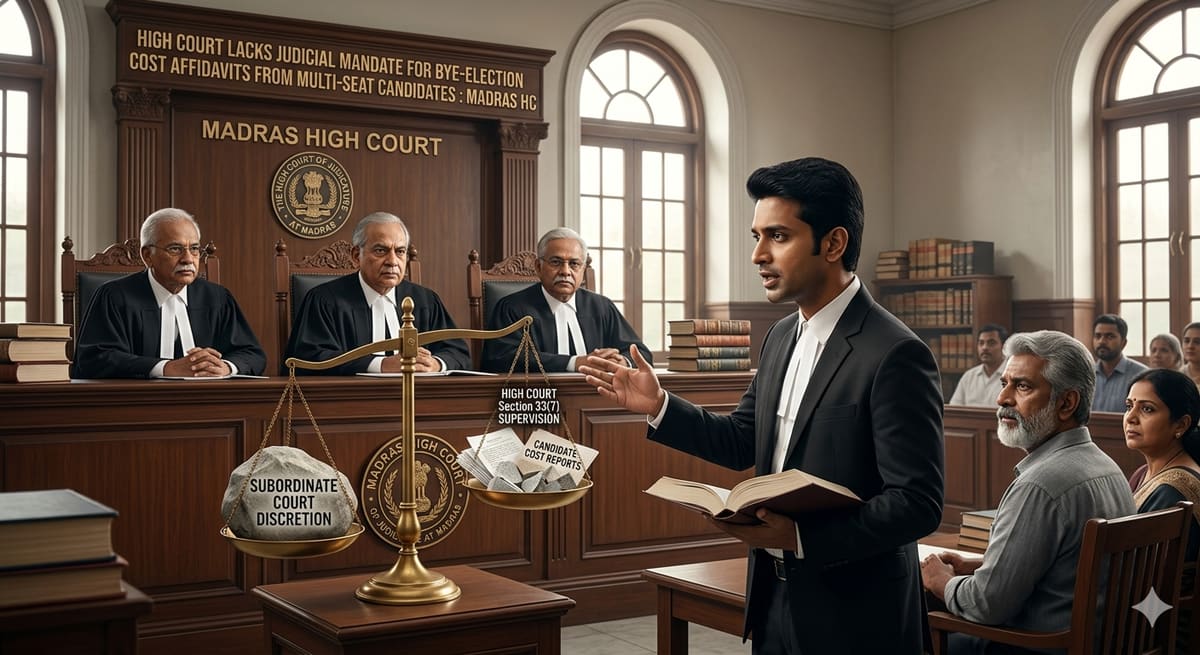
Section 33(7) RP Act | No Judicial Mandate for Bye-Election Cost Affidavits from Multi-Seat Candidates : Madras HC
Case Law Analysis
|Madras High Court

Section 33(7) RP Act | No Judicial Mandate for Bye-Election Cost Affidavits from Multi-Seat Candidates : Madras HC

Madras High Court rules that imposing affidavit requirements on multi-seat candidates to cover bye-election costs exceeds judicial authority, as such reforms require legislative action. The judgment underscores judicial restraint in electoral law, leaving financial burdens of bye-elections to statutory amendments rather than PIL-driven mandates.

Section 100 RP Act | Election Affidavit Non-Disclosure Must Be Challenged via Election Petition, Not Writ Under Article 226 : Madras HC
Case Law Analysis
|Madras High Court

Section 100 RP Act | Election Affidavit Non-Disclosure Must Be Challenged via Election Petition, Not Writ Under Article 226 : Madras HC

Madras High Court reaffirms statutory exclusivity under the Representation of the People Act, 1951, holding that election affidavit discrepancies can only be contested through election petitions, not writ jurisdiction. The ruling bars Article 226 remedies for non-disclosure, reinforcing procedural safeguards for electoral integrity.

Article 329(b) Bars Writ Petitions | Election Affidavit Non-Disclosure Must Be Challenged via Election Petition Under Section 100 RPA : Madras HC
Case Law Analysis
|Madras High Court

Article 329(b) Bars Writ Petitions | Election Affidavit Non-Disclosure Must Be Challenged via Election Petition Under Section 100 RPA : Madras HC

Madras HC reaffirms that challenges to candidate affidavit disclosures must be raised exclusively through election petitions under Section 100 of the Representation of the People Act, 1951. Article 329(b) precludes alternative remedies like writ petitions, reinforcing the statutory exclusivity of election disputes.

Section 23 RP Act, 1950 | Petitioners Must Exhaust Electoral Roll Correction Remedies Before Filing Writ Petitions Under Article 226, Even Amid Imminent Polling : Gauhati HC
Case Law Analysis
|Gauhati High Court

Section 23 RP Act, 1950 | Petitioners Must Exhaust Electoral Roll Correction Remedies Before Filing Writ Petitions Under Article 226, Even Amid Imminent Polling : Gauhati HC

The Gauhati High Court has ruled that voters deleted from electoral rolls cannot bypass statutory remedies under Section 23 of the Representation of the People Act, 1950 by directly approaching the High Court under Article 226 - even when elections are days away. This reinforces the principle that administrative纠错 mechanisms must be exhausted before constitutional remedies are invoked, affecting millions of voters in Assam, Nagaland, Mizoram, and Arunachal Pradesh who rely on electoral roll corrections.

Article 191 | Office in APMC Not an 'Office of Profit' Disqualifying Election Candidacy : Bombay HC
Case Law Analysis
|Bombay High Court

Article 191 | Office in APMC Not an 'Office of Profit' Disqualifying Election Candidacy : Bombay HC

The Bombay High Court ruled that holding a position in a local authority such as the Agricultural Produce Market Committee does not amount to an office of profit under Article 191 of the Constitution, thereby upholding the election of a candidate who held such a post. The judgment also clarifies that minor procedural defects in nomination forms cannot invalidate an election unless proven to have materially affected the outcome, offering critical clarity to local officeholders seeking public office.

Motor Vehicles Act | State Liable for Accidents Involving Requisitioned Vehicles During Public Use : SC Shifts Liability from Insurer to Requisitioning Authority
Case Law Analysis
|Supreme Court of India

Motor Vehicles Act | State Liable for Accidents Involving Requisitioned Vehicles During Public Use : SC Shifts Liability from Insurer to Requisitioning Authority

The Supreme Court ruled that when a vehicle is requisitioned by the State for public purposes like elections, the requisitioning authority-not the insurer-bears liability for accidents. This holding clarifies that statutory control under the Motor Vehicles Act overrides legal ownership, directly impacting government bodies and insurers in similar claims.

Section 22 RP Act, 1951 | Prior Hearing Mandatory Before Electoral Roll Deletion : Gauhati HC
Case Law Analysis
|Gauhati High Court

Section 22 RP Act, 1951 | Prior Hearing Mandatory Before Electoral Roll Deletion : Gauhati HC

The Gauhati High Court has ruled that removing voters from electoral rolls without giving them a prior opportunity to be heard violates the principles of natural justice under Section 22 of the Representation of the People Act. Authorities must now complete inclusion proceedings within 14 days and communicate all decisions in writing, safeguarding millions of citizens from arbitrary disenfranchisement.