Topic

Professional Regulation

Professional regulation in India governs the conduct, enrollment, and disciplinary proceedings of licensed professionals like advocates, architects, and chartered accountants under specific statutes and regulatory bodies.

8 articlesLatest July 2026
Electrohomeopathy Certificate Insufficient for Allopathic Practice | Right to Practice Medicine Under Article 19(1)(g) Requires Valid Allopathic Registration : Allahabad HC
Case Law Analysis
|Allahabad High Court

Electrohomeopathy Certificate Insufficient for Allopathic Practice | Right to Practice Medicine Under Article 19(1)(g) Requires Valid Allopathic Registration : Allahabad HC

Allahabad High Court rules that practitioners holding only electrohomeopathy certificates cannot legally operate allopathic clinics, reinforcing that valid registration under the allopathic system is mandatory. The judgment prioritizes public health protections over individual claims, setting a clear precedent for medical licensing compliance.
RBI Caution List Cannot Include Advocates for Professional Negligence | SC Upholds Self-Regulation Under Advocates Act 1961 : SC
Case Law Analysis
|Supreme Court of India

RBI Caution List Cannot Include Advocates for Professional Negligence | SC Upholds Self-Regulation Under Advocates Act 1961 : SC

Supreme Court rules that RBI's Caution List cannot be used to blacklist advocates for professional negligence, reinforcing the Bar Council of India's exclusive disciplinary authority under the Advocates Act 1961. The judgment mandates institutional reforms, including Continuing Legal Education, to ensure accountability in the legal profession.

Article 226 | High Court Mandates 24-Hour Issuance of Enrolment Certificate for Overseas LLM Admission Amid Bar Council Administrative Vacuum : Kerala HC
Case Law Analysis
|Kerala High Court

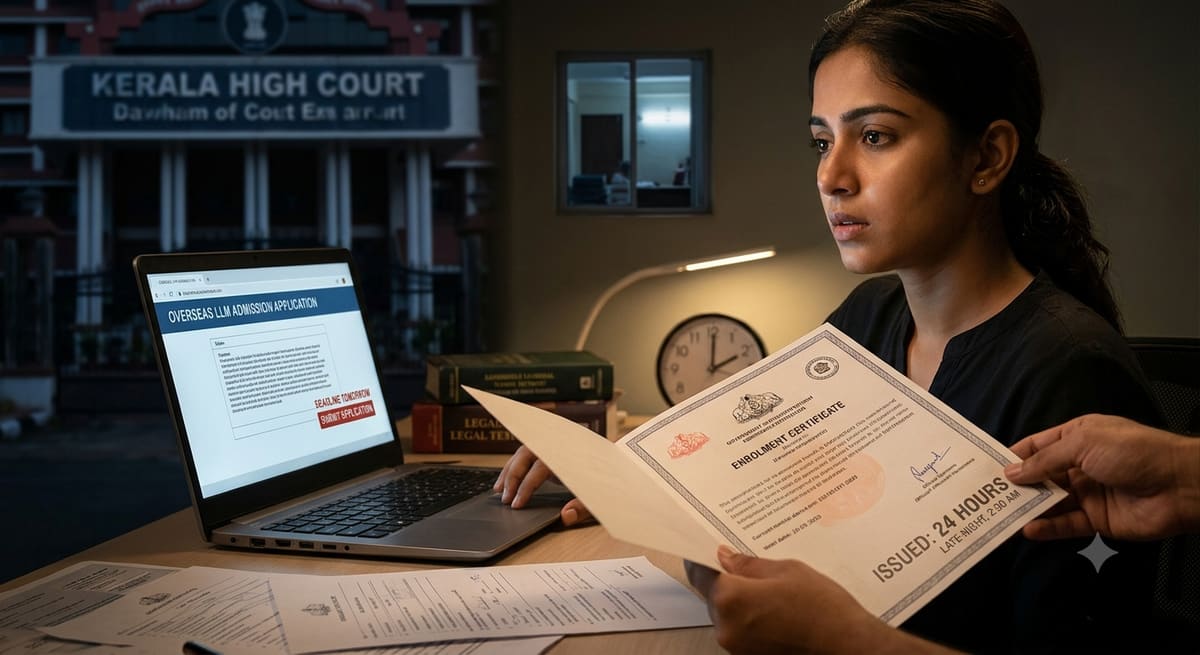
Article 226 | High Court Mandates 24-Hour Issuance of Enrolment Certificate for Overseas LLM Admission Amid Bar Council Administrative Vacuum : Kerala HC

The Kerala High Court has ordered the Bar Council of Kerala to issue an original enrolment certificate within 24 hours to an advocate seeking admission to an LLM program in New Zealand, recognizing the administrative paralysis caused by the delayed assumption of office by the newly elected council. This ruling establishes that procedural delays by statutory bodies cannot deprive professionals of fundamental rights to pursue education abroad, setting a precedent for timely administrative action in professional licensing matters.

Certificate of Practice | Exclusive Practice in Karnataka Overrides Enrollment Jurisdiction for Bar Election Voting Rights : Karnataka HC
Case Law Analysis
|Karnataka High Court

Certificate of Practice | Exclusive Practice in Karnataka Overrides Enrollment Jurisdiction for Bar Election Voting Rights : Karnataka HC

The Karnataka High Court has ruled that senior advocates enrolled with the Maharashtra Bar Council may vote in Belagavi Bar Association elections if they exclusively practice in Karnataka, setting a precedent that territorial practice trumps technical COP requirements. This decision empowers advocates with deep local roots but interstate enrollment to participate in regional legal governance, reinforcing the principle that professional presence, not bureaucratic registration, defines electoral eligibility.

Advocate Enrollment | Minimum Percentage Thresholds Cannot Override Natural Justice & Right to Hearing : Bombay HC
Case Law Analysis
|Bombay High Court

Advocate Enrollment | Minimum Percentage Thresholds Cannot Override Natural Justice & Right to Hearing : Bombay HC

The Bombay High Court has ruled that the Bar Council must provide a fair opportunity to applicants who fall slightly below the minimum academic percentage, emphasizing that procedural fairness under Article 14 and audi alteram partem takes precedence over mechanical application of rules. This sets a critical precedent for all state Bar Councils handling enrollment applications with borderline academic credentials.

Judicial Review Limits | Courts Cannot Reappreciate Evidence in Architects Act Disciplinary Proceedings : Bombay HC
Case Law Analysis
|Bombay High Court

Judicial Review Limits | Courts Cannot Reappreciate Evidence in Architects Act Disciplinary Proceedings : Bombay HC

Bombay High Court reinforces that judicial review under the Architects Act, 1972, is confined to procedural fairness and cannot extend to re-evaluating evidence. The ruling clarifies that courts must defer to expert bodies like the Council of Architecture in disciplinary matters, impacting architects facing professional misconduct allegations.