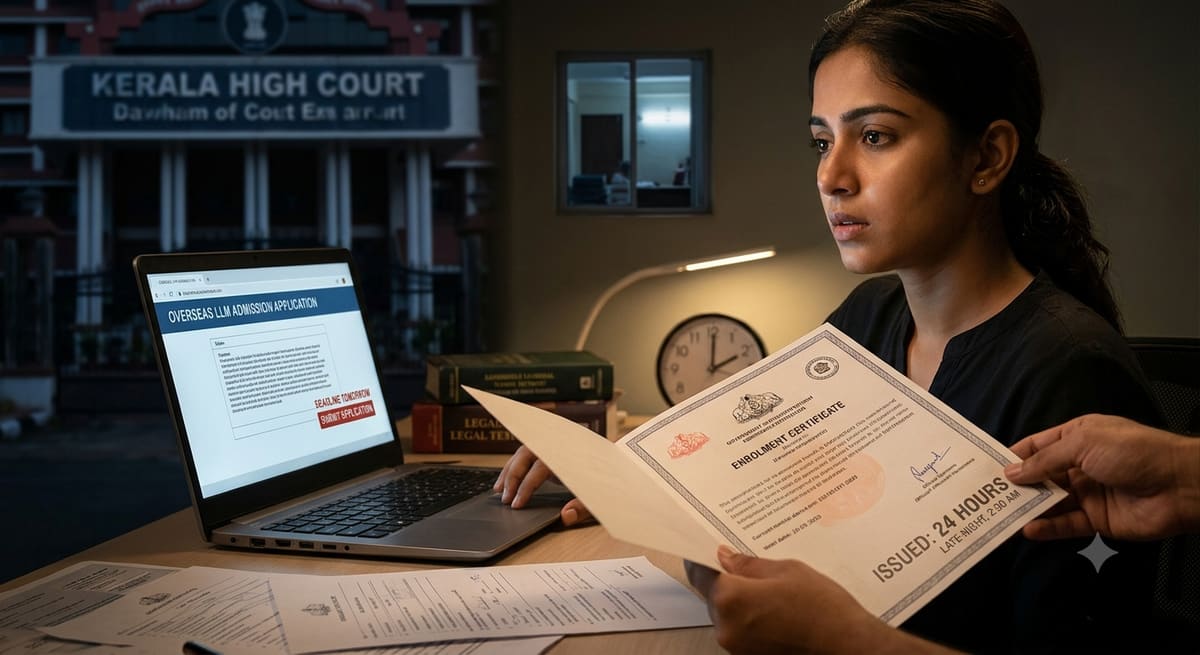
An extraordinary intervention by the Kerala High Court has underscored the critical link between procedural compliance in legal registration and access to international education. In a rare exercise of its writ jurisdiction under Article 226, the Court mandated the immediate issuance of an enrolment certificate to a practicing advocate whose academic opportunity in New Zealand hung in the balance.
Background & Facts
The Dispute
The petitioner, Silpa U Krishnan, an advocate enrolled with the Bar Council of Kerala on 12.05.2018, has been unable to obtain her original Certificate of Enrolment despite repeated requests. This absence has jeopardized her admission to an LLM programme at the University of Waikato, Hamilton, New Zealand, which requires proof of legal qualification as a condition of enrollment. The petitioner, who has been practicing since enrolment, contends that the delay is not due to her failure to apply, but due to administrative inertia within the Bar Council.
Key Facts
The petitioner was enrolled as an Advocate on 12.05.2018 by the Bar Council of Kerala.
She has been actively practicing law since enrolment.
On 22.04.2026, she received a formal offer of admission from the University of Waikato, New Zealand, contingent upon submission of her original Certificate of Enrolment.
Despite multiple requests, the Bar Council has not issued the original certificate.
Exhibit P1: Identity card issued by the Bar Council of Kerala, confirming enrolment.
Exhibit P2: Official offer letter from the University of Waikato dated 22.04.2026.
The petitioner has not received any written communication denying her request, nor has she been informed of any pending formalities.
Procedural History
12.05.2018: Petitioner enrolled as an Advocate with the Bar Council of Kerala.
22.04.2026: Formal admission offer received from University of Waikato, New Zealand.
May - June 2026: Repeated oral and written requests made to the Bar Council for issuance of original enrolment certificate.
02.07.2026: Writ Petition (WP(C) No. 22633 of 2026) filed before the High Court of Kerala.
02.07.2026: Court heard arguments and delivered judgment on the same day.
The Parties' Positions
Petitioner: Argued that her enrolment was complete and lawful since 2018, and the failure to issue the certificate is an arbitrary administrative omission. She emphasized that the certificate is not merely a document but a legal prerequisite for international academic and professional mobility. She cited her active practice as proof of her status.
Respondents: Did not dispute the petitioner’s enrolment. The Standing Counsel admitted that the original certificate had not been issued and acknowledged the petitioner’s entitlement. However, they contended that due to the transitional period following the completion of Bar Council elections, and the absence of a duly constituted Committee, no officer had the authority to authorize issuance of the certificate. They claimed the delay was institutional, not malicious.
Relief Sought
The petitioner sought a writ of mandamus directing the Bar Council of Kerala to issue her original Certificate of Enrolment without delay, and to do so within a timeframe that would not nullify her admission offer.
The Legal Issue
The central question was whether the High Court may invoke its extraordinary jurisdiction under Article 226 of the Constitution to compel the issuance of a Certificate of Enrolment when the administrative body, though acknowledging the petitioner’s entitlement, claims lack of authority due to transitional governance.
Arguments Presented
For the Petitioner
The petitioner’s counsel relied on the principle that once an advocate is duly enrolled under the Advocates Act, 1961, the issuance of the Certificate of Enrolment is a mandatory, non-discretionary duty of the Bar Council. She cited Bar Council of India v. A.K. Balaji to affirm that enrolment is complete upon recording in the State Roll, and the certificate is merely a formal confirmation. She argued that administrative inertia, even if due to transitional arrangements, cannot deprive a citizen of a fundamental right to pursue education or profession. The delay, she submitted, was not merely procedural but consequential, threatening to extinguish a time-bound opportunity.
For the Respondent
The Standing Counsel conceded that the petitioner was lawfully enrolled and entitled to the certificate. However, he argued that under the Bar Council of India’s rules, only the duly elected Committee has the authority to sign and issue the certificate. Since the newly elected members had not yet assumed office, and the Ad hoc Committee lacked explicit statutory power to issue enrolment certificates, the respondents were in a legal limbo. He submitted that the Court’s intervention, while sympathetic, could set a precedent undermining the statutory structure of the Bar Council’s governance.
The Court's Analysis
The Court acknowledged the respondents’ procedural predicament but rejected the notion that institutional transition could justify the denial of a fundamental right. It emphasized that the petitioner’s enrolment was not in dispute and that the certificate was not a grant of privilege but a confirmation of a right already vested.
"The petitioner’s right to pursue higher education abroad is not contingent upon the internal administrative mechanics of the Bar Council. Once enrolled, the certificate is a mere formality, and its withholding, without legal justification, amounts to an unreasonable restriction on professional mobility."
The Court noted that the Bar Council’s own rules and the Advocates Act contemplate the issuance of the certificate as a ministerial duty, not a discretionary act. The absence of a duly constituted Committee does not extinguish the obligation to perform routine administrative functions. The Court further observed that the Ad hoc Committee, though interim, was functioning under the Supreme Court’s permission and was therefore empowered to carry out essential administrative tasks, including issuance of enrolment certificates.
The Court distinguished this case from routine administrative delays by highlighting the unique and time-sensitive nature of the petitioner’s circumstance: a confirmed international academic opportunity with a fixed deadline. It held that the extraordinary jurisdiction under Article 226 is precisely meant for such situations where ordinary remedies are inadequate and irreparable harm is imminent.
The Verdict
The writ petition was allowed. The Court directed the third respondent, the Secretary of the Bar Council of Kerala, to issue the original Certificate of Enrolment to the petitioner within 24 hours of the judgment. The direction was issued as an exceptional measure under the facts of this case and was explicitly stated not to constitute a precedent for future cases. No costs were awarded.
What This Means For Similar Cases
Administrative Transition Cannot Justify Denial of Rights
Practitioners whose enrolment is confirmed but certificate issuance delayed due to Bar Council elections or interim committees may now invoke Article 226 if the delay threatens professional or educational opportunities.
The Bar Council’s internal governance structure cannot override statutory obligations under the Advocates Act, 1961.
Certificate of Enrolment Is Not Discretionary
Enrolment under the Advocates Act is complete upon recording in the State Roll; the certificate is a formal document, not a grant of status.
Delays in issuance, even if administrative, may be challenged as violations of Article 14 and Article 21 if they impede professional mobility.
Time-Sensitive Remedies Require Urgent Judicial Intervention
Courts may act swiftly under Article 226 when a petitioner demonstrates a concrete, time-bound opportunity (e.g., overseas education, international employment, licensing) that is contingent on a legal document.
The burden shifts to the authority to prove that delay is legally justified - not merely inconvenient.